Table of Contents
Antarctica - A Journey Out of this World to the Bottom of the Earth
In some ways, Antarctica is surely the Last Place on Earth you would choose to go for a holiday. It is a long way away, cold, inhospitable and no-one lives there – so why bother? In these days of easy travel it is really hard to find somewhere that no one else has been so for me, a trip to Antarctica was all about exploring an unknown continent that very few people visit. It’s very remoteness and inaccessibility was what intrigued me and exerted a sort of magnetic pull that drew it right up to the top of my bucket list.
The quest for novelty is very human. I was hoping to discover a pristine, untouched, white wilderness – something new and amazing that I could experience and share with others when I was safely back home in the hope that they might also go an explore. It would be an adventure too – an opportunity to learn, to test myself, and discover my limits. You have to accept that things might go wrong, that there might be some discomfort and disappointment along the way, but ultimately, I would expand my horizons and come back enriched and the ups would outweigh any downs:
“The quality l look for most is optimism: especially optimism in the face of reverses and apparent defeat. Optimism is true moral courage.” Shackleton
So I was ready for an adventure – but my appetite for risk has never been particularly high and reduces the older I get, so I chose to make my journey to Antarctica with Silversea. This would be my third trip with them and I had confidence that they would put together a good itinerary, deliver it efficiently, respect sustainability and leave no stone unturned with health and safety measures. A small ship with around 220 passengers seemed an ideal size – small enough to navigate the nooks and crannies of wilderness areas but large enough to offer a high level of comfort – and company. I like my optimism served with a healthy dose of realism and I know my own limits for tolerating risk and discomfort. I wanted to make sure that this would be an enjoyable holiday as well as an adventure.
Our Route to Antarctica
We chose a 20 night cruise from Valparaiso to Puerto Williams with 5 days spent cruising in Antarctica. Although Antarctica was the ultimate goal of the trip, exploring Chile in some depth en route added a lot to the trip. The trouble with flying is that you can sometimes arrive in a new place so fast that you struggle to appreciate just how far you have travelled? Antarctica felt like the sort of place where it was appropriate to spend some time actually getting there and Chile was the obvious route. You can read more about our journey through Chile here:
When to Go
We travelled in late November and so spent the first week of December in Antarctica, which is Summer time. It is possible to visit as early as October, but the temperatures are colder then, the days are shorter and there is a real risk that ice prevents landing in some of the areas you might like to explore. There was plenty of wildlife to see in December and we had glorious sunny weather with blue skies for the majority of our trip.
If you delay your trip until maybe the second week of January, you may have the opportunity to see young penguin chicks which might be fun. The later in the year you travel, the less ice and snow you will see though and I think the end of February would probably be too late. The visiting window for Antarctica is definitely very short.
The Early Explorers
People have known about the existence of Antarctica for a long time.. Medieval cartographers referred to it as “Terra Australis Incognito” – the Unknown Southern Land. Captain Cook was sent by George III to look for the missing continent and determine what potential riches it held once and for all. He made a brave attempt, but on 30th January 1774 was thwarted by solid sea ice and forced to turn back. He wrote:
“I who had ambition not only to go farther than anyone had been before, but as far as it was possible for man to go, was not sorry in meeting with this interruption”. What he had discovered was a cold hell and he was glad to leave.
After the myth of a far off Southern Land full of promise had been dispelled, people forgot about it for a while and occupied themselves by colouring in the rest of the map of the world, but the intrigue remained and the attraction to intrepid explorers seeking the ultimate adventure challenge continued.
Ever since my first voyage on Silversea’s Silver Wind I had been captivated by the remarkable artwork on the ship depicting the adventures of the early explorers in photographs taken by Herbert Ponting, photographer on Scott’s ill fated Terra Nove Expedition. The ship was designed to cope with the challenges of sailing in Antarctica and Antarctica made it to my bucket list there and then.

These photos are part of an amazing body of work by Unsplash called Unseen Histories which aims to achieve what Ponting could never do – to present the Antarctic world in natural colours. It is incredible to think that modern day travellers now have the power to do just that so easily with just a mobile phone?

The artwork on the Silver Wind is a partnership with the Royal Geographical Society and you can see more of Herbert Ponting’s wonderful photographs on the links below. They really bring the world of the early explorers of Antarctica to life.
The tales of the early explorers are well documented and familiar to many for the excitement their stories brought when the news eventually travelled all the way back home to Terra Cognita.
Robert Falcon Scott is one of the most famous early explorers. His 1901-1904 Discovery Expedition managed to get within 97 miles of the South Pole but had to turn round because of lack of food. They did manage to record the first hot air balloon flight over Antarctica though and take some of the first aerial photos. Shackleton was part of that crew, but he was invalided out. There are some enchanting photos in the collections on the links above commemorating this achievement.
After that, it became a race between Scott and Norwegian Roald Amundsen. Amundsen won and became the first to discover the South Pole on 14th December 1911. He had prepared for the voyage meticulously, carefully studying the lifestyle of the Inuits, testing and re-testing equipment and using dogs to pull sledges not men. When he got to the South Pole, he left a letter there for the Norwegian King claiming his victory – just in case he failed to make it back home.
Scott’s 1910-1913 Terra Nova Expedition arrived shortly after and must have been bitterly disappointed to find the letter to King Haakon on 17th January 1912 and realise that they had come second in the race – a euphemism – they had lost. Unlike Amundsen who made it safely back home, Scott’s voyage ended in tragedy and the death of all 5 of the men including the courageous Captain Lawrence Oates who sacrificed his own life in the hope that this might save the others as he knew he was weak: “I am just going outside and may be some time.”
Despite the obvious dangers – or maybe because of them – Shackleton attempted the first crossing of the Antarctic continent on his 1914-1916 Endurance expedition. Amazingly, when you consider the newspaper advert he placed for his crew, 27 men joined him on the expedition. The Endurance was immobilised in ice for 10 months, but incredibly, all 27 men survived to tell the tale.

Sir Raymond Priestley famously wrote:
“For scientific leadership, give me Scott; for safe and efficient travel, Amundsen; but when you are in a hopeless situation, when there seems to be no way out, get on your knees and pray for Shackleton.”
In these emancipated days, it interests that there were no women in the crew. It was not for lack of enthusiasm. Shackleton received a letter from “3 sporty girls” (Peggy Pegrine, Valerie Davey and Betty Webster) who begged him to let them join the expedition saying they were willing to wear men’s clothes if required and happy to endure any hardships that were required. They wrote: “We do not see why men should have all the glory, and women none, especially when there are women just as brave and capable as there are men”. Shackleton replied that he regretted that “there are no vacancies for the opposite sex on the Expedition”. How times have changed?
Despite the fact that Amundsen won the race to the South Pole, Shackleton and Scott’s adventures brought them far more fame and glory than the victor. Shackleton in particular goes down in history as a great leader and there is much to be learned from his books “South” and “The Heart of the Antarctic”. The wreckage of The Endurance was discovered on the anniversary of Shackleton’s death 100 years later. If you are short of time to read his novels, take the short cut and watch these movies:
Getting to Antarctica - Drake’s Passage - The Worst Journey in the World?
There is no way around it. If you want to sail from South America to Antarctica, then you have to spend 2 days navigating the treacherous Drake’s Passage. The Drake is so rough because it is where the Pacific, Atlantic and Southern Oceans converge. In addition there no landmass to create resistance, and there are also high winds. All of this combines to make rocky waters inevitable. The swell can reach up to 8 metres high, but usually, it averages out at about 4 metres.
“This, then, was the Drake Passage, the most dreaded bit of ocean on the globe—and rightly so. Here nature has been given a proving ground on which to demonstrate what she can do if left alone. The results are impressive.” Alfred Lansing – Endurance: Shackleton’s Incredible Voyage
As our own journey across the Drake began, we were entertained by all the superstitions sailors have collected over the years to help them survive at sea. We “touch wood” because we want to be sure that our vessel is seaworthy. We don’t clink glasses because it sounds too much like a death bell ringing for comfort – so you put your fingers in between the glasses to deaden the noise. We even avoid bananas (because they give off ethylene gas which causes other fruit to rot?).

We made light of it all and laughed at the Expedition Team Leader’s invitation to “Enjoy the Energy in the Ocean”. We got to know each other better too because you frequently found yourself on the opposite side of the corridor from your planned route and ended up talking to the person you bumped into that you hadn’t actually met before. There was a lot of discussion about which position on the ship was best to avoid travel sickness. The usual advice is keep low and stay mid-ship. This pleased those that hadn’t booked the biggest suites which are positioned up on the higher decks at the bow of the ship.
We took sensible precautions. I wore travel sickness bands throughout and took Sturgeon 15, which I started a couple of hours before we set sail. We kept well hydrated, We went out on deck and got plenty of fresh air and we availed ourselves of the ginger sweets provided too. We held the hand rails and enjoyed the dance.
In the end, we set sail from Puerrto Williams (where we collected the mandatory Chilean Pilots) at midnight on Thursday and arrived in Antarctica by lunchtime on Saturday, so it only took one and a half days. The timing was carefully thought out. The detour to Puerrto Williams managed to avoid some of the rough seas. We enjoyed a Thanksgiving Dinner with our American friends on Thursday evening and 8 hours of the voyage passed by effortlessly while we were asleep overnight. Although there was a 4.5 meter swell overnight, we didn’t even notice it. A glass broke in our suite overnight but was quickly swept away and disposed of.
Friday brought what was considered to be a 3/10 Drake with 5/10 being average. We spent a leisurely day at sea learning how to play Mahjong and the tiles managed to stay stable enough – most of the time – not to interrupt the learning process too much. By 6pm, the swell had subsided and the rest of the crossing was calm and – excitingly – accompanied by large numbers of giant albatross. I pondered that their wing span was about the same as the average height of the swell we had encountered.

What Does Antarctica Actually Look Like?
So many people have written eloquently about what Antarctica looks like. My pre trip reading had given me high expectations and it was now finally time to see it all for myself. Would it live up to the hype?
When something is Out of this World, it is by the nature of it extremely difficult to describe because naturally, we tend to search for that with which we are already familiar to describe something novel? We will search for a colour (that we once used to describe something else), for an adjective (that reminds us of a previous experience) – how can that ever really do justice to something that is completely new to us? However, here are some of my favourite descriptions of Antarctica:
“It was Summer in Antarctica. But most of it was white. There was so much white land, fluted like corduroy and plated with glaciated slopes, glittering and reflecting the sun. There were some ice cliffs, but mostly, the land sloped down to the ocean, which crusted into ice in a wide band all around the island.” Sara Wheeler – Chile: Travels in a Thin Country
“If Antarctica were music it would be Mozart. Art, and it would be Michelangelo. Literature, and it would be Shakespeare. And yet it is something even greater; the only place on earth that is still as it should be. May we never tame it.” Andrew Denton
“The tranquillity of the water heightened the superb effects of this glacial world. Majestic tabular bergs whose crevices exhaled a vaporous azure; lofty spires, radiant turrets and splendid castles; honeycombed masses illumined by pale green light within whose fairy labyrinths the water washed and gurgled. Seals and penguins on magic gondolas were the silent denizens of this dreamy Venice. In the soft glamour of the midsummer midnight sun, we were possessed by a rapturous wonder — the rare thrill of unreality.” Douglas Mawson
Our Antarctica Itinerary
Five days felt like about the right amount of time to spend in Antarctica. It was long enough to be able to feel that I definitely “got the T shirt” but not long enough to make me tire of the inhospitable climate and mourn the lack of any infrastructure.
During 5 days, we managed to visit a wide variety of areas. The challenge of the terrain means you have to be prepared for the itinerary to be fluid and flexible. If you like knowing exactly when you are going where, this is not the trip for you. As we were frequently reminded by the Expedition Leader, you need an Expedition spirit to enjoy an adventure like visiting Antarctica.

There were a number of 6 am starts, frequent changes of plan, early evening landings if necessary and flexible meal times to make sure we didn’t miss any opportunities. With a heated swimming pool and two bubbling jacuzzis in operation too, it meant that we spend a fair amount of time getting dressed and undressed for various activities. Learning to expect the unexpected was all part of the fun.
During our 5 days, we were scheduled to make 10 excursions (2 a day) which were not specified beforehand to allow full flexibility. By the end, that is exactly what we did achieve, although only be altering times and changing the original itinerary along the way according to weather conditions. We were very lucky with the weather though and it may well be that on another voyage, fewer landings/excursions might be possible.
Antarctica - We Have Finally Arrived!
Fort Point (Greenwich Island)
So – we have finally arrived! Our first photo of Antarctica was taken at Fort Point which at the time we arrived was shrouded in mist. The weather gradually began to clear though and we soon got our first sight of the snowy wilderness we had been dreaming of – and eventually a clear view of Fort Point.


Spert Island
Strict biosecurity measures are well observed throughout – particularly as when we were travelling, avian flu was an added danger. Careful scrubbing of boots and and avoidance of kneeling or lying close to the ground was essential. The Mud Room – located near the disembarkation doors on Deck 3 – was everyone’s least favourite area of the ship.


It is not a large space and has to store everyone’s boots and kit in numbered racks as well as accommodate changing space. Inevitably, it can get crowded, particularly if people are slow getting boots on and off and/or don’t stick to allotted groups/disembarkation times. Efficiency of the Mud Room gradually improved as everyone got used to its requirements.
Our first acquaintance with the Mud Room coincided with an appreciation of just how quickly the weather can change in Antarctica and the level of energy that is stored in the ocean. By the time we made our first landing at Spert Island in the South Shetland Isles, the weather that had allowed us clear views of 4th Point changed again all too quickly and our first glimpse of the rubber zodiac bouncing up and down on rough and rocky water required a hard swallow on my part
The safety briefings had been comprehensive though and I had every confidence in the Expedition team. After 4 loud “NO!’s, I was called to step onto the zodiac with an even louder “NOW!. With the support of two strong arms with expert sailor’s grips, I was in the boat and ready for adventure. It is a bit challenging at first, but no-one ever fell in – or out – of a zodiac during 3 weeks, so that should give even the most nervous traveller confidence?!
After a wet landing (I.e., you get your boots wet as you walk through the sea to the shore), we were rewarded by close up viewings of 3 sorts of penguins (Chinstrap, Adélie and Gentoo), Elephant seals and Leopard seals – all on our very first day in Antarctica!


Did you know that the collective noun for a group of penguins is a rookery, colony or huddle. When they are swimming, they are called a raft and when they are walking together on land – guess what – they are called a waddle!
Portal Point
It is worth explaining that visiting Antarctica is unlike visiting anywhere else in the world. Thankfully, this little visited region is covered by strict guidelines agreed to by all the 57 countries signed up to the Atlantic Treaty Organisation to ensure that it remains a last wilderness, protected for the benefit of science and research.
This means that no more than 100 people are ever allowed on ashore anywhere at one time, so – unlike areas like the River Nile, for example – you will not see groups of cruise ships gathering in one place – whatever wildlife is there to attract them. Landings are carefully spaced out across a huge territory, so isolation is guaranteed.
Larger ships do visit Antarctica, but the rules are the same for all visitors. Ships larger than 500 passengers are not permitted to land passengers ashore. With around 200 guests (a number choose not to disembark every day), everyone is able to disembark and land twice a day in groups of around 8 to a zodiac. Cruising close to shore in zodiacs does not count as landing, so zodiac cruising offers more options. There is also a choice of kayaking offered twice a day (at no extra charge) , which is restricted to a maximum of 18 people (2 per kayak + expedition team). The ship can reposition itself during excursions to find the best viewing points and calmest weather/sea conditions.
Fortunately, after the first day, luck was on our side and the weather scored 10/10 overall with blue skies and sunshine all the way. The views from Portal Point – our second landing site – were stunning. You couldn’t help but feel infinitesimally small in your universe.
“Sometimes, it is like Antarctica has no soul … it is not a place for man. But at other times … I feel like I am in a big, wondrous temple.” Sara Weeler – Chile: Travels in a Thin Country

“The most experienced Antarcticans talk not about conquering the continent but about surrendering to it. No matter how powerful you believe yourself to be—how good your technology, how rich your invention—Antarctica is always bigger. And if we humans look honestly into this ice mirror, and see how small we are, we may learn a humility that is the first step towards wisdom.” Gabrielle Walker – Antarctica: An Intimate Portrait of the World’s Most Mysterious Continent

We were warned to stay on the path – which was very narrow and not really wide enough for passing. Despite best efforts, I put one foot a little too far to the right and – alarmingly quickly – found myself up to my waist in snow which I could not pull myself out of. Of course, two strong arms of one of the expedition team crew quickly yanked me to safety, but I am really glad that I am not a shorter person! The snow was deep here and the paths steep and icy, so several people found walking poles helpful to keep balance. There is always a barrel full brought on a zodiac to the shore, so you really don’t need to bother bringing your own.
Mikkelsen Harbour
Mikkelsen Harbour was a great place to watch penguins waddling down their icy guano brown stained highways to do their form of polar plunge and take a swim. Their waddle makes us laugh, but it is actually quite an efficient way of getting from A to B in the polar regions and may well have saved me from my inadvertent icy plunge yesterday?!


Cierva Cove
Cierva Cove was one of the most scenic parts of our trip. Fundamentally, Antarctica is white, but the longer you spend there, quietly observing it, the more colours you eventually begin to see as your brain tires of the monochrome and begins to notice a far more polychromatic vista.

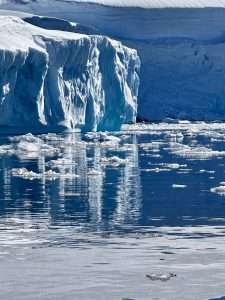
With a bright sun, high in the sky, the sky is the deepest of blues. The sun catching on brash ice gives you a sprinkling of jewel like silver in the palette. Many icebergs appear in hues of blue and green because when light encounters the dense, compressed ice, longer wavelengths of colour (red and yellow) are absorbed whilst short wavelengths (green and blue) reflect the light.


Greys, blacks and browns are everywhere too, of course. Black ice makes the best sort of ice for drinks and we had fun “catching” a large piece of it and enjoying it with a Gin and Tonic in the bar later on.


Very few people live in Antarctica and those that do are researchers and scientists usually on fixed term contracts. Cierva Cove is a beautiful – if desolate spot for the Primavera, the Argentinian Research Base.

When we got back to the ship, the excitement continued with sighting of orca at the bow of the ship. Unfortunately, you can never see very much of large marine mammals as they are mostly under the sea. Multi image cameras captured one of these orca with a poor little penguin in their mouth – photo too upsetting for sharing. You have to respect that the food chain is naturally – as a means of survival – the reality of marine life here in Antarctica.

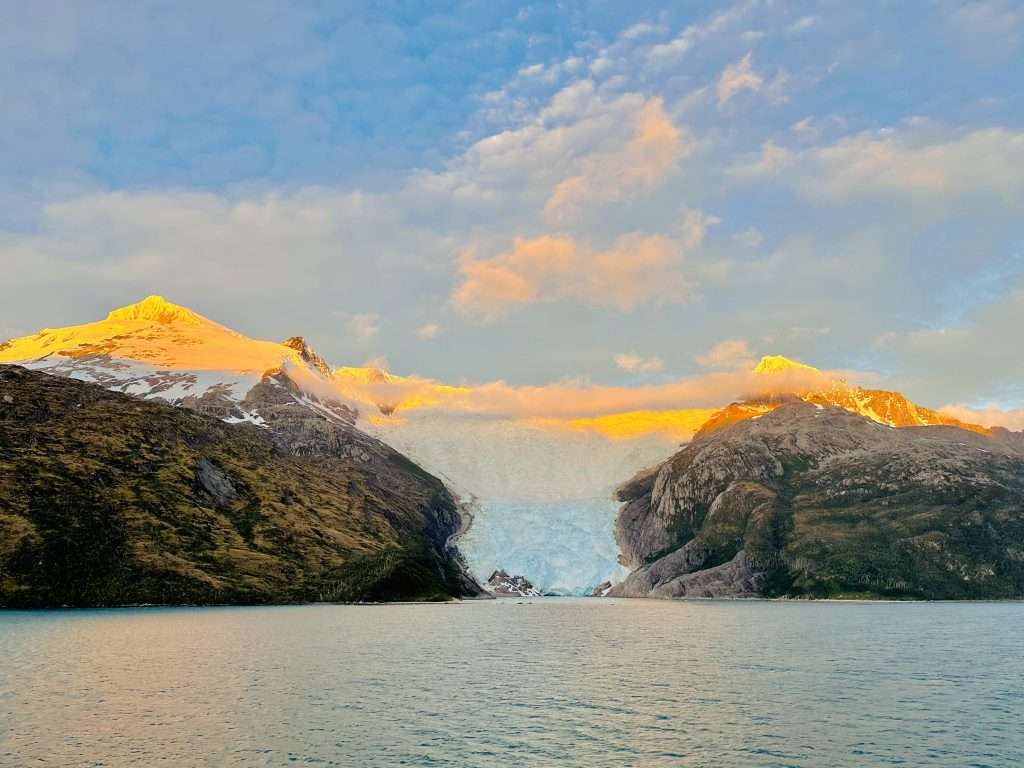
As evening draws in, sunsets bring pink, orange and fingers of red to the sky. Antarctica is a veritable playground for light – and so the dream of a challenge for the photographer.


Neko Harbour
A pod of whales kindly dropped by during our visit to Anvord Bay. If Portal Point had made us feel small in our universe then bouncing around on a zodiac/kayak as whales glided through the water quite close to us made us feel almost insignificant.

The excitement of the past few days was beginning to tire me out. 24 hour daylight can be quit exhausting – especially when you are on the trip of a lifetime and don’t want to miss a thing. Tonight, I was very grateful for the efficient blackout curtains in our suite.
Cuverville Island
It isn’t just the play of light that makes the scenery of Antarctica so captivating – the ice has a structural beauty all of its own too. In the “Iceberg Graveyard” that is Cuverville Island, we enjoyed playing iceberg slalom through the amazing ice forms. At times, the ice had sharp angular faces – as though it had been expertly carved by a great knife from a massive chunk of polystyrene and could blow away on a gust of wind at any moment.


Elsewhere, it was as though someone had taken a giant icing bag and carefully piped layers upon layer of meringue on top of each other, decorating the concoction with swirls and stripes as they pleased.

At this point, I could see why one of the Australian guests on board was making her third trip to Antarctica. As she rightly observed, every season, as the land emerges from the frozen clutches of the long, black Winter, it changes – always giving you something fresh and new to look at. I can well appreciate that that could become addictive …
Fournier Bay
Of all the areas we visited in Antarctica, Fournier Bay stood out for me as the most special. We made no landing there but cruised close to the icy shoreline in a small zodiac. It was a spectacular day when we visited which meant that the we could see a long distance through the crystal clear blue waters to watch rafts of penguins swimming along in the water beside us.


Cormorants jostled for position alongside us too. A couple of penguins hopped on top of a flat as a pancake tabular iceberg and hitched a ride – as though on a day trip to their next playground destination. When we turned back home, penguins followed us a large part of the way back dancing in the wake of the zodiac. This majestic frozen continent belongs to the wildlife here – not to us. Long may that continue – leave only footprints.


Anticipation mounted during the late afternoon as many guests opted to perform a polar plunge, jumping off the side of the ship dressed only in swimwear into the icy water beneath before swimming back to the safety of the steps, a towel and a few shots of something strong to defrost whatever had been frozen during the jump. On this occasion, I decided to opt for being the photographer rather than a participant.
Half Moon Island
Our last day in Antarctica brought us very close to the penguin colony at Half Moon Island. It was an atmospheric site with relics of old sealing pots and a wooden whaling boat telling tales of a time when Antarctica was not preserved for scientific research but was used for some commercial activities.

Yankee Island
Later in the day at Yankee Island, we were close enough to penguins to be able to see the eggs in their nests. Nearby seals lazed comatose around a glittering ice pool and dozed in the sun. Occasionally, one would lumber over to the pool and splash around for a while, flicking their tail playfully and trumpeting with pleasure as they bathed. The rest barely moved, except for the odd languorous droop of an eyelid.


Edinburgh Hill (South Shetland Isles)
After passing Edinburgh Hill in the South Shetland Isles, our expedition to Antarctica was over. Back on board, a lunchtime swim in a 30 degree steaming pool watching icebergs float by was a surreal experience and a nice way to say adieu to Antarctica. Later that evening, we clapped and thanked the Silversea Expedition Team that had looked after us all so well and cheered as the Silversea Expedition Team/Flag raised $1700 US in a raffle to support the crew welfare fund.


Getting Back Home
Getting home from Antarctica inevitably requires crossing the Drake’s Passage for a second time. We were lucky – our 2 day voyage back to Puerto Wiliams was incredibly smooth – what is known as a “Drake Lake”.
Is Ushuaia the city at the end of the world or not? Puerto Williams – the last destination for our cruise after visiting Antarctica is it’s close rival. At the moment, the argument goes that Puerto Williams is a town, rather than a city, but it is growing and is further South than Ushuaia, so it can surely only be a matter of time before it claims the title – and the resulting tourist numbers?


It was strange arriving at Puerto Williams. Although it is a minute place, after the solitude of Antarctica, it seemed oddly busy? There were people, buildings and cars there – we hadn’t seen that for quite a while! Puerto Williams is a lively little town and I much preferred it to Ushuaia. It has a nice community space in the middle which gives it the heart that Ushuaia lacks. The souvenir shops are fewer – and decidedly less tacky. Although it is small, there are a number of restaurants and bars there which all have a very friendly atmosphere.
From Puerto Williams, we travelled by bus to the airfield then took a small plane for a 40 minute flight to Punta Arenas where we boarded a larger plane back to Santiago where we rested overnight before our international flight home. The journey took 2 days in all – it is a long way home from the end of the world!
Antarctica - Alternative Ways of Visiting
There are a number of cruise companies operating in Antarctica and it really depends what sort of holiday you are looking for which one is right for you. Remember that Regulations put forward by both the Antarctic Treaty System (ATS) and the International Association of Antarctica Tour Operators (IAATO) prohibit ships that carry more than 500 passengers from conducting any landing activities.
The vessel we travelled with – Silversea’s Silver Wind – carries just over 200 passengers. There are smaller ships with up to 89 passengers which means that everyone would be able to go ashore at once. You might find shorter waiting times to disembark (although this wasn’t an issue for us). You might also feel the energy in the ocean more on a smaller ship and of course, the smaller the ship, the less luxurious the facilities will inevitably be.
For example, a number of companies (eg AE Expeditions, Secret Atlas and Antarctica21) offer cruises that escape the Drake Passage by flying directly from Punta Arenas to King George Island. Remember that you will need to get to Punta Arenas somehow first though!
There are also very small ships – maximum of 12 passengers – which might be more your cup of tea?
If you are very keen on photography, you might also be interested in a cruise that offers more in depth photography experiences, although I was quite happy with the Silver Wind Photo Lab and the expert on board photographer who could also hire out advanced camera equipment if you required it.
It is even possible to take a day trip to Antarctica from Punta Arenas, but I haven’t included a link to that option as for me, it seems to offer nothing more than a “Munro bagging” opportunity and Antarctica is surely worth more of our time than that? I haven’t seen anyone offering hot air balloon flights over Antarctica yet, but who knows what the future holds?!
If you really are the adventurous type, then you may be intrigued to know that there is an annual Antarctic Ice Marathon. King George Island is the site of the 42km 26 mile marathon course which attracts adventurous runners from around the world every year. “For the registration fee of USD $22,500, participants will be flown round-trip from Punta Arenas, Chile, to the Union Glacier camp in the interior of the Antarctic. Competitors will receive accommodation and food for their entire Antarctic trip and entry to their race of choice”. You also get a free photo – so – you pays your money and you takes your choice!
It is always nice to know that there are alternatives – especially if you are making a once in a lifetime journey. Personally, I was very happy with the choice we made especially as the journey through Chile was just as much fun as the journey in Antarctica itself, which is perhaps another consideration to weigh in to your own choice.

The Last Word
If you are thinking about a trip to Antarctica and worrying about the inhospitable climate, I’d say – don’t be afraid. After all, remember that it actually rains more in Scotland, the grass is wetter there – and there are midges too!
Perhaps it is fitting to give the last word to Shackleton: ”Difficulties are just things to overcome, after all.”
Where to Next?
Antarctica is the 6th continent I have visited – Asia remains unexplored as yet – but watch this space. Antarctica has sharpened my Love to Wander and the 7th continent beckons …