Table of Contents
Chile - The Long Thin Route to Antarctica
“Focus on the journey, not the destination. Joy is found not in finishing an activity but in doing it.” Greg Anderson
Antarctica offers the seasoned traveller a plethora of superlatives with which to rejuvenate the wanderlust. Who could resist the temptation to go and explore the coldest, driest, highest, windiest place on our planet?
For me though, travelling is always as much about the journey as the destination and so it feels right to start an expedition to Antarctica by slowly winding your way down through the emaciated country that stretches itself out along the Pacific Ocean pointing the way to the end of the earth – Chile.

Chile - The Long Thin Route to Antarctica
South America has always fascinated me since school days, when – for reasons best known to my geography teacher – I had to learn the names of all its countries and their capitals by heart. Of all the South American countries, the long thin strip of Chile – 4,270 kilometres long by just 177 kilometres wide – made it the most interesting to a 7 year old whose little finger measured exactly the same size.
How very nice it would have been to have started my journey in the far North and work my way all the way down from top to bottom. With more time – and budget – available, I would have been able to tell you all about the Atacama Desert. Imagine that – Chile manages to pack a desert into its tourist menu as well as lakes, glaciers and bustling modern cities!
“Night, snow and sand make up the form of my thin country all silence lies in its long line.”. Pablo Neruda – “Descubridores de Chile” – Discoverers of Chile – 1950.
Instead, my Chilean expedition started with a plane that whisked me from the middle of the British Winter and – just 12 hours later – dropped me off in Santiago at the start of the Southern American Summer. I couldn’t help reflecting on just how difficult that journey would have been for the 7 year old girl measuring the size of Chile with her little finger on a battered old school geography book. Back in the 1970s, taking a long distance flight from Britain to South America would have been possible, but the comparatively exorbitant expense of it would have rendered it impossible for me even to dream about. 55 years later, the flight had been completed and the Santiago sunshine beckoned me to set off and start exploring bustling modern Chile’s capital city.

Santiago
Fortified by a strong pisco sour and a plate of delicious empanadas (fried pastry turnover with a variety of fillings) – which I soon happily discovered are ubiquitous in this long thin county – I took the funicular to admire the Statue of the Immaculate Conception at the top and look down on the city, The hop on hop off bus runs a circular route with a stop conveniently just outside my base at the the Mandarin Oriental hotel and was a good way to get a feel for the city and take in the funicular en route. I would have a little more time to return and explore more after my wanderlust had been quenched in Antarctica.


Valparaiso
Valparaiso – Chile’s second city – is just 2 hours by bus from the capital to the coast. The port’s glory days were back in the 19th century and the magnificent pink customs house dates back to the halcyon days when it was one of the leading ports on the Pacific rim. My attention was focussed as much on the sleeping street dogs (quiltros) on the pavements and the jumbled tangle of power lines as the buildings. It definitely felt as though I was a long way from home here.
Patagonia
The region of Patagonia encompasses the southern end of South America and spreads across both Chile and Argentina. I was going to explore the rugged Chilean side which offers lakes, fiords, forests and glaciers and so what better way to discover it than by ship? Navigating these narrow and remote waterways – many virtually untouched by humans – from the comfort of a luxury vessel seemed ideal. Exploring on land via Zodiacs appealed to and so I embarked on a second expedition voyage with Silversea. We were occupying the same cabin on the Silver Wind as our last voyage, so we felt quite at home.

Tips for Future Travellers
Don’t be shy! You are very likely to be invited by the restaurant staff to share a table on your first night. When everyone is new on board, it can feel daunting to share a table with strangers and on your first night at sea, you might well prefer to stay in your comfort zone and dine with your familiar travelling companion. My advice is to take up the invitation – we met some great new friends on our first night and very much enjoyed their company for the whole of the rest of the voyage.
Niebla - Valdivia - The Key to the South Pacific
An early breakfast on the restaurant terrace on a sunny, blue sky day prepared us well for a hike along the stunningly beautiful coastline where the Chilean Firetree – the Herald of Spring – was in full fiery red bloom. The protected coastal area of Curiñanco takes its name from the tribal chief of the brave Mapuche people – the only Amerindians to resist the long haul of colonialism and retain their land.
Our trek took us through the heart of the Valdvian jungle – home to many types of trees including myrtles and ancient olivillos, some of which have witnessed more than 600 years of history.


Puerto Montt
Another early morning start offered a good opportunity to sample the extensive in suite breakfast menu. I decided on a plate of perfectly arranged fresh pineapple, sliced mango, water melon and fresh berries and a honey glazed pear with yogurt and nuts. Just hang your request on your door before 2am and the rest will be seamlessly taken care off leaving you free to be ready in good time for your day’s excursion. For a leisurely journey, luxury cruising is pretty hard to beat!


If you were driving this far South in Chile, Puerto Montt is probably where things would start to get difficult for you. The Pan-American Highway – the longest road in the world at 30,000 kilometres – runs all the way (with the small exception of the Darién Gap) from Alaska in the North to Ushuaia in Argentina in the South and would probably have made your journey thus far pretty straightforward. At Puerto Montt though, the coastline begins to crumble into the icy fingers of the Chiloé Archipelago. Few people live down here and even fewer visit, which makes accessing it via ship a great choice. There is a definite feeling that the full trappings of Chilean civilisation begin to come to an end at Puerto Montt.
Puerto Montt is also home to one of the largest salmon aquaculture industries in the world and evidence of the hatcheries, fisheries and packing plants can be seen all along the coast. Salmon is not native to this area though and the economy suffered hugely during the salmon aquaculture crisis in 2007-9. I noticed there was no salmon on the menu in the restaurant and it makes you think carefully about choosing sustainable alternatives.

The Germans colonised this area extensively from the 1850s and the wooden turreted houses and churches have a distinctively Germanic look. You can even buy kuchenes (pies) in the shops. Puerto Montt feels quite cosmopolitan as a result. We travelled north of Puerto Montt in Southern Chile’s Lake District towards Lake Llanquihue – the second largest lake in Chile. In fact – it is more like a sea than a lake and offered picture perfect reflections on a sunny Summer day.
This area offers far more excitement than lakes with mirror views though. Despite cautionary warnings from the expedition team, we stuck to our plan to take a whitewater rafting trip down the Petrohué River. These are Class III/IV rapids – not a trip to be taken lightly if you have no experience. But we have done this before – and we can swim – so all will be OK – right?


It was more than OK – it was super exhilarating. The snow capped Osorno Volcano made a stunning backdrop to the trip. We were well looked after by our experienced guide the entire time – I certainly felt challenged, but never in any real danger. This trip was definitely at the limit of my comfort zone – but I survived to tell the tale and encourage others to follow in my footsteps, which is really the essence of a good travel experience?

Chiloé Island
The island of Chiloé in Chile’s Lake District – often overlooked by tourists – was our next stop. Our journey started in the old colonial settlement port of Castro – the island’s capital – famous for the monkey puzzle trees in its neat streets.

Castro’s waterfront is lined with colourful houses on stilts called palafitos. Apparently, they were built as a cheeky way of avoiding buying land. Instead, you just built your house on wooden stilts and paid a small concession to the state, who owned the coastline. The houses on stilts had other advantages too – if you wanted to move house, you just pulled the stilts out and relocated it to it’s new position. The area beneath the stilts gave you the perfect place to keep your boat for fast commuting too – “easy peasy”!


It is always interesting to visit supermarkets when you are travelling?
I was intrigued to see the menacing black labels on “bad for you” foods – certainly more likely to make you think twice about buying/eating those crisps and cakes than the light touch 3 way traffic light system we have in the UK.
It is Chile’s way of trying to tackle it’s growing obesity problem.

We took a bus from Castro to Dalcahue (about a half an hour’s ride away) and spent some time browsing the many craft markets there filled with locally hand crafted items made from wood and wool. The promenade is certainly picturesque – lined with brightly coloured fishing boats.


Potatoes are indigenous to this area and have been cultivated by the local people for many years – long before Darwin noted the astonishing number of varieties that grew naturally here. They are eaten every day. For lunch, we were offered the regional dish of curanto – a huge mountain of shellfish, potato, spicy sausage and vegetables. Fishermen used to pack these ingredients into the giant rhubarb like nalca leaves that grow all around here and bury it between heated stones under a fire so it would stay nice and warm to sustain them while they fished in remote areas. The other thing you see everywhere here is Nescafé – giving rise to the phrase “Nescafe no es cafe” (Instant coffee is not coffee).


From Dalcahue, there is an old trundly ferry across to Quinchao Island and the interesting little town of Achao. Back in the 17th century, over 150 wooden churches built by Jesuit missionaries once stood on Chiloé Island and more than 70 are still standing today. 16 of these are UNESCO World Heritage Sights. It is remarkable that they are built entirely of wood – even the “nails” that hold them together are wooden.


Tortel
Continuing to wind our way down the Pacific Coast through the rivers, forests and rugged mountains of the Southern Patagonia Wilderness eventually brought us to the tiny coastal fishing town of Tortel – home to a little over 500 people. The indigenous Kawésquar canoe nomads became extinct long ago, but wooden statues dotted through the village give you an idea of what they would have looked like.


A system of wooden walkways connect piers and houses and runs for four and a half miles around the cove. From the walkways, you can admire the towering red hardy fuchsias – much taller than mine ever grow at home in the UK and flowering in Spring/Summer, rather than Autumn too.

Isla de los Muertos - Island of the Dead
This island is located at the mouth of Baker River and is accessible only by boat. Wooden boardwalks lead to the haunting cemetery containing crooked wooden crosses laden with a cloak of wet green moss and standing in an ever encroaching mass of ferns. These sad sentinels commemorate the death of 33 loggers who were reputedly abandoned by their employers on the island. The ship they were expecting to come and take them home at the end of their contract failed to arrive and they were left to perish in this inhospitable remote area, probably dying from lack of food/disease. We went to pay our respects.


Navigating the English Narrows
One of the nice things about a day at sea is that everything runs at a very leisurely pace. There is plenty to do – but you can opt just to take it easy and do very little if you want to. Sailing through the English Narrows – it just 200 yards wide in places – just watching the progress of the ship is quite entertaining enough. The bow (normally only accessible by the crew) was opened up specially to allow passengers some great views. You have to pause to admire the skill of everyone on board – it is all too easy to take things for granted on a trip like this.

Decisions abound again at lunch time – The choice is yours:
- A South American buffet in the sunshine of the pool deck
- 3 courses with health consciously sized diminutuve portions in the restaurant, choosing a seat on the starboard side so you can enjoy the first glimpses of the Pio XI glacier as the ship begins to sail towards it
- a buffet at La Terazza with an outside table to admire the views or avail yourself
- All day en-suite dining service?
By now, our friendship group on board had become quite cosmopolitan spanning Queensland, Seattle and Utah. A cocktail of the day seemed to lead effortlessly to a champagne toast followed by dinner accompanied by a choice of Chilean wines. If you had told the 7 year old girl avidly reading her Geography book that this was how wonderful travelling the world could be, I suspect that the seed of wanderlust would have germinated and blossomed a whole lot faster.
Bernardo O’Higgins National Park - Pioneer XI (Pio XI) Glacier
Located in Bernardo O´Higgins National Park, Pio XI Glacier was our next destination. Pio XI is the biggest glacier in South America and – unusually – it is still growing in height, length and density by 50 metres every day. It is huge – as big as Santiago!.
We arrived at the Pio XI Glacier (also known as Brüggen Glacier) by late afternoon but thanks to the long hours of daylight here – which will increase to a full 24 hours at the South Pole – small group zodiac travel was possible well into the evening. We were able to get as close as health and safety considerations would allow to the towering wall of blue ice and watch in awe as this advancing glacier calved, fracturing to release huge blocks of ice and sending them crashing down into the ocean. The glacier carvings were accompanied by a deep and all pervading rumble – akin to the power of thunder in an electrical storm. We were stunned to silence as we observed the incredible force of nature. This isn’t the first time I had seen a glacier, but it was the first time I had been on such a small boat right in front of one and it was certainly close enough for me!


By this stage of your trip, you will doubtless have accumulated some laundry. If you have not yet achieved the elevated status of having free laundry (100 days of sailing), there is a free laundry with tumble driers on Deck 4. There is also a retractable washing line in your shower which you can use to dry hand washed undies. They dried easily overnight as the suites are all kept at a comfortably warm temperature.
Southern Patagonia Ice Field - Ventisquero Brujo Glacier
I was up early next morning and I was the only one on deck as we drew close to the Ventisquero Brujo Glacier in the Southern Patagonian Ice Field – the region where the national parks of Bernardo O’Higgins, Torres del Paine, and Argentina’s Los Glaciares meet.


Have you ever heard a glacier breath? It was a windy morning, so I couldn’t capture the sound on video because there was too much interference. I spent a peaceful half an hour watching the glacier through half closed eyes, listening as it cracked, popped, sighed and yes – breathed.

At breakfast, Violeta Parra was thoughtfully being played in the restaurant. Chilean born, she is considered to be one of the most influential and prolific figures in the Spanish-speaking world and her reinvention of Chilean folk music is loved the world over. Her best known song – Gracias a la Vida (Thanks to Life) has long been an ll time favourites – definitely one of my Desert Island Disc choices. I didn’t;t realise until this trip that it was in fact a form of suicide note. Sad.
Later in the day, we were able to take a zodiac through the brash ice (small ice fragments) picking out growlers (icebergs less than a metre high) and bergy bits (up to 5 metres high and 100-300 metres squared) for a close up view of the mighty glacier. As we navigated the ice, we amused ourselves playing “What do you See in the Ice games?” Play it after drinking your way through the extensive Silversea cocktail list and you might learn a lot more than you bargained for about your fellow passengers?!

Magellan Straits/Beagle Channel
Our route down to Ushuaia took us through the Magellan Straits (pronounced muh-JEL-uhn) – one of the few sea routes between the Atlantic and the Pacific before the construction of the Panama Canal so a real game changer when the narrow inlet was discovered back in 1520. This is one of the bleakest and remotest areas you can imagine – beset by unpredictable winds and currents. You can’t help but admire those early navigators – how on earth did they find their narrow route through? What patience they must have had, trying one inlet after another only to arrive at what must have been a plethora of dead ends?

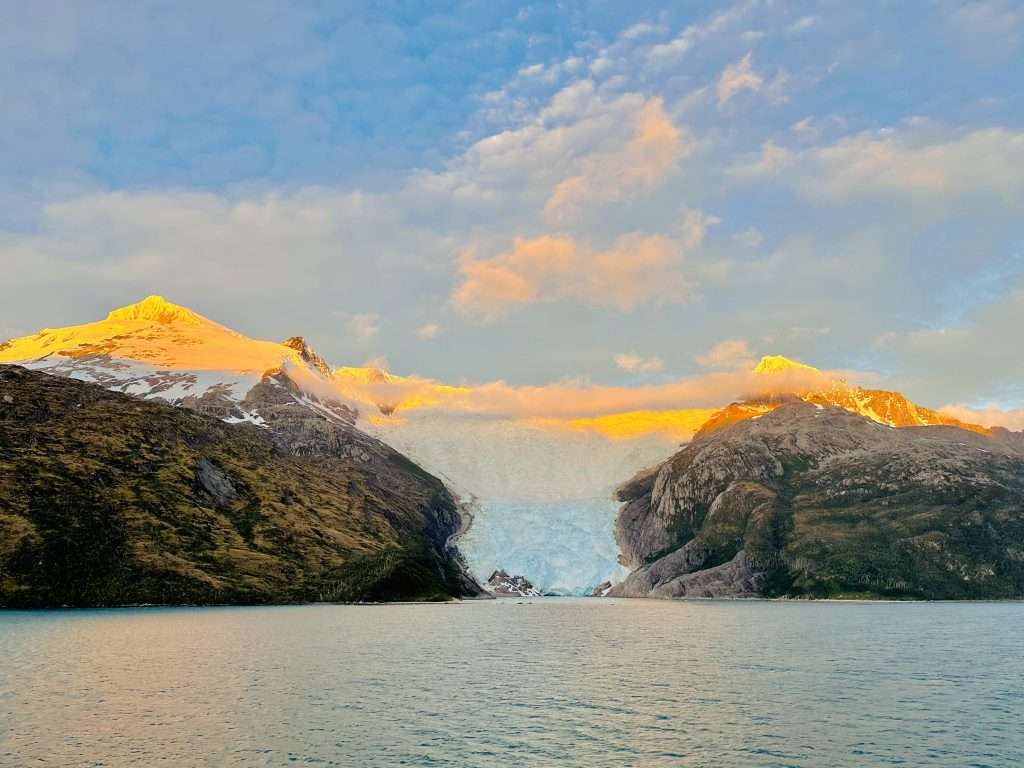
Almost everyone seemed to take the captain’s advice to enjoy an early dinner so that we could marvel at the stunning sunset views as we sailed down the Avenue of Glaciers through the Beagle Channel in the vast territory of the Tierra del Fuego. Magellan christened this area “Smokeland” after the wispy columns of smoke he observed rising from the natives’ fires, but “Fireland “ was the name preferred by the Spanish Crown (his patron), so Tierra del Fuego was what it became known as.

Could there be a better time to experience this voyage than by sunset? The towering snow capped peaks seemed to light up as we slowly cruised by – as though someone was turning the lights on especially for us?! There was very little wind up on deck and we were well wrapped up – and anyway, with a light show this spectacular, no-one was thinking about being cold. The colours deepened as the evening drew to a close and the illuminations eventually subsided. After the thrill of the Avenue of Glaciers at Sunset, there is only one choice of after dinner drink – it just has to be a Silversea signature Fire and Ice hot chocolate?
Silversea Fire and Ice Hot Chocolate
Ingredients: Ancho Reyes Chili Liquor, Hot Chocolate, Cinnamon, Vanilla, Cacao Bitters, Chili, Chocolate, Spice
“The colossal West Antarctic ice sheet hides a dark secret – the largest volcanic region on the planet. Experts have recently discovered as many as 91 of these sleeping giants lying peacefully under the Antarctic ice. When will the violently awaken…only time will tell. Our signature hot chocolate certainly has a little sting in its tail.”

Tierra del Fuego National Park
En route to Ushuaia, it was a bit of fun to take an inflatable canoe and paddle for an hour or so down from the fresh water of the Lapataia/Ovando rivers into the saltwater sea at Lapataia Bay. From there, you can walk visit the end of the Pan Am Highway and pay your respects to the world’s southernmost Post Office.


Ushuaia - Argentina - The City at the End of the World
After the majesty of the glaciers, our arrival at Ushuaia – which claims the title of the Southernmost city in the world – was a bit of a let down really. It has the feel of a frontier boomtown – rugged and a bit frayed round the edges. There are two main streets with a number of shops and restaurants keen to do business, but the pavements are a rough and tumble affair. You could pass the time browsing the souvenir shops, but there was nothing really inspiring to buy in them. You could order a King Crab salad downtown too, if you fancied, but then the King Crab salad on board the ship is equally delicious and already paid for?

Perhaps the most interesting thing to do is have a cup of tea – Chilean style. Maté – the national (non alcoholic) beverage of Chile – is a caffeinated tea made by soaking dried yerba maté leaves in hot water and is served in a small round cups/gourds (maté) from which it is traditionally sipped through a metal straw (bombilla). This is a social affair – the maté is usually passed around and shared between the participants. Despite being an avid tea drinker back home, I didn’t like the taste too much. Maybe it would have been better with the addition of lemon, orange, mint, or verbena, while others add sugar, honey, coffee, or whiskey. As a result, I managed to resisted buying one of the – rather splendid – traditional tea cups as a souvenir.


The Alfajores that accompanied the maté were quite a a different matter though. Soft, sweet shortbread-like biscuits sandwiched with a dulce de leche chocolate cream and coated in chocolate elevate afternoon tea to a whole new level.


Ushuaia (pronounced oo-swy-ah) is actually in Argentina, so we had already left Chile behind by the time we got there and the ultimate goal of our long journey – the intriguingly unexplored continent of Antarctica – was drawing ever closer. The expedition team on the Silver Wind on this voyage numbered 27 enthusiastic officers each with their own specialised interests and enthusiasms. As we approached the highlight of our journey, we invited those we had got to know best en route to join us for dinner – a great way of getting to know each other better and to learn from their previous experience of travelling in this little visited part of the world.
Antarctica - The Great Unexplored White Continent Beckons
As we started began our 2 day voyage across the fabled Drake’s Passage, the sense of anticipation and excitement began to grow on board. For most passengers (or should I say “guests”), this would be the first time – and very possibly also the last time – that we would set foot on Antarctica – the great unexplored white continent. We were united in the thrill of travelling on an adventure together and on board friendships deepened as a result. Keep reading to find out how our trip to Antarctica turned out…