Table of Contents
Kerala - A Journey of Discovery through God’s Own Country
Arrival in Kerala - 2 Days in Kochi
Kochi (or Cochin as it used to be known) was a good place to pick to begin our 3 week tour of Kerala. Easily accessible via a direct flight 10 hour 40 minutes from London, this is the city where India began to trade its riches with China, Africa, Arabia and later Europe. The Chinese, Romans, Portuguese, Dutch and British have all left their mark on Kochi over the years and the city’s architecture plays testament to that. They say that Kochi is not just a city, it is a feeling – well it certainly had a feel good vibe for me.
Driving in Kerala
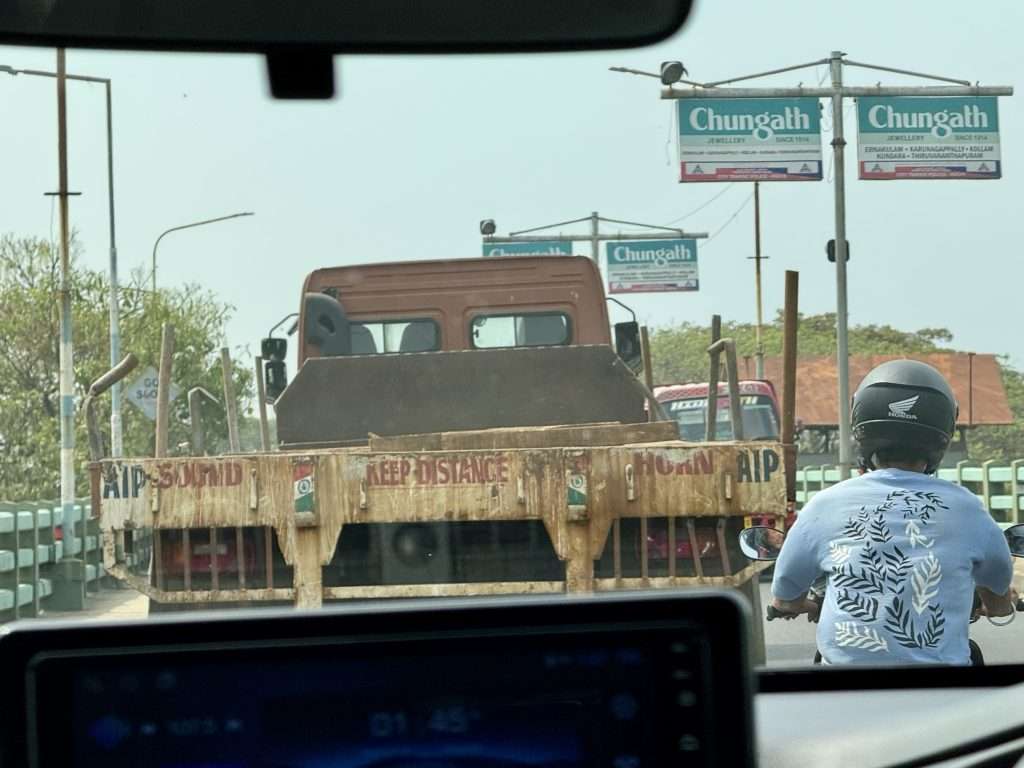
Before you can start to explore this fascinating city though, there is the not insignificant matter of negotiating the Indian road system. It is nothing like I have experienced anywhere in the world before – even Naples and Palermo (and that is saying something!).
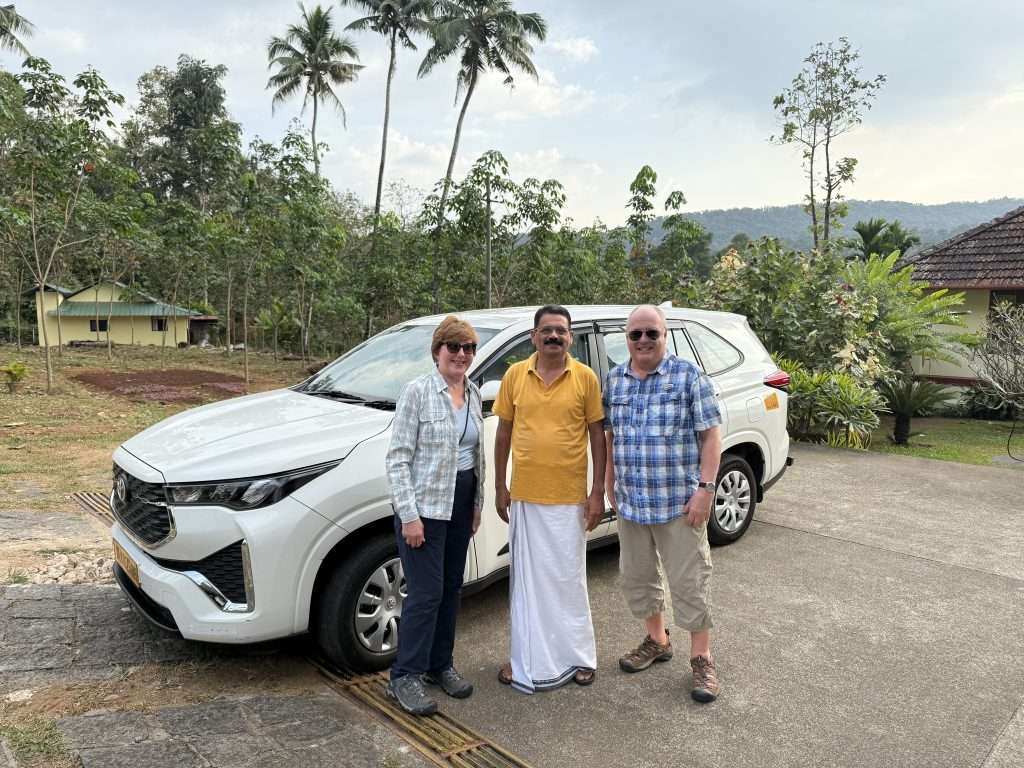
Fortunately, it is reasonably economical to hire a private driver to transport you – and also to be your friendly local guide – for the duration of your trip. I would say that hiring a private driver is not an optional add-on luxurious extra, it is an absolute, cast iron, must do necessity. Not only are you safely transported from A to B in air conditioned comfort, with wi fi connectivity and bottled water always available, you also have the benefit of expert local knowledge of where to find safe ATM cash machines, how best to go about buying alcohol, where to find a good local spot for lunch and tips on local sights that you might have missed out on if attempting to make your own way. A reliable private driver is worth every single penny – including a generous tip
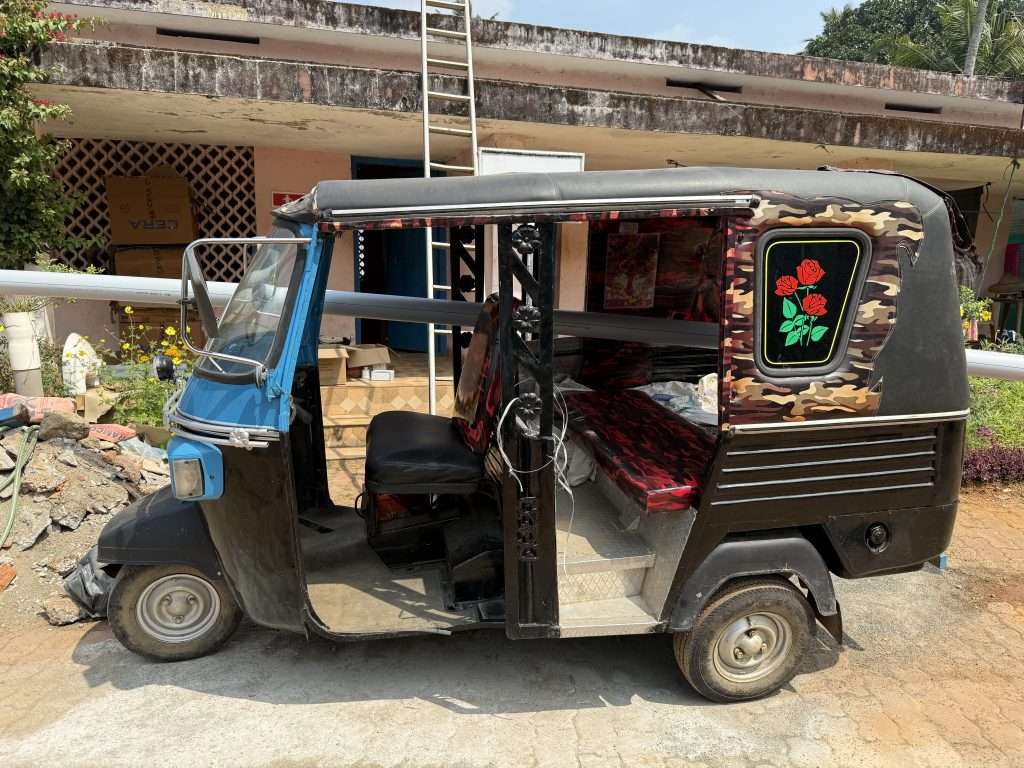
Although there are lanes marked on the roads, there seems to be little regard for them and tuc tucs, two wheelers (motor bikes), lorries, carts, bikes, pedestrians and the occasional cow all jostle for position with your car. At times, it seemed impossible to find a safe path through it all with everything flying around us at speed and horns being used all the time almost as a casual way of drivers saying “Hi there” rather than the language we are used to in the West (“Move out of the way FAST – an accident is imminent”).
Initially, it was a quite a shock to the system, but we gradually got used to it and – thanks to a growing confidence and trust in our very experienced driver – we began to relax and go with the flow. It is something of an accolade that in the whole of our trip, there was never a traffic jam (by which I mean the traffic comes to a halt), we never witnessed an accident and the predicted journey times were spot on with no need to apologise anywhere for being stuck in traffic. If only we could say that back home?
Maybe we were just lucky though, because I read in one of the English translated papers here that 4.80 lakh (480,000) road accidents took place in India last year resulting in over 1.78 lakh (178,000) people fatalities. That equates to around 55 crashes and 20 fatalities every single hour – not a statistic you want to read when you are at the beginning of a road trip! Kerala has the third highest number of road accidents of all the states in India too contributing around 10 percent of India’s total.
One essential skill that is necessary for driving in India is the ability to use the horn – a lot. The driving test involves driving around an H track (for 4 wheelers) and an 8 track for 2 wheelers (motorbikes) and 3 wheelers (tuc tucs). Once they have mastered the H and the 8, most vehicles seem to celebrate by continuing to drive in the same pattern?
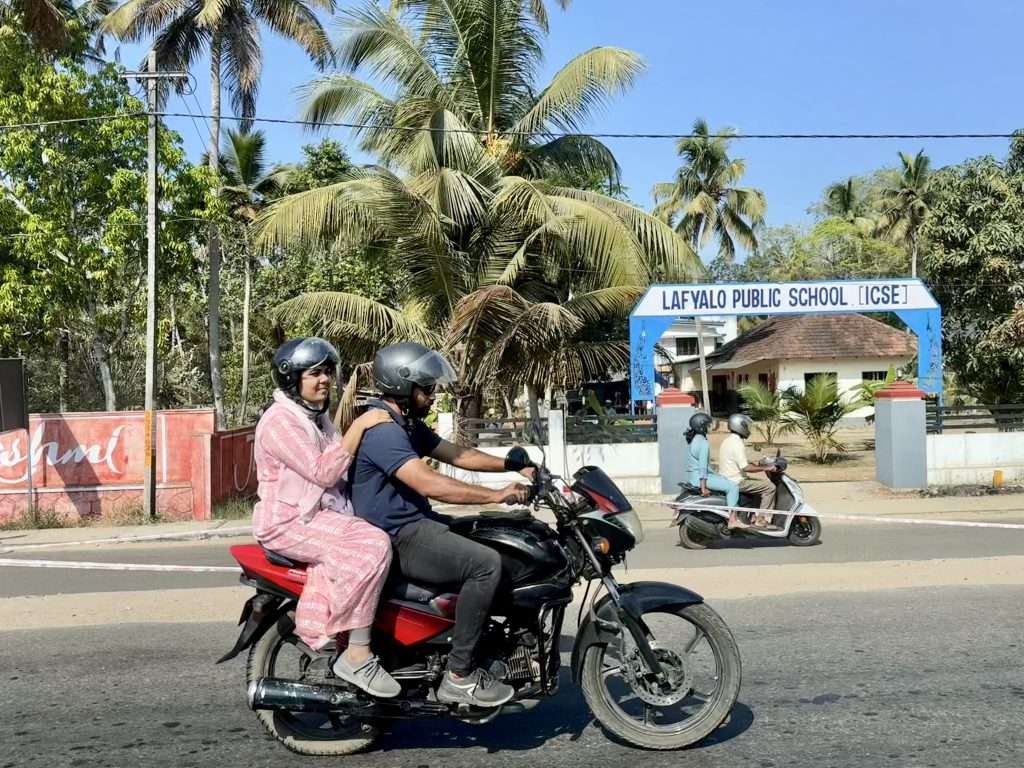
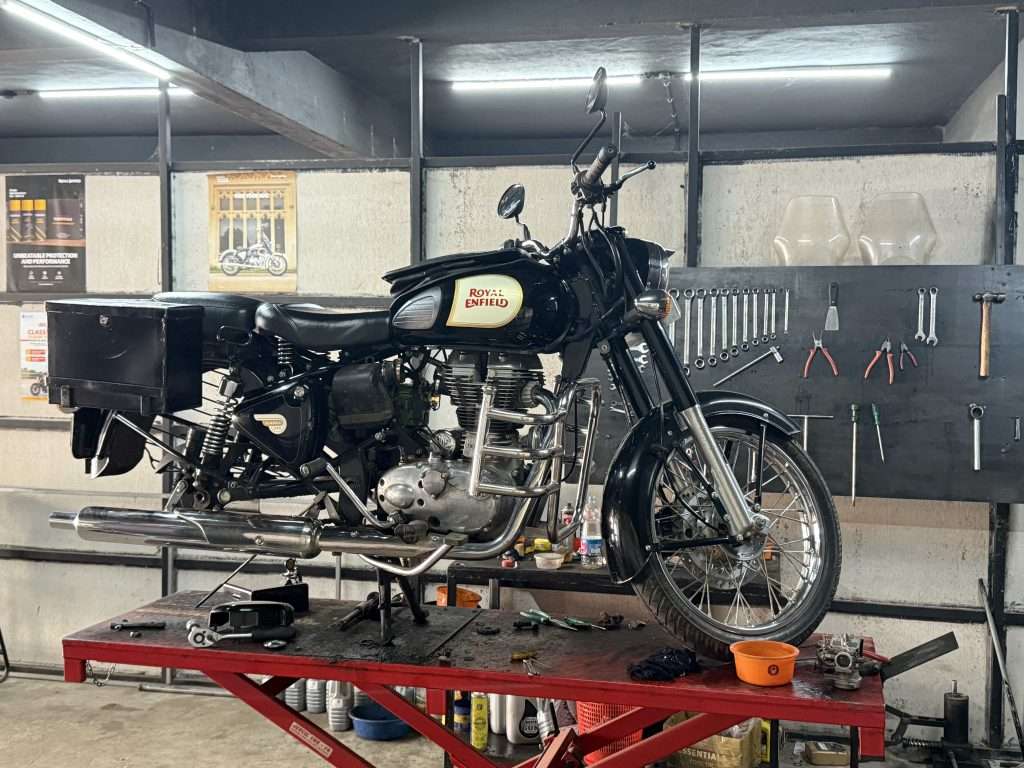
There are so many motorbikes – way more than we are used to seeing back home. More often than not, they are carrying two passengers with the lady on the back – with her sari gaily fluttering behind her. Royal Enfield bikes – originally made in England by the Enfield Cycle Company in Redditch – are very popular here. The brand was sold out to an Indian group back in 1994.
The Chinese Fishing Nets
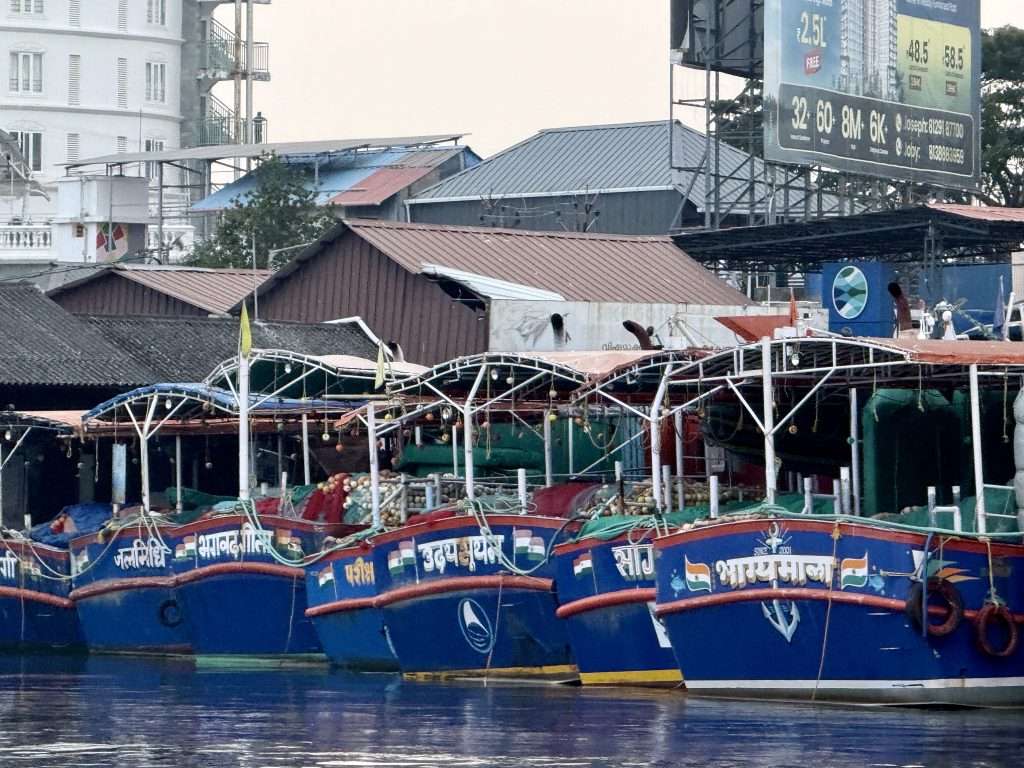
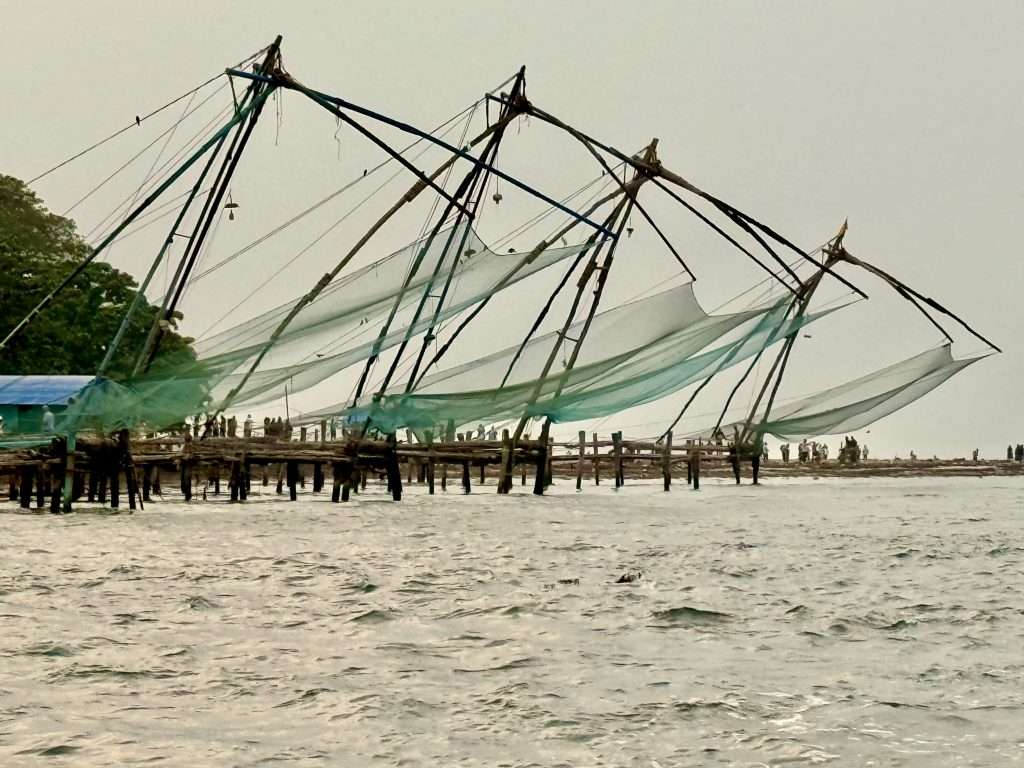
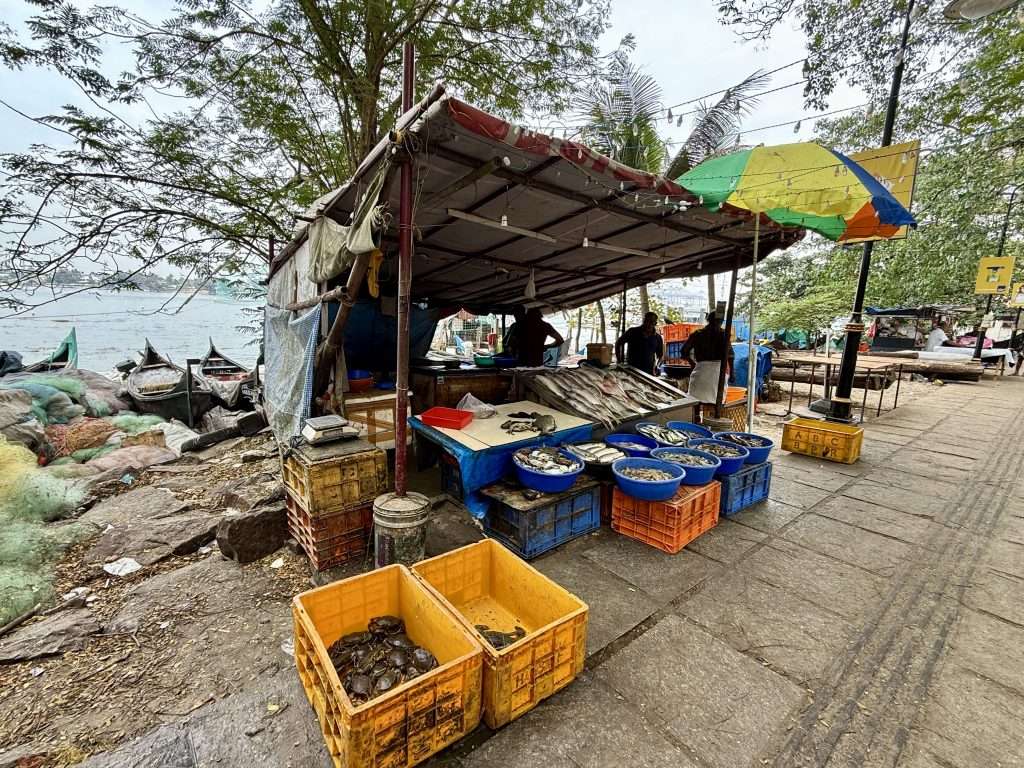
The Chinese Fishing nets are the unmistakeable emblem of Kochi. Stretched out along the waterfront, they are still very effective at catching even the tiniest of fish. Fresh fish is for sale at many small stalls dotted alongside the nets.
Religion
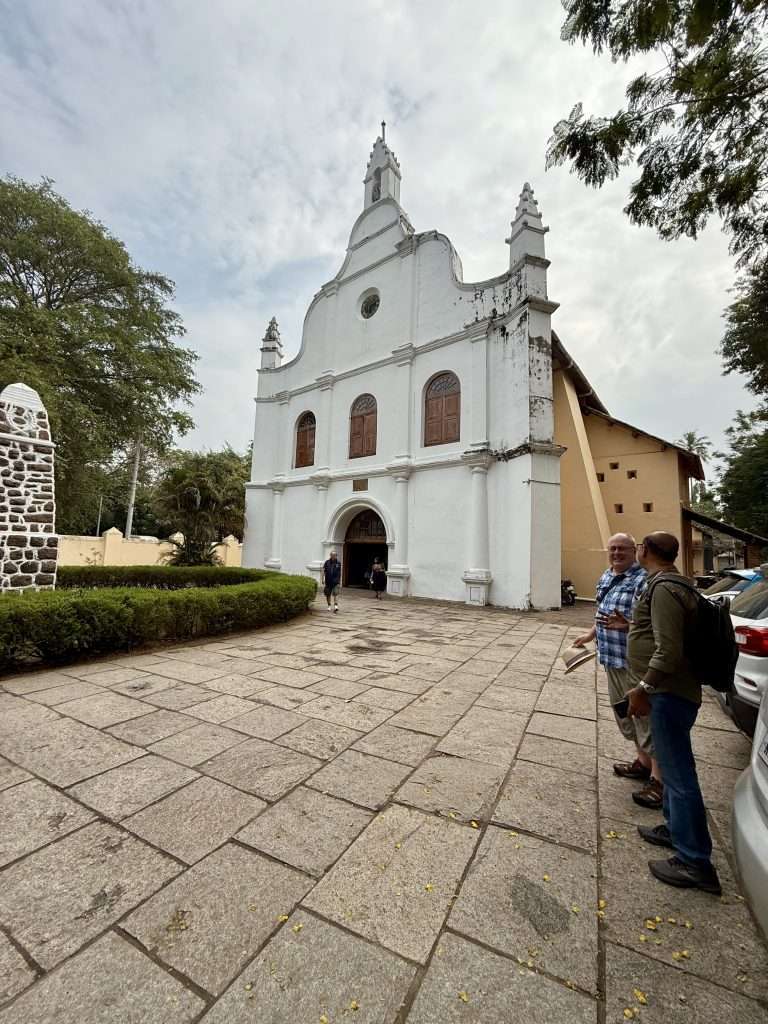
St. Francis Church in the centre of Kochi is a well known city landmark. The original wooden chapel was built by Portuguese Franciscan friars in 1503 and replaced in the 16th century by the faded ochre coloured building that still stands today. We were there on a Sunday and music filled the air around the old church. The congregation were cheerfully singing out “Praise my Soul the King of Heaven” at the top of their voices. For a few minutes, I was transported back to my old school assembly – except there was one big difference – the familiar hymn was being sung in the native Malayalam language. Many of the Christian hymns have been translated to Malayalam in the same way. The pretty church is fitted out with fine examples of the old style air conditioning – punkahs (fans). To function, they have to be hand pulled – by a punkah wallah.
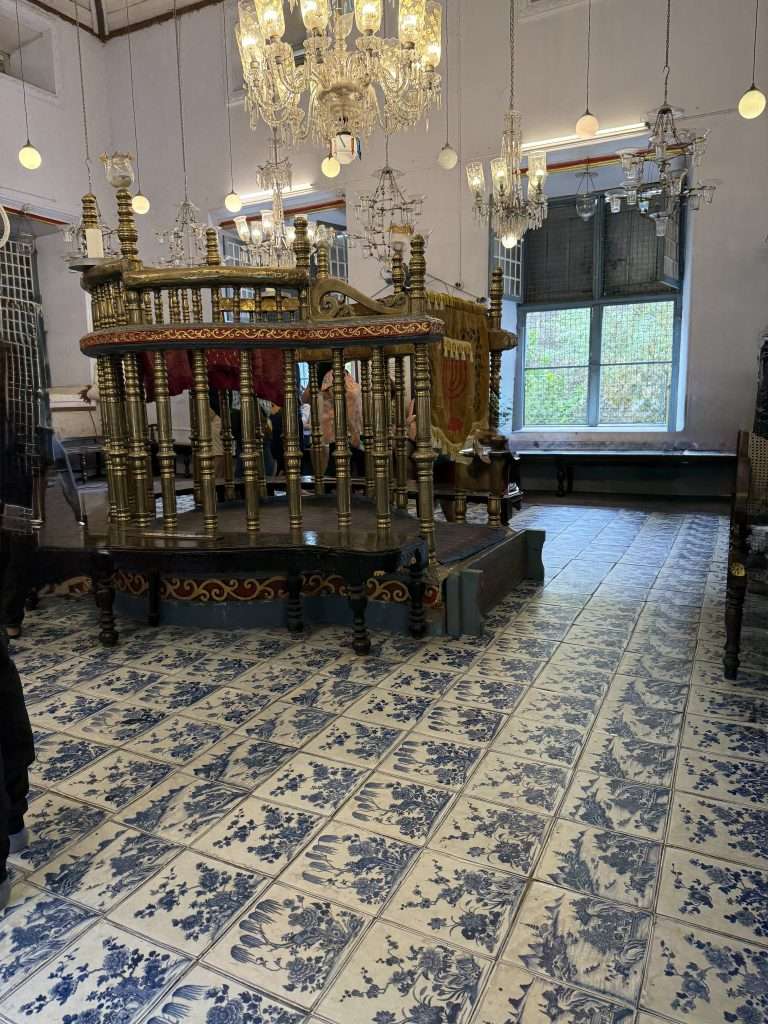
There is a good mix of religions in Kerala – Christians, Jews, Hindus and Muslims all live in peace side by side. Jews came to Kochi after being expelled from the Iberian Peninsula in 1524. The Raja of Cochin gave them refuge and granted them land near his own Palace. Paradesi Synagogue – the oldest active synagogue in India – was built there in 1568 and the Jew Town neighbourhood developed around it. The Synagogue features many beautiful glass chandeliers and hand painted Chinese tiles.
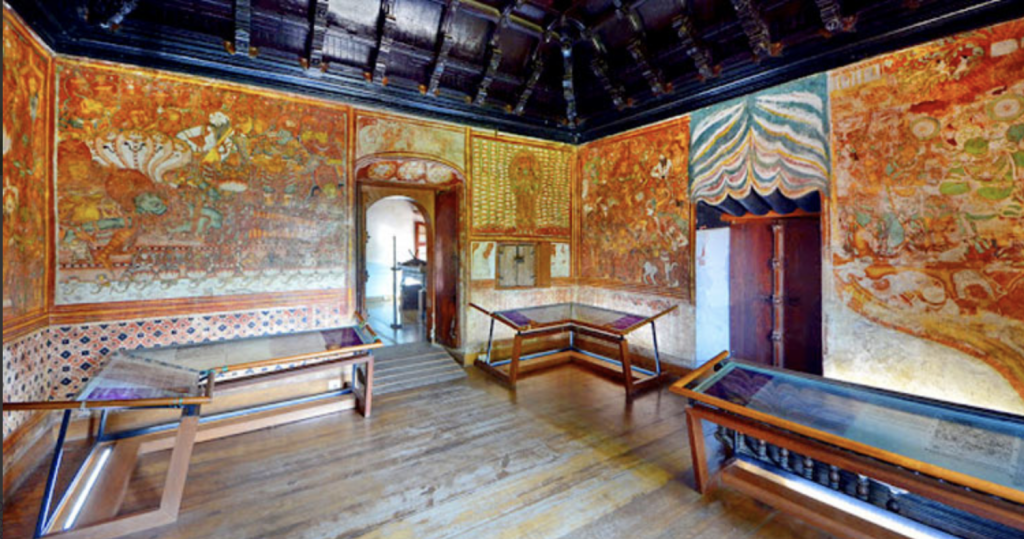
Another must see sight in Kochi is the Mattancherry Palace – a grand building with murals narrating Hindu mythology adorning the inside walls. The Hindu epics are central to their beliefs and cultural practices. They tell stories of heroic deeds and significant events in history but also preach the importance of duty and morality and shed light on the many facets of the human experience. It is good to have a guide with you who can explain the stories behind the elaborate murals so you can really appreciate what you are looking at. The museum inside the Palace also has many photographs and artefacts which bring to life the history of Kerala and the – voluntary and peaceful – end of the reign of the royal family.
Of course, peaceful tolerance of several religions means that you get to enjoy lots of festivals. Whatever their religion, everyone enjoys the Christmas celebrations here. Quite a few a Christmas Decorations were still up in a Kochi when we travelled in mid January. There are 36 festivals in the Hindu calendar too, with the Annual Festival of Colours (Holi) celebrating Spring and Onam (celebrating harvest) two of the biggest. Hindu festivals follow the lunar caleddar, so their dates change each year.
Feeling at Home
The church music wasn’t the only thing that made me feel at home in Kochi. Many of the street names here are English and English is widely understood and spoken. These days, many schools are English speaking and literacy rates are high in Kerala too at 90% compared to around 59% nationwide. They even know how to spell stationery correctly – which is more than the newsagent in my own suburb of Birmingham does!
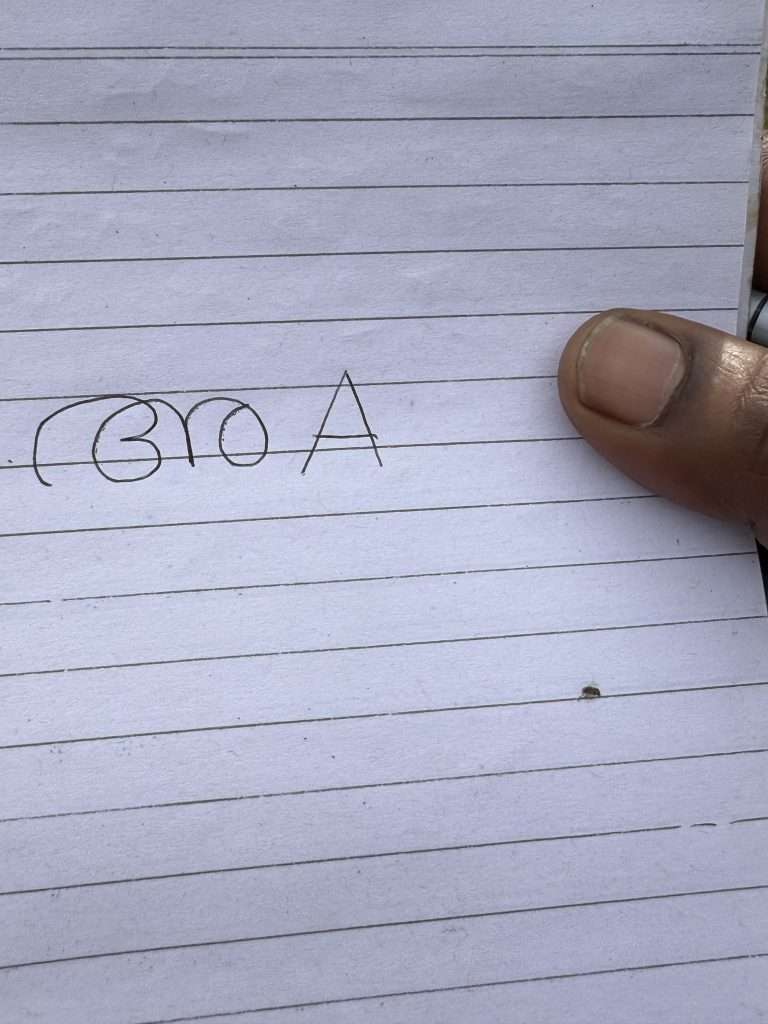
One of our young guides told me that her own children find it easier to learn English than their native Malayalam which is a rhythmic language, often spoken very quickly and is extremely hard to write, as the comparison of the letter A here shows..
Malayalam is spoken at home because her grandmother looks after the children while she is at work 6 days out of 7 and her mother has no English. Her mother did not work when she was a child – she was not educated and confined herself to looking after the family. Just as in the rest of the world, things are changing in Kerala – particularly for modern women. What our young guide wanted most of all for her own children was a good education – and a command of English as excellent as her own.
In the local park, you can hear the frequent loud thwack of a cricket ball and the occasional cheer as a wicket falls. Many of the buildings in Kochi date from the period of the British Raj. The British Club House has stood up well to the test of time and is still being well used by many nationalities today.
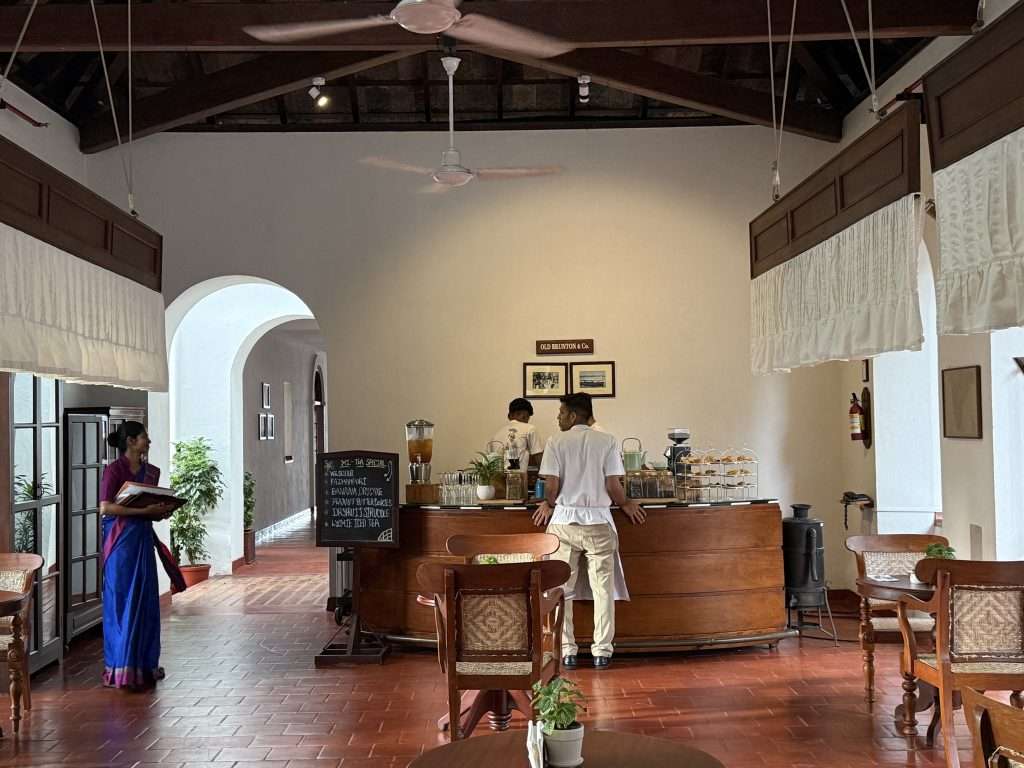
Not only that, all the hotels we stayed in had a plentiful supply of tea in the room and most celebrated tea time at 4 pm too with an assortment of tempting tiffin (snacks) usually offered alongside.
Hidden Gem - The Dhobi Khana Laundry
A visit to a public laundry isn’t normally high up on any tourist itinerary, but the Dhobi Khana Public Laundry is well worth a visit for the tales it has to tell about about the Indian caste system, the British colonial days and also, I think, modern India. Spread across two-acres in the village of Fort Kochi in the Ernakulam district of Cochin, the laundry was started back in the 19th century driven by the increasing demand for a hygienic laundry service among the European population of Fort Kochi.
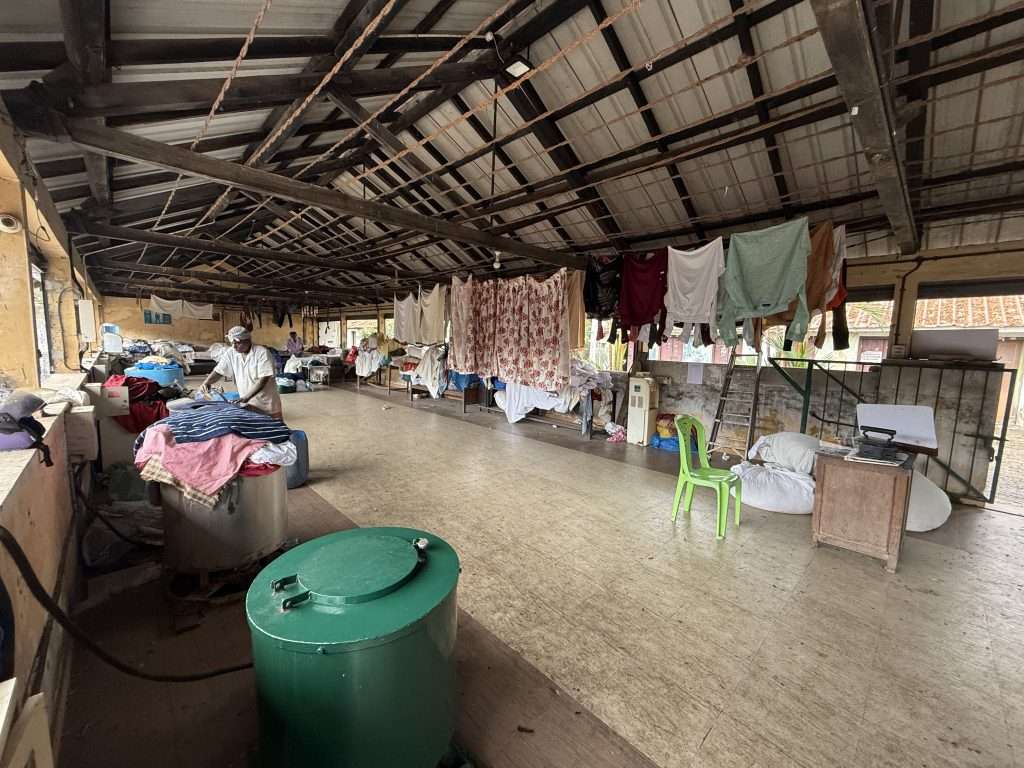
The British administration at the time wanted to find a way of incorporating the Indian caste system into their system of governance and invited the Tamil Vannan community (traditionally associated with washing) to settle in the area and operate the laundry. The Vannan community’s expertise in traditional laundry techniques was highly valued by the British colonialists who valued cleanliness and order.
The community operated laundry respected traditional caste hierarchies so embedded in the society at the time whilst providing the Vannan community with a formal role in the local economy. It was a great example of a community initiative blending local traditions with external demand. The discriminatory caste system was abolished in India in 1950, but it is so deeply entrenched in the culture of many Indian states that it still persists today despite the change in the law.
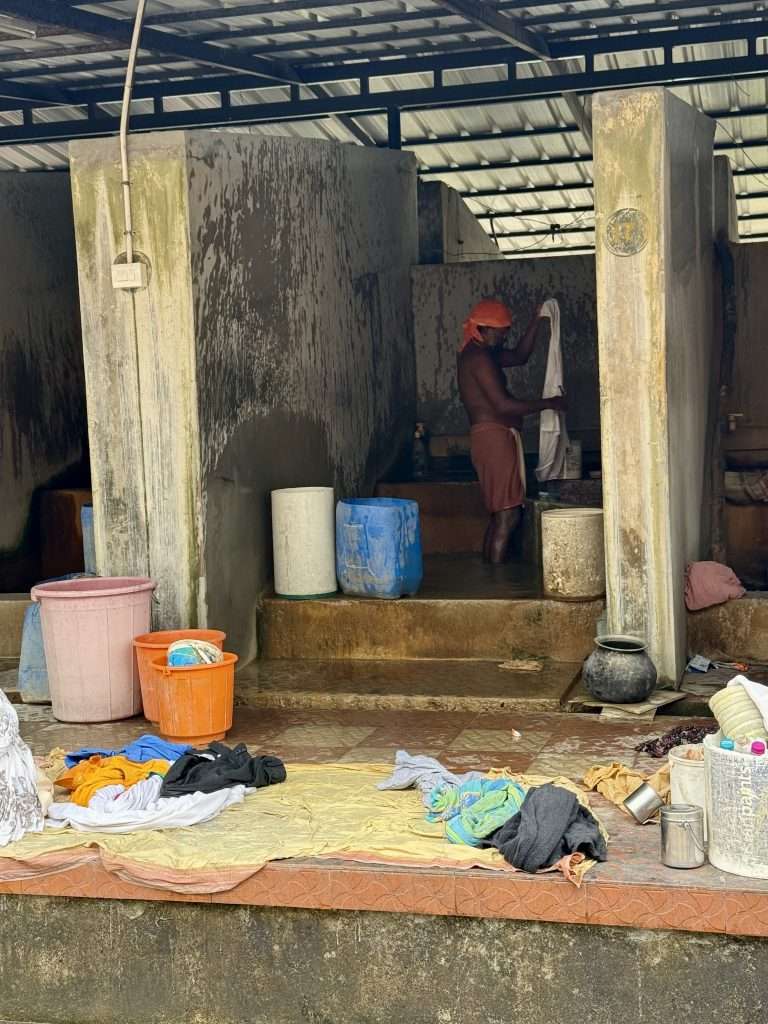
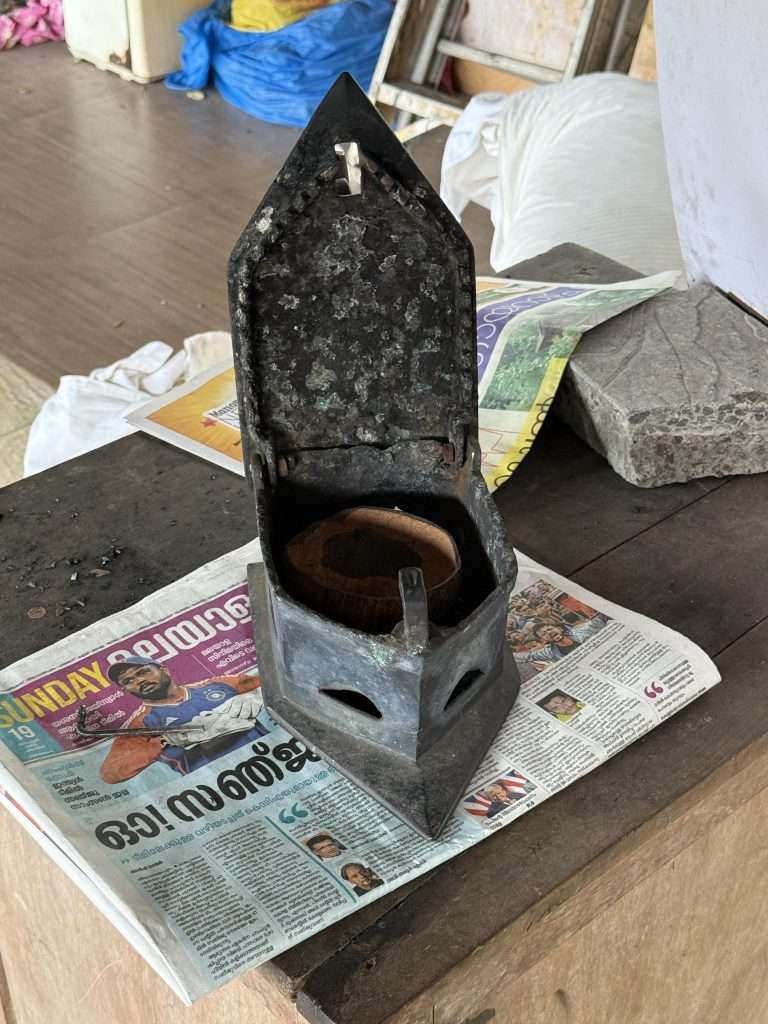
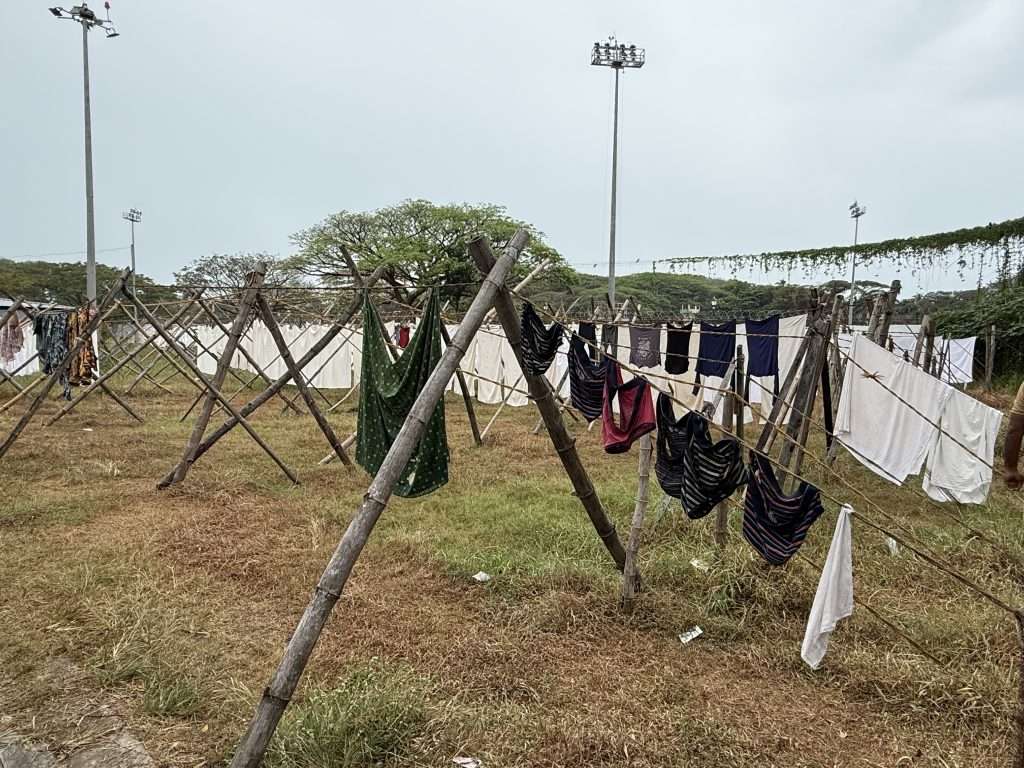
The Dhobi Khana Laundry still uses age old laundry practices such as washing stones (some over a century old), charcoal irons and vast areas of drying lines where laundry is carefully tucked between twisted ropes to hold it in place. Each working family has its own thotti (washing pen). Western garments are washed alongside traditional Indian saris and dhotis. Between December and February, hotels and home stays are bustling with visitors and Dhobi Khana is very busy. Hospitals, local hotels and households use their services all year round.
Things change though and time moves on:
- The caste system in India is now thankfully in decline – particularly in a Kerala. Modern families aspire to an education for their children and a brighter future than being a laundry walla (sp.)
- Modern mechanical alternatives both at home and in commercial laundries have reduced the demand for a manually operated laundry.
- Urbanisation and infrastructure development are placing increasing demands on space which the traditional laundry requires a lot of.
Hopefully, the laundry will one day become designated as a UNESCO Cultural Heritage site and so continue to thrive.
The Indian Caste System
The dhobi was one of India’s Dalit communities – a “scheduled caste” or outcast once regarded as“untouchables”. If you were born into this caste, you weren’t allowed to pass food to a higher caste or to go inside a temple or to associate with higher castes. Once you were born into a caste, there was no way to escape it – your future would be predetermined from the day you were born with no escape. How unimaginably awful must that be? You couldn’t study industriously and educate yourself upwards or work hard to better yourself – you just had to accept your lot in life, put a smile on your face and get on with your inherited occupation. The only people you could associate with in this descent-based system of discrimination would be other “untouchables”
Thankfully, after 1920, social unrest began to lead to changes and a policy of positive discrimination began with a percentage of government jobs being reserved for the lower castes. After independence in 1947, negative discrimination on the basis of caste was banned by law – but despite that, it still persists in many parts of an India, although (according to our guide) it is not prevalent in modern day Kerala. The Supreme Court of India ruled in 2017 that calling anyone a dhobi was offensive.
Shopping for Souvenirs
Kochi is a great place to go shopping. We visited one of the government run outlets en route and I found a soft as butter blue silk pashmina scarf which I would later find useful to protect me from the sun in the beach portion of our trip, keep the mosquitos at bay on the backwaters houseboat and to show respect when visiting a temple later on – so a good investment.
The skilled women seamstresses that work here can run up a made to measure shirt in just 2 hours. What better souvenir of a first trip to India could there be for the man you love most in all the world than a shirt made from a fabric decorated with his all time favourite wild animal – the elephant?
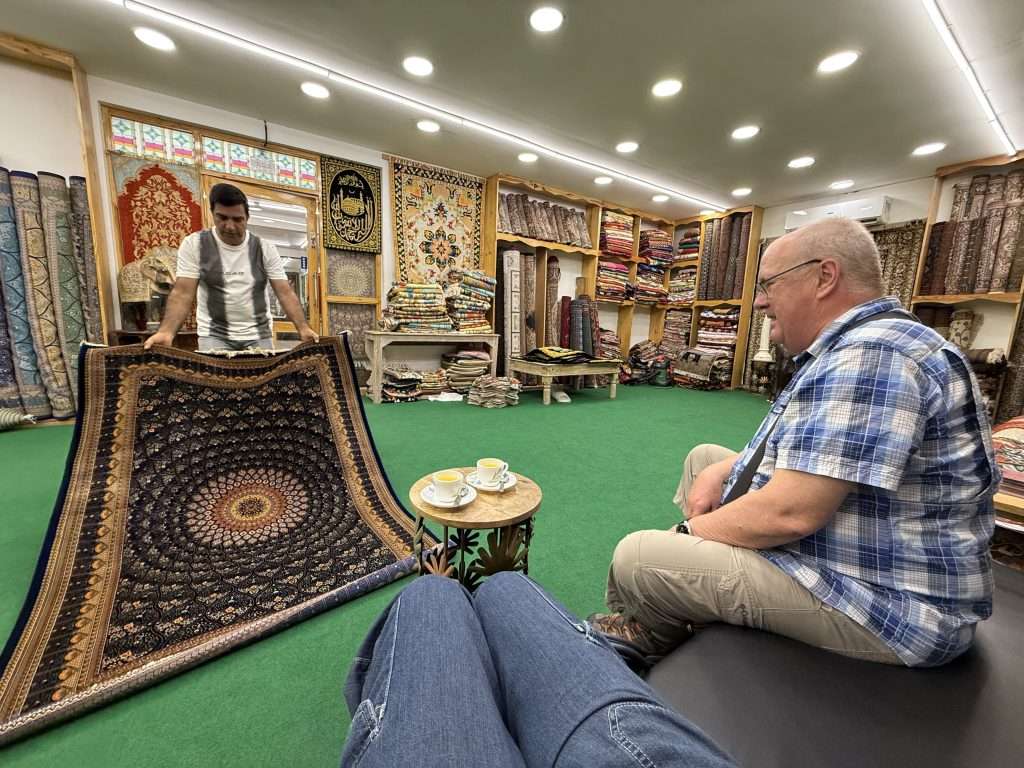
We managed to resist the Indian carpet.
Keralan Kathakali Dance
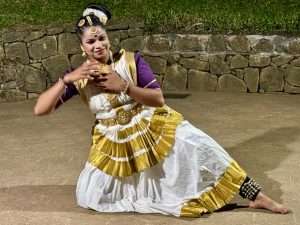
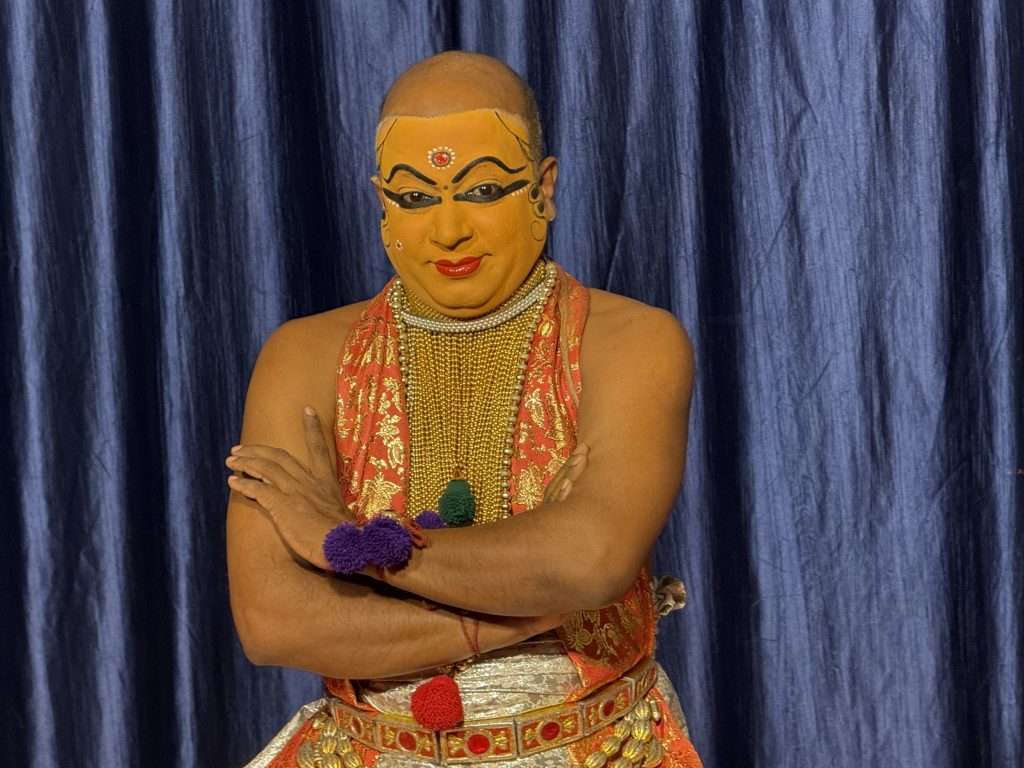
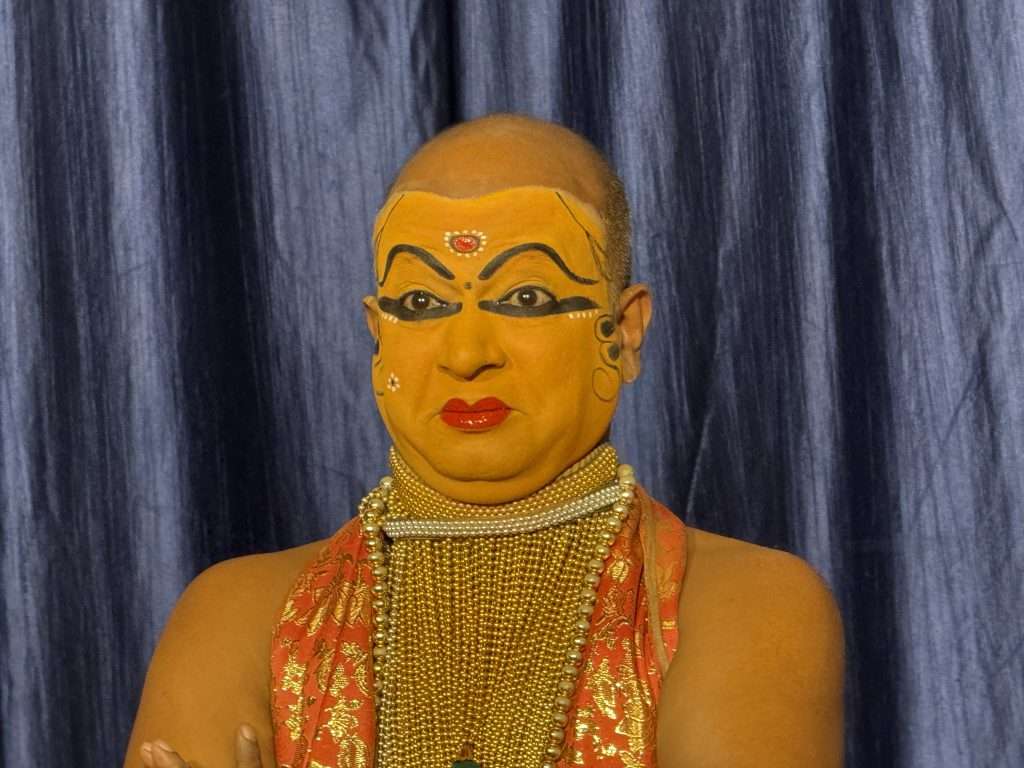
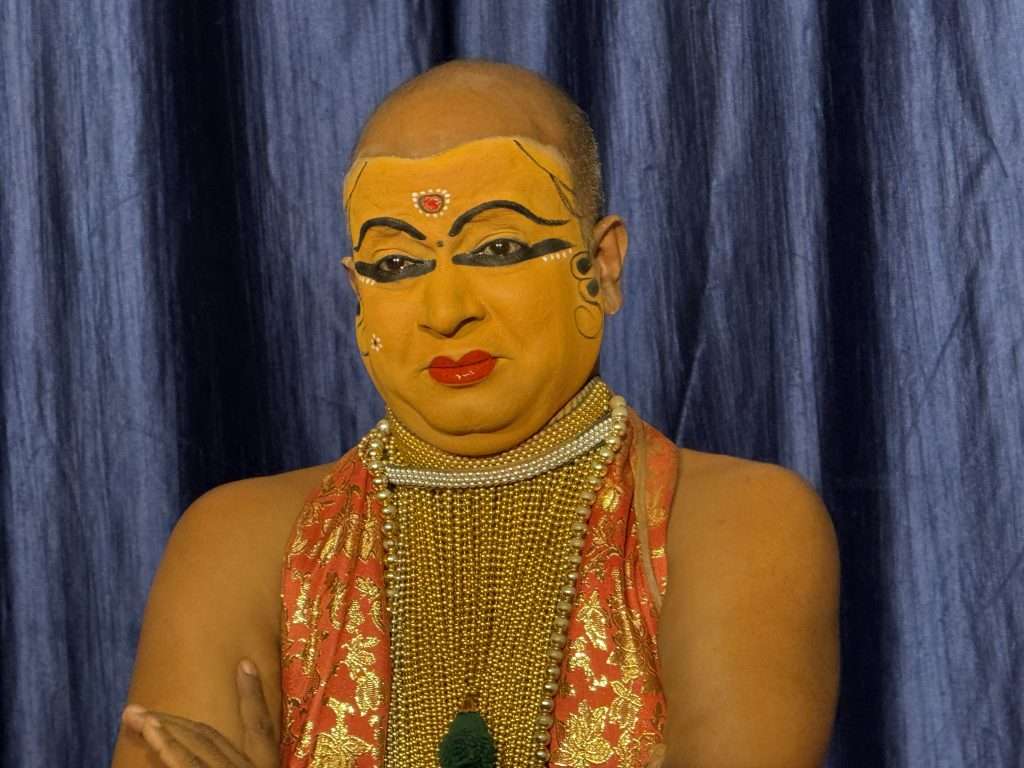
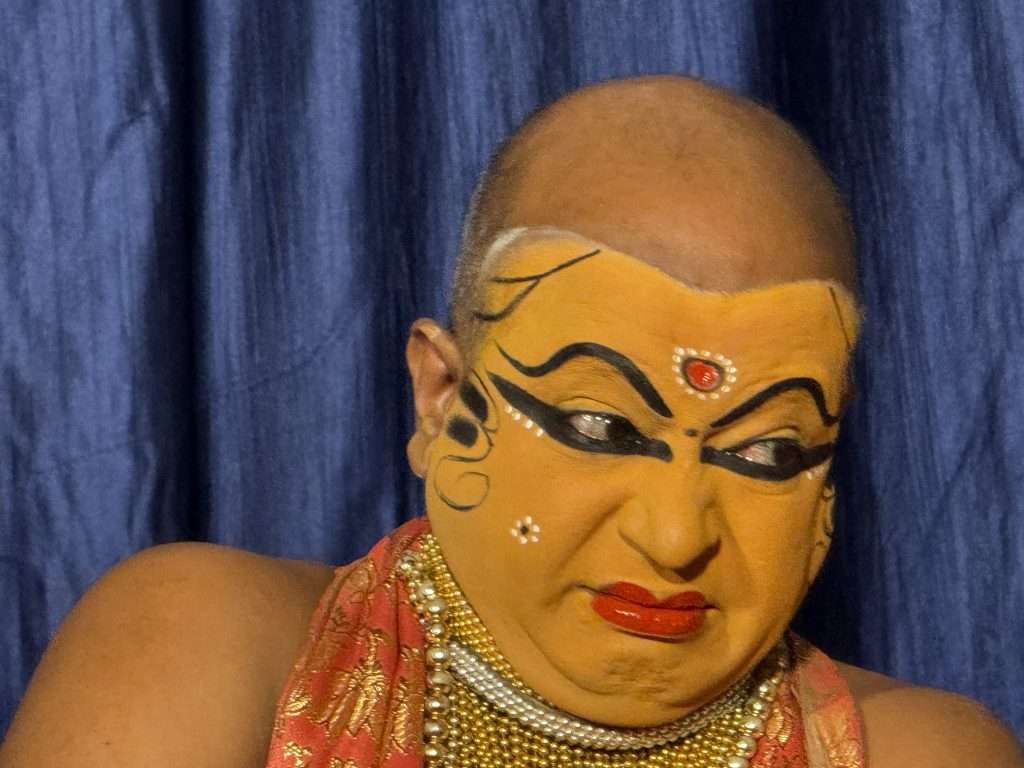
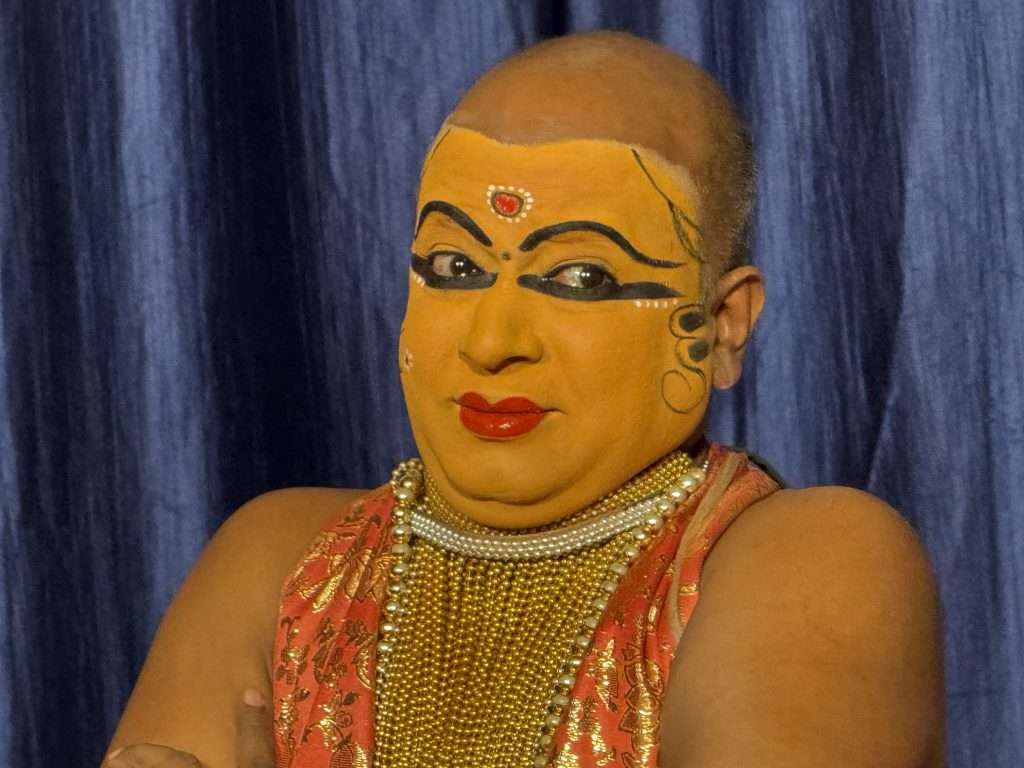
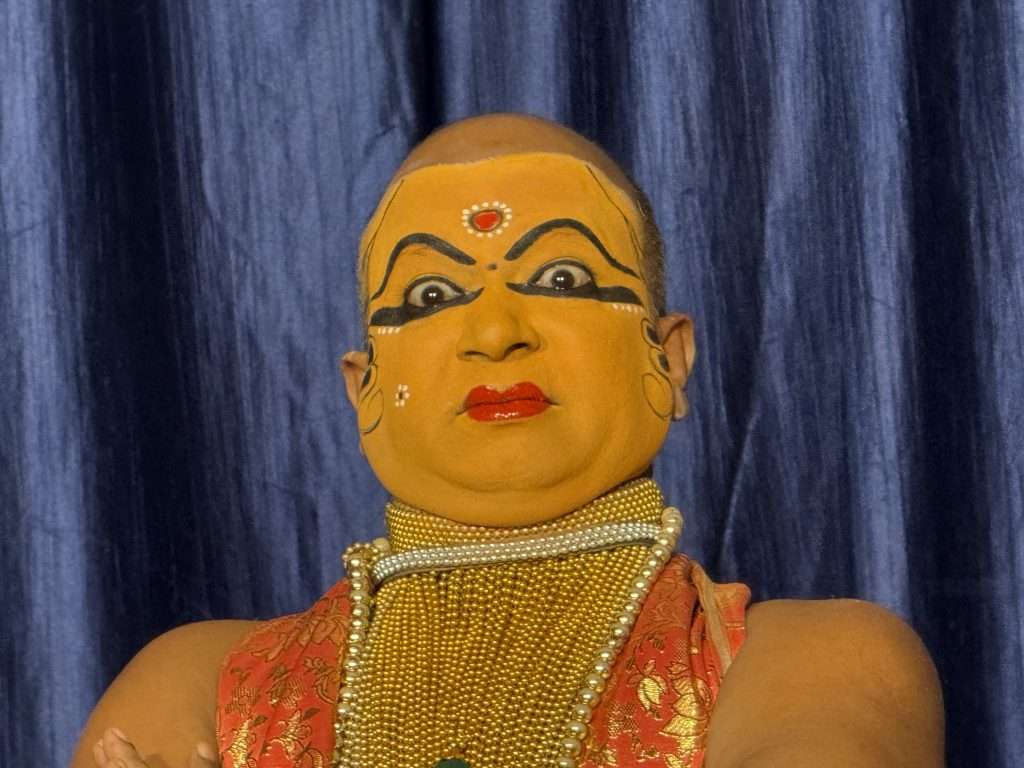
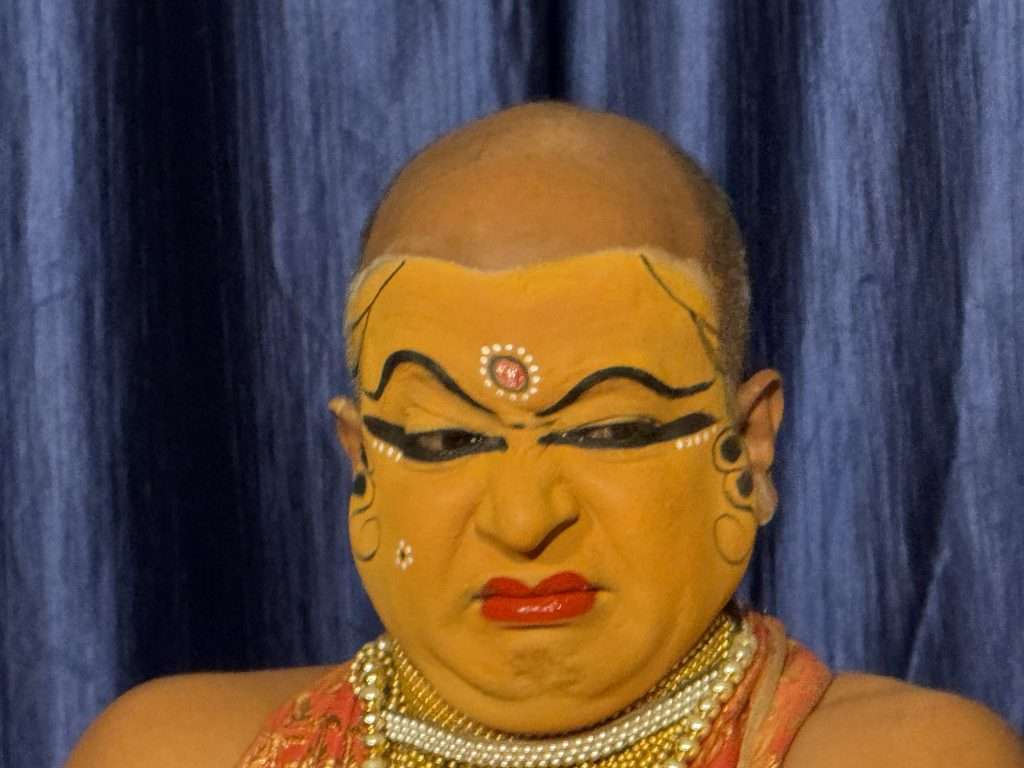
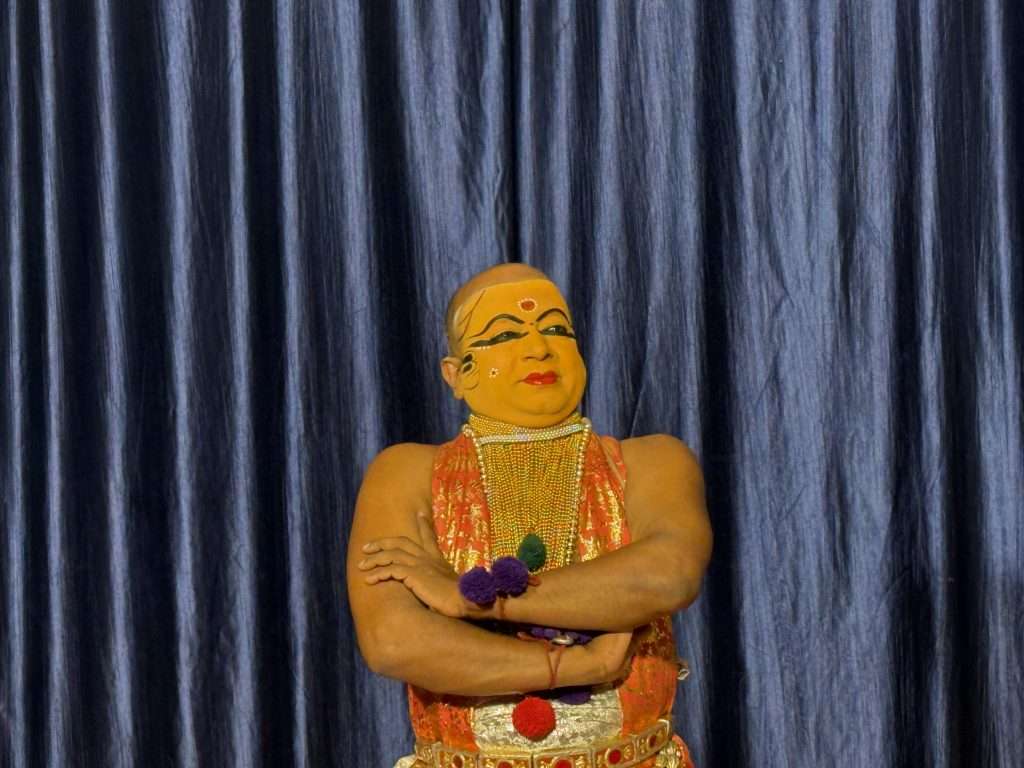
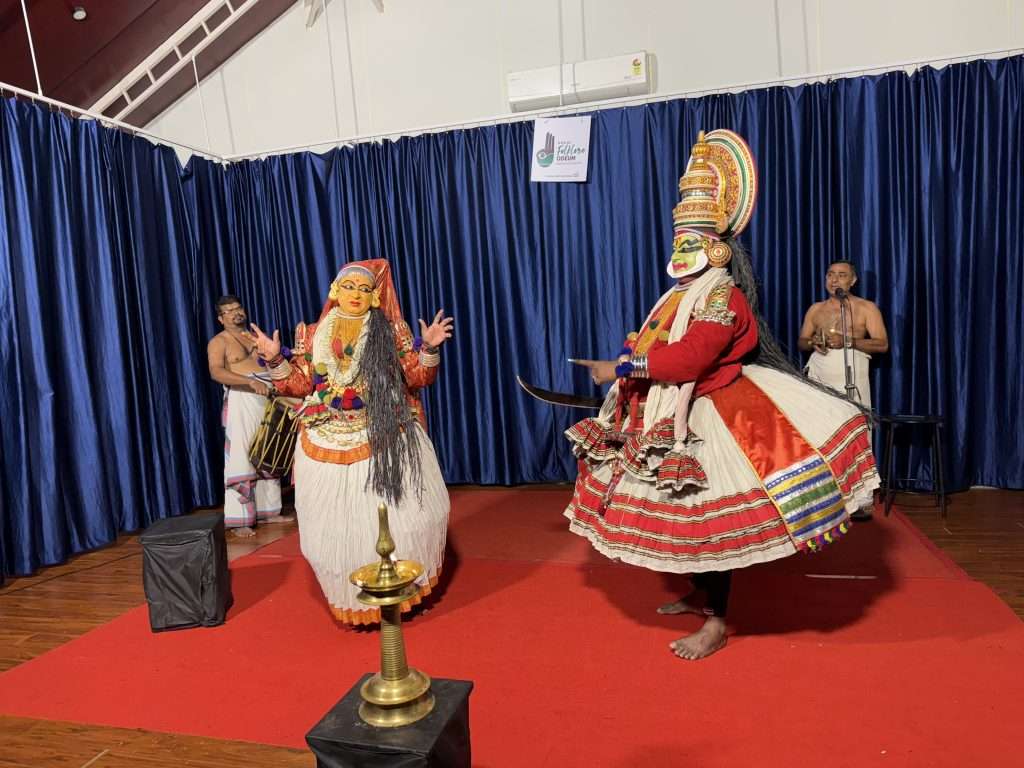
In the evening, we had tickets for a Kathakali show at the Kochi Kolklore Odium. Kathakali is the famous dance drama of Kerala which is only performed in this state. Telling the stories of the Hindu epics, the heavily made up dancers dressed in traditional costumes use a range of facial and hand movements to bring drama to the stories and create a piece of highly entertaining theatre.
Without ever opening their mouths, they use their facial expressions and particularly their eyes to convey the full gamut of human emotions. The training to achieve this level of skill is arduously long and it is truly fascinating to watch.
There are 9 emotions conveyed all through facial expressions, sign language and movement:
- Sringaram: Love, pleasure, delight
- Hasyam: Comic, laugh, mocking
- Karunam: Pathetic, sad
- Raudram: Anger, fury
- Viram: Heroic, vigor, enthusiasm
- Bhayanakam: Fear, concern, worry
- Bibhatsam: Disgust, repulsive
- Adbhutam: Wonder, marvelous, curious
- Shantam: Peace, tranquility
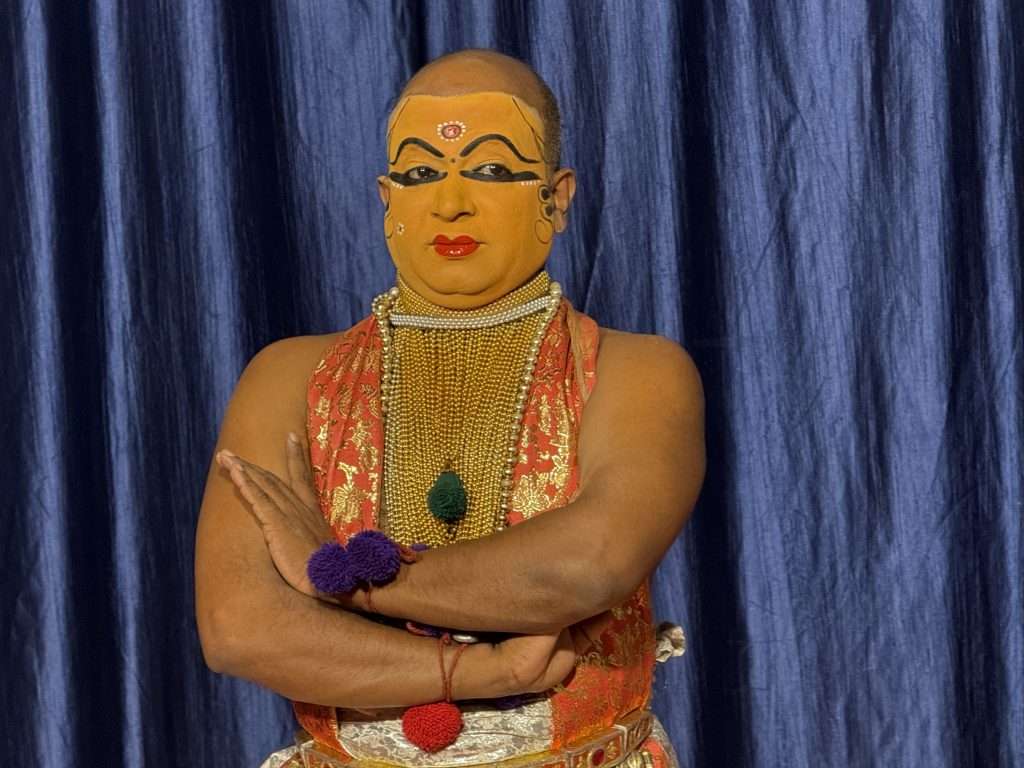
After the performance, we chose to walk back to our hotel along the side streets and then along the beach/waterfront. In contrast to other big cities I have visited (e.g. Rio de Janeiro and Cape Town), the quite long walk in the dark felt safe and not in the least threatening. People were helpful and friendly when we lost our way a little. There was more danger from the busy traffic, darting tuc tucs and the odd stray dog than ever there was from any human. I like that about India – I really like that!
Tips for Future Travellers
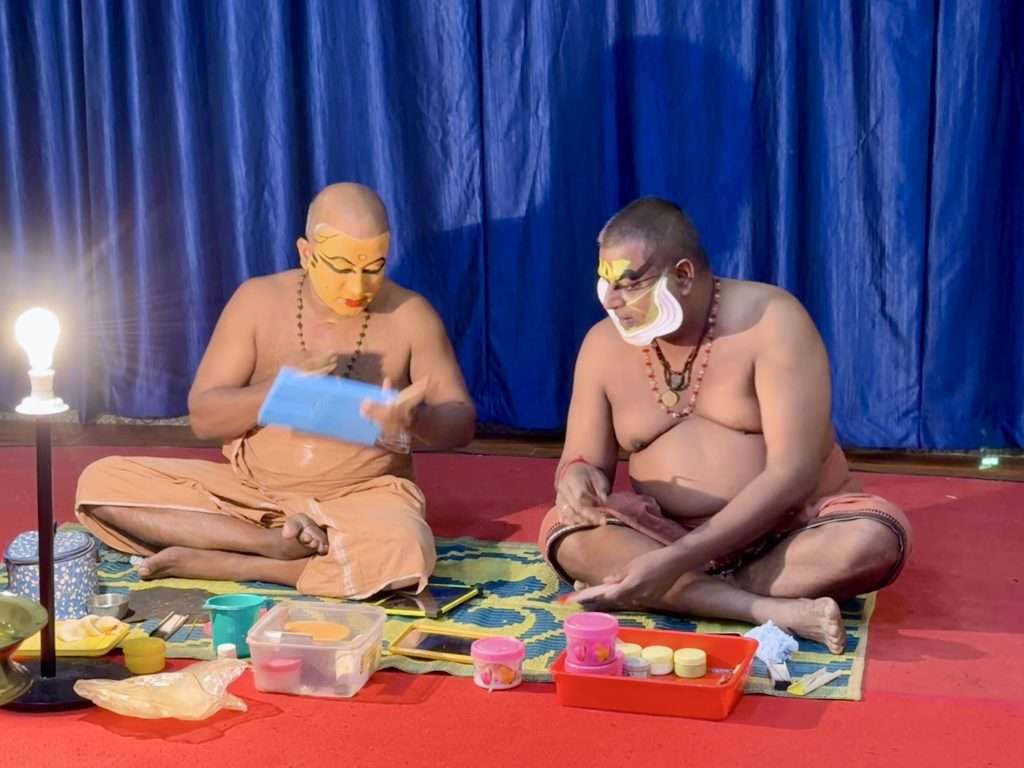
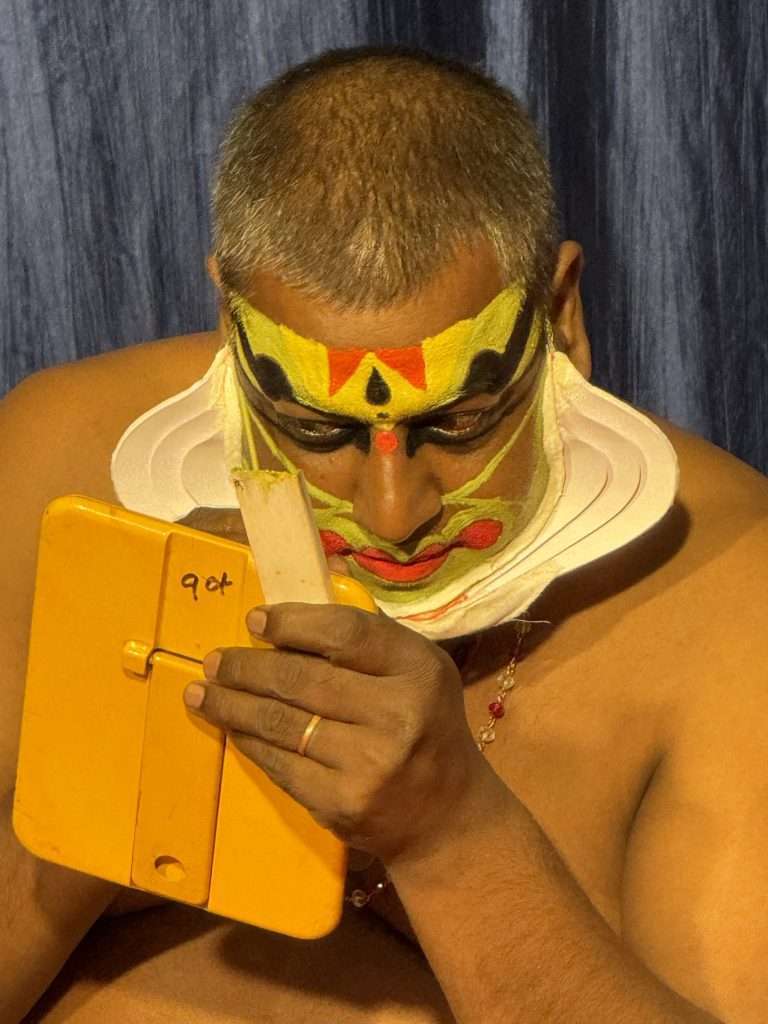
Make sure you arrive a good half an hour early so you can watch the performers applying the make up that transforms them into Khatakali characters.
From Kochi Port to the Midlands - 2 Days in Neriamangalam
To travel from Kochi to our next destination in the Midlands of Kerala – Neriamangalam – took 3 hours and required us to cross Asia’s first Class A Arch Bridge. The bridge was laid across the Periyar River (the longest river in Kerala) connecting Aluva and Munnar by the British. The 214 metre long bridge is a gateway – connecting the lowlands of Kochi with the uphills of Munnar and Idukki and originally provided a transport route for tea, aromatic crops and trees from the high ranges to Kochi. These days, it provides convenient access for tourists to the top hotels and luxury resorts located in the uphill regions. A new bridge is currently being built alongside the old one to cope with increasing levels of traffic, but the old bridge has stood the test of time amazingly well.
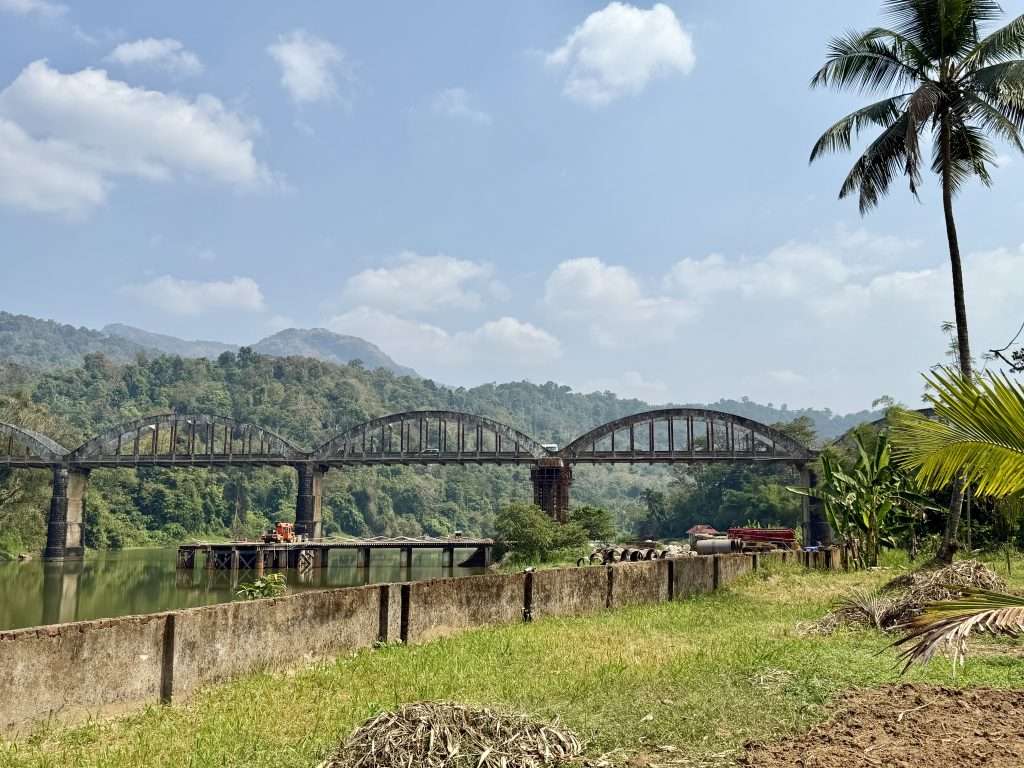
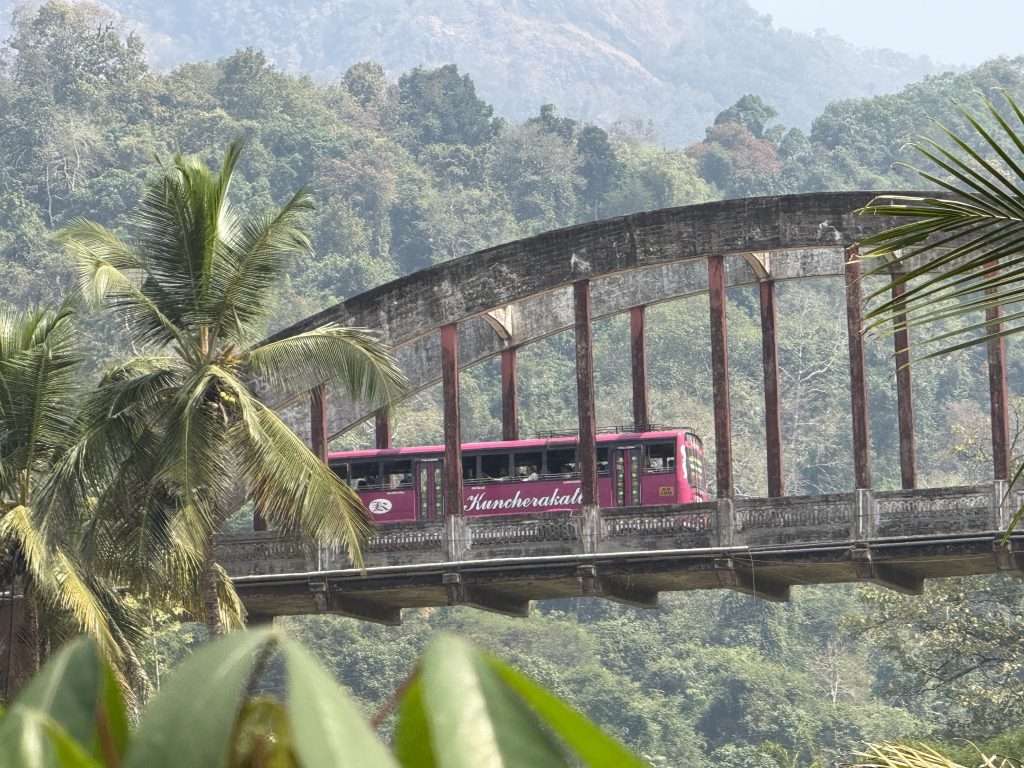
Construction started in 1924 and was completed in 1935. Everyone, including the native villagers, had their role in the completion of the epic build. I was told that the strength of the bridge was tested by walking 100 elephants across it. I’m not sure whether that is true and I couldn’t find any concrete evidence to prove or disprove it. While I was searching though, I did discover that in 1884, Barnum’s circus paraded 21 elephants and 17 camels across the Brooklyn Bridge to demonstrate the bridge’s strength and safety. The parade was a public relations stunt for Barnum’s circus and helped dispel fears about the bridge’s stability. So maybe it is true?
Indian Elephants
Elephants – the gentle giants of India – are a sacred symbol in both the Hindu and Buddhist religions, representing loyalty, power, wisdom, and fertility.
The Asian Elephant – differentiated from the African elephant by its smaller ears – is India’s National Heritage Animal. Elephants are well protected by the Wildlife Protection Act 1972 which prevents their abuse and exploitation. There is an absolute prohibition on the poaching, trafficking and trading of elephants, inviting a hefty fine and incarceration of up to 7 years if the law is broken. Tusks have to be declared to the State Forest Department.
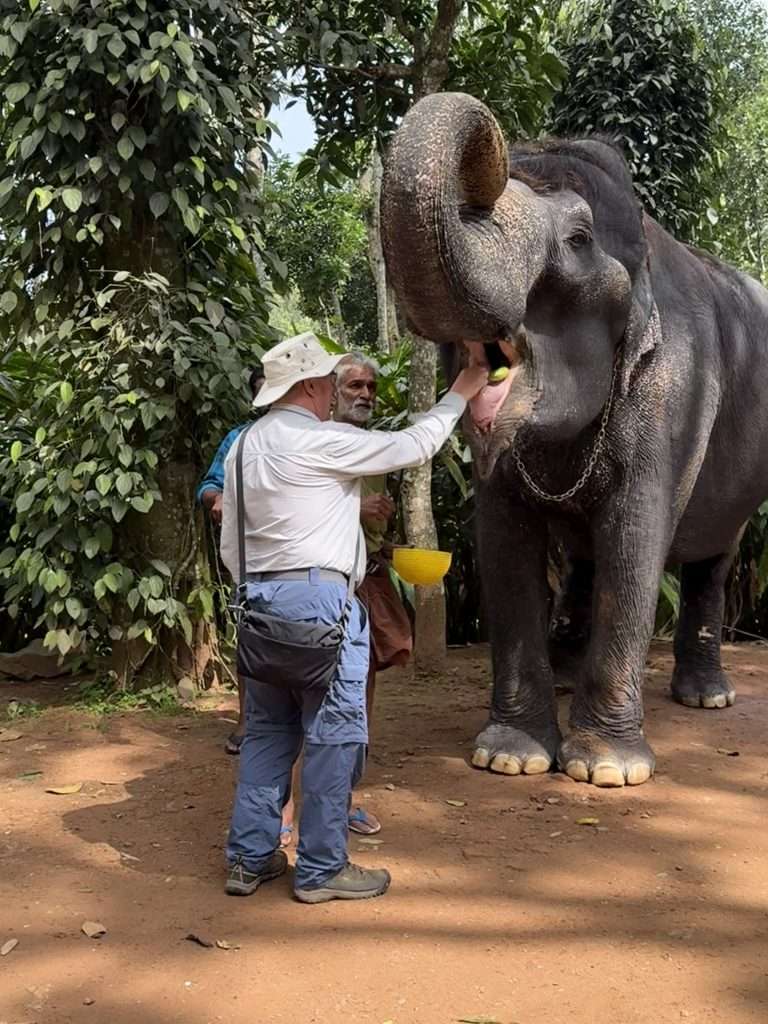
Although they look as though they are gentle creatures they are huge and wild elephants can cause injury to humans if they charge. In 2021-22, there were 52 human deaths caused by wild animal attacks in India and of these, 25 deaths were caused by elephants. The government had recently erected electric elephant fences around the hotel where we were staying in Neriamangalam. I am very glad they did as there was as a wild elephant came to visit while we were there.
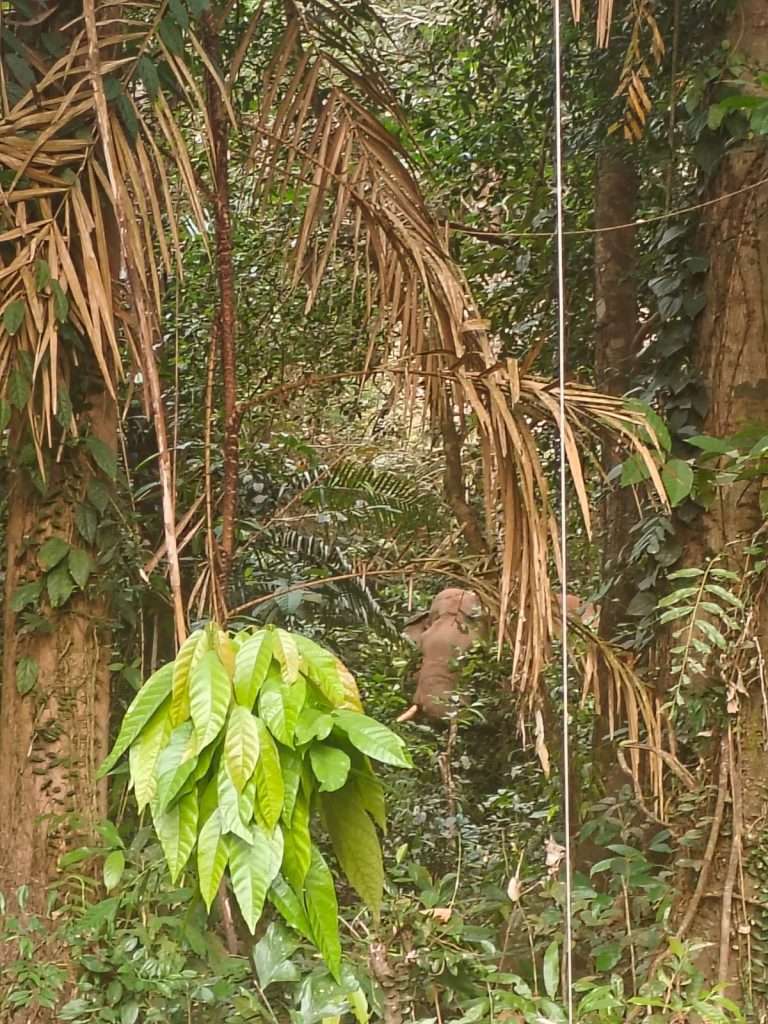
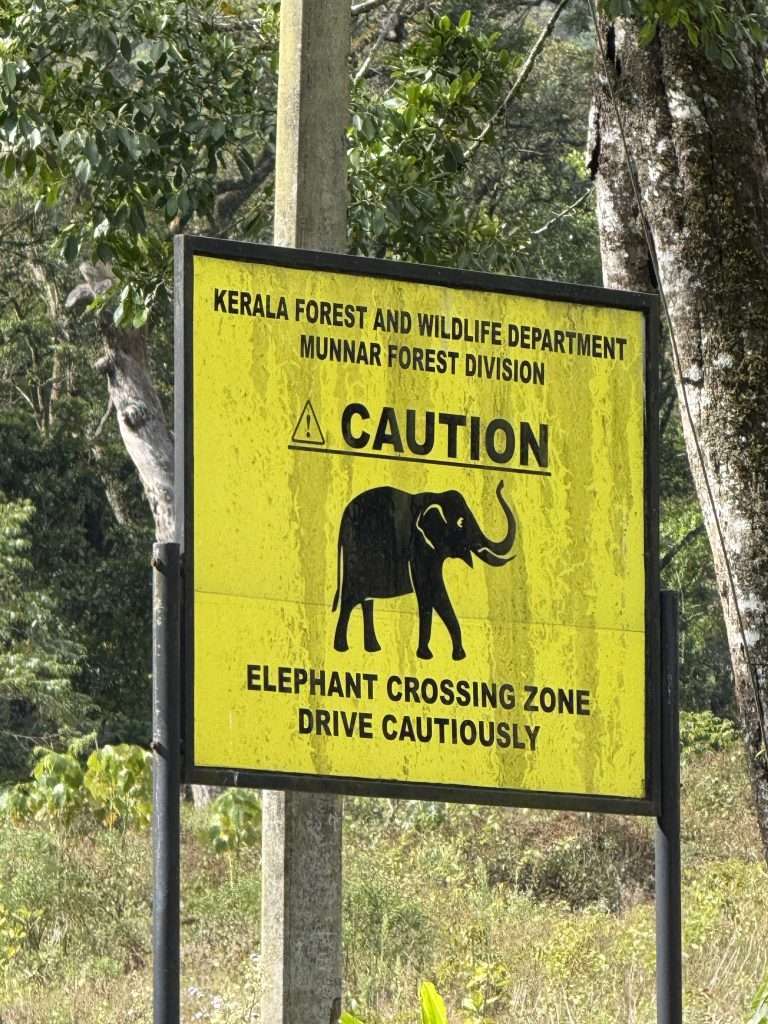
In order to contain the increasing number of human encounters with wildlife, the forest departments of Kerala and Karnataka recently reached interstate agreement to collaborate closely to mitigate the challenges posed by wild animals encroaching into human settlements. We noticed several Elephant Crossing Notices along the main road from Neriamangalam to Munnar.
The Western Ghats - Kerala’s Market Garden
Neriamangalam is situated in the Western Ghats – a UNESCO World Heritage Site and one of the 36 biodiversity hotspots in the world. The wildest lands are covered with dense forests, while other regions lie under tea and coffee plantations (established mainly in the 19th and 20th centuries) or other forms of cultivation. Within the space of a couple of hours walking through the areas surrounding the village, we saw rubber trees (with pineapples planted beneath them as companion plants whilst the rubber trees get established), coconut and mango trees, arabica coffee, cashew nuts, tapioca, turmeric, arrowroot, peppers and jack fruit.
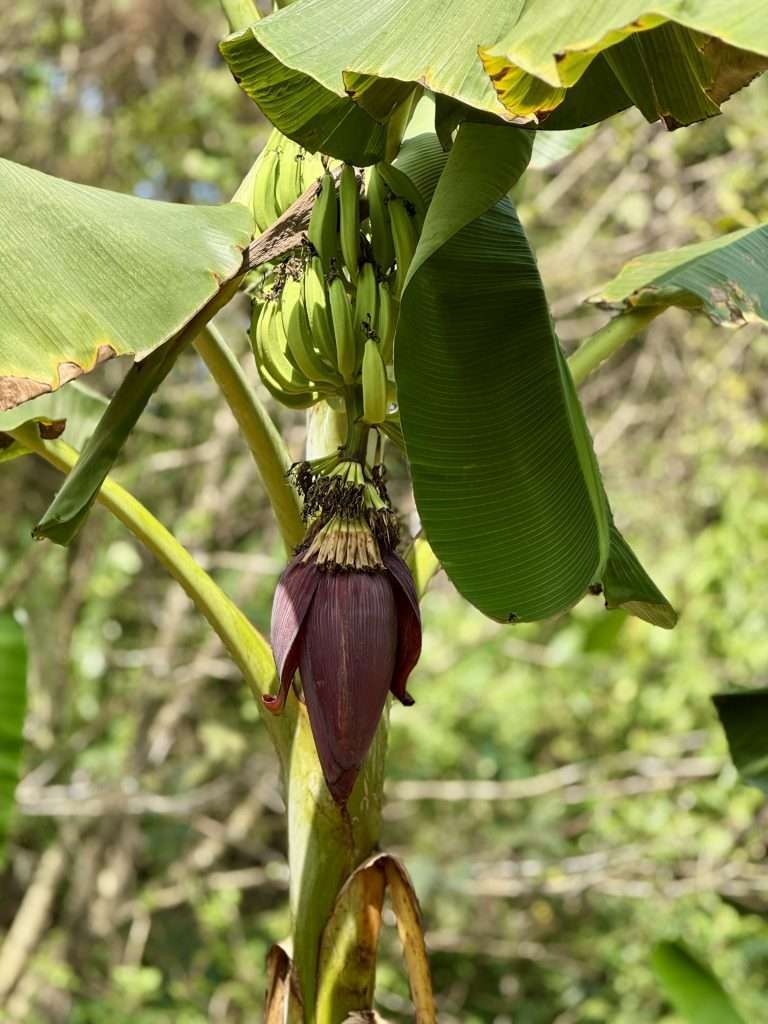
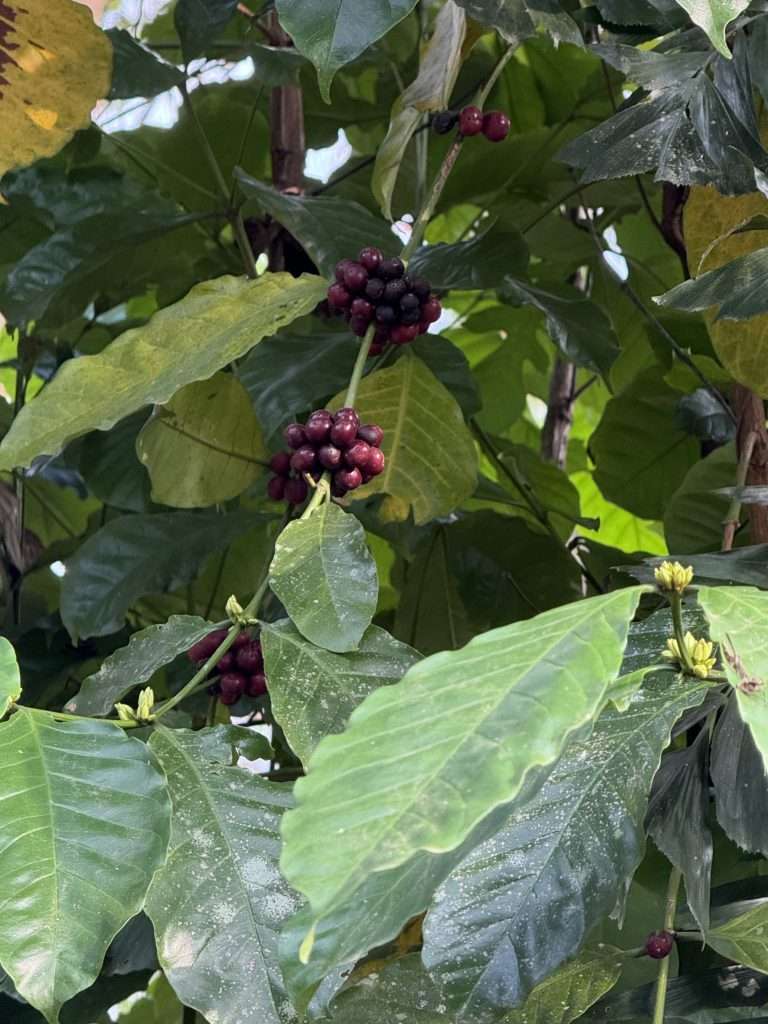
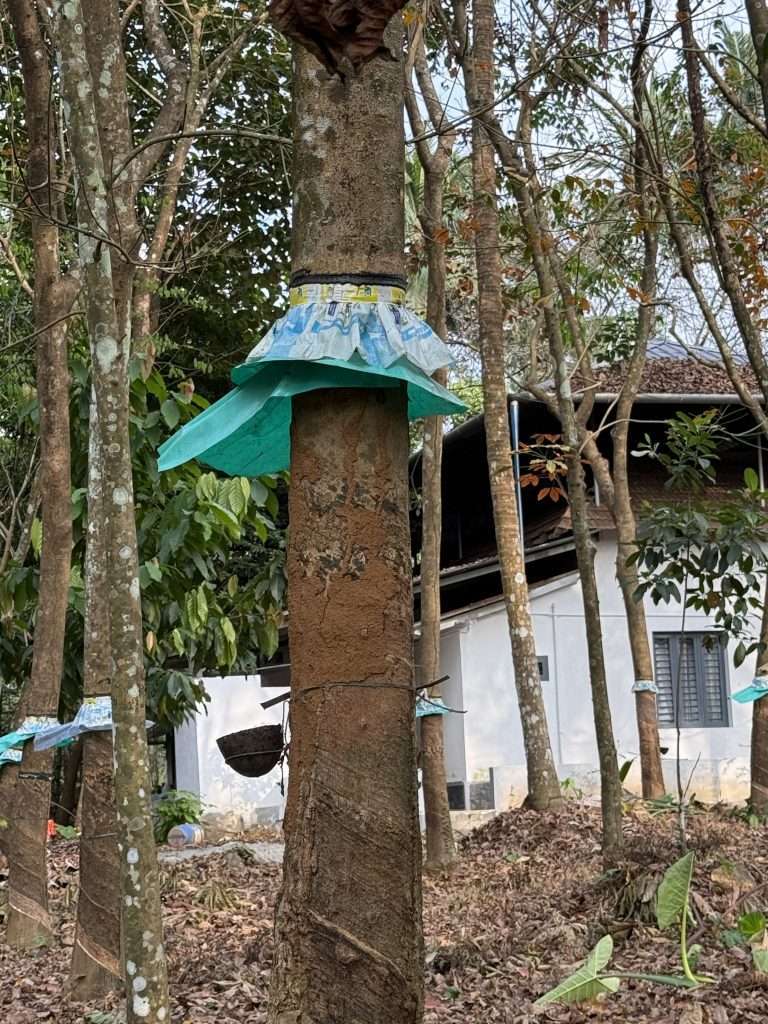
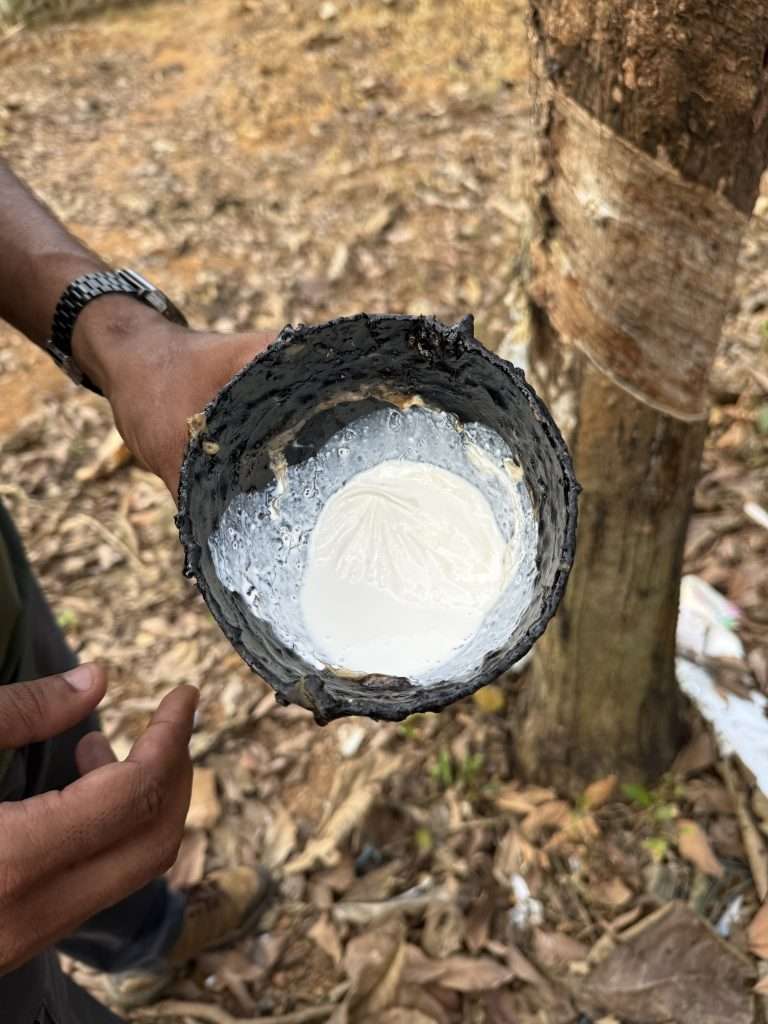
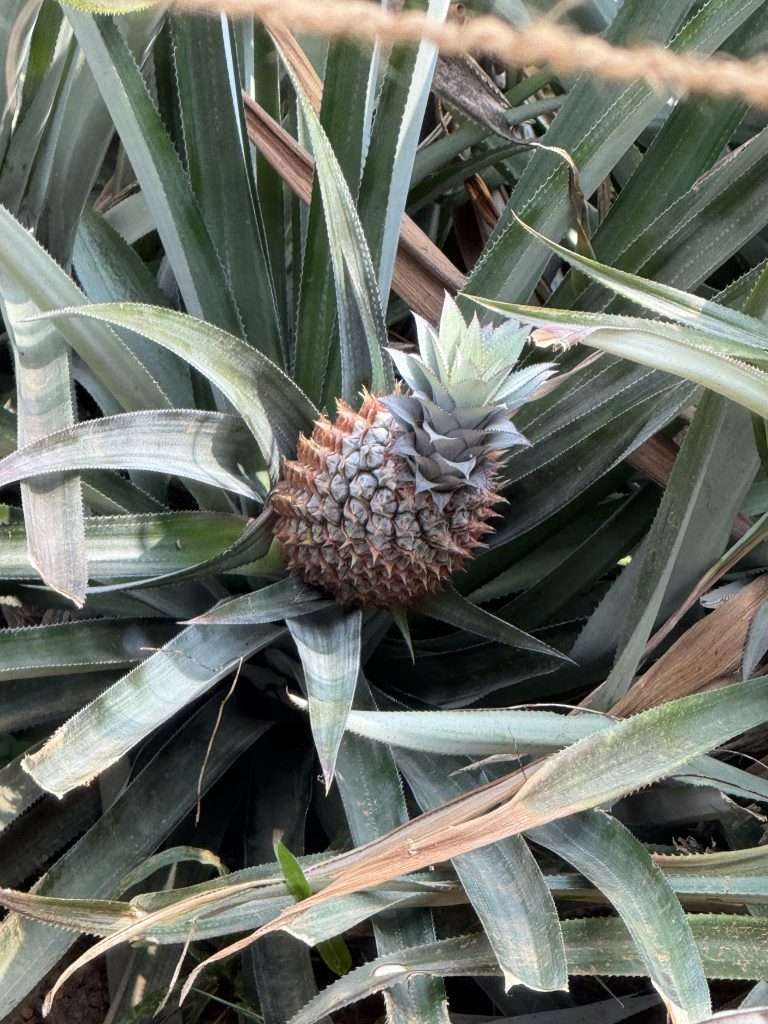
Over 120 bird species inhabit this area and as the sun rises, it seems as though they are all singing at once. As the birdsong diminishes, the sound of early morning prayers being sung takes its place heralding the start of another day in God’s Own Country.
Inchathotty Suspension Bridge
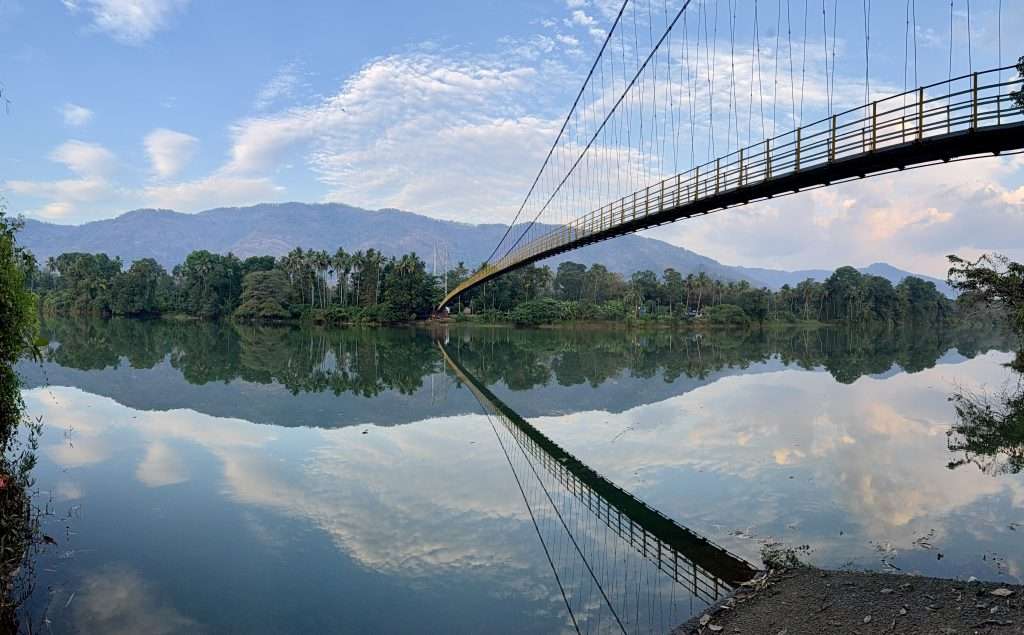
Our walk through the outskirts of Neriamangalam brought us to the Inchathotty Suspension Bridge which is the longest hanging bridge in Kerala with a length of 183 meters and a width of 4 feet. If you are a fan of suspension bridges, it is definitely worth a visit to take the wobbly walk across. Unlike similar bridges I have walked across in other parts of the world, there was seemingly no notice restricting numbers to a maximum here for health and safety reasons. If you are nostalgic for the days before even the most basic of school trips required signature of a damage limitation waiver, then you might find a trip India quite refreshing.
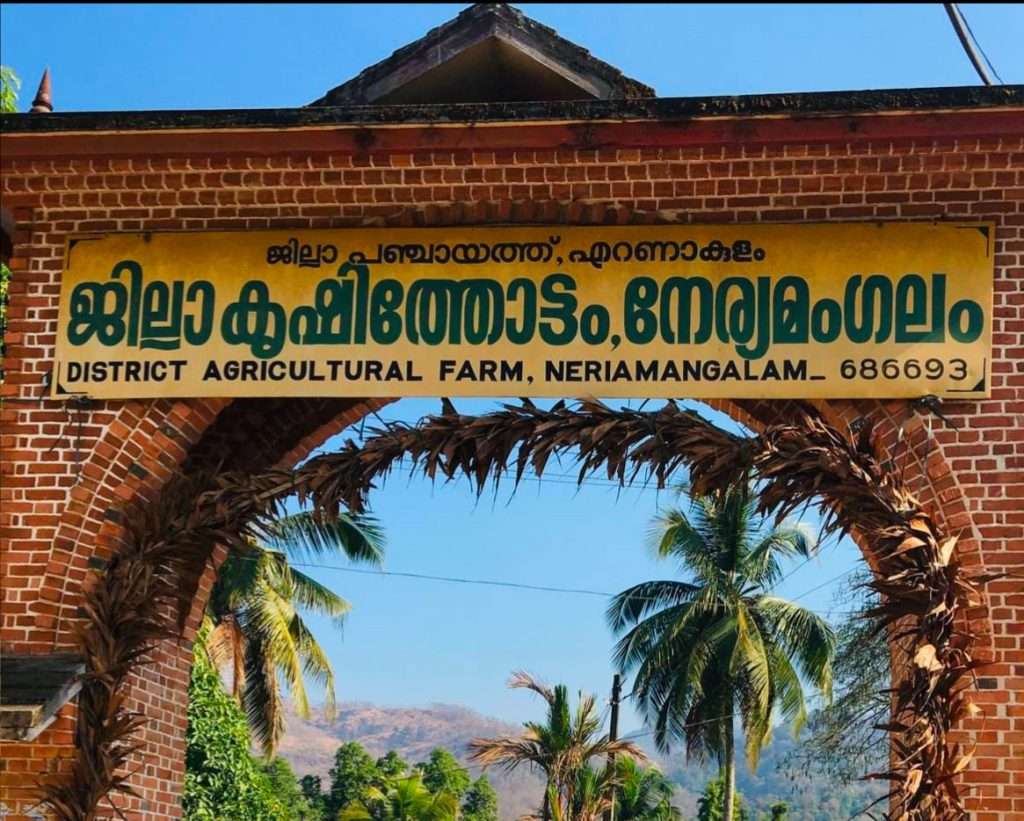
District Agricultural Farm Neriamangalam (DAFN)
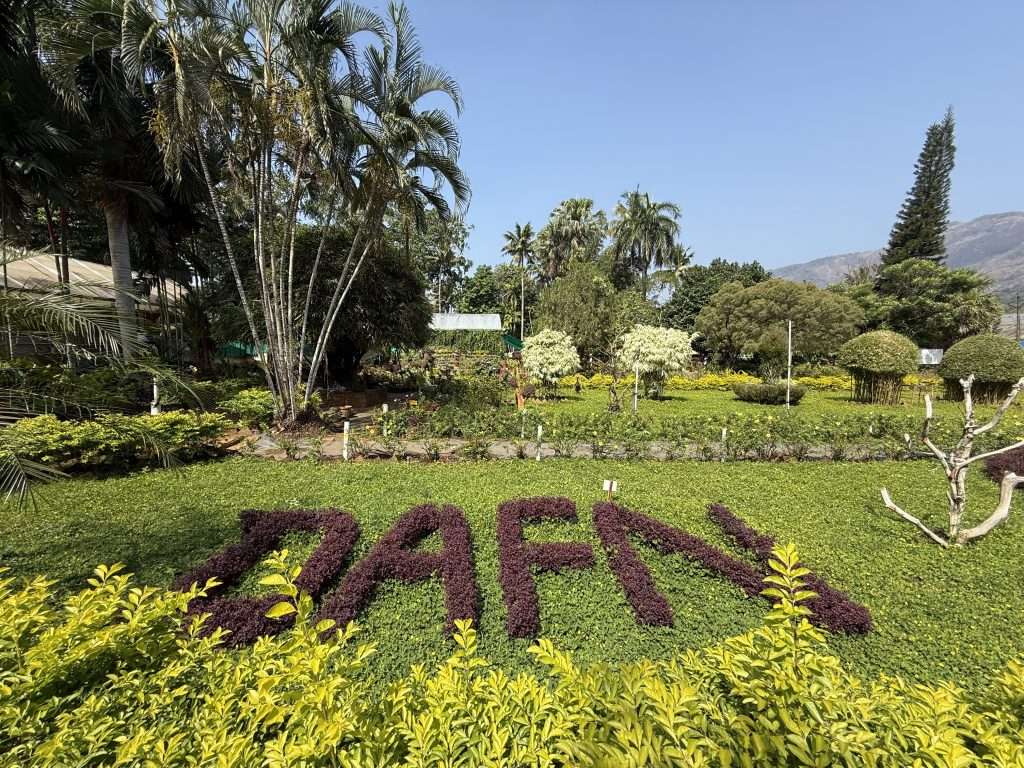
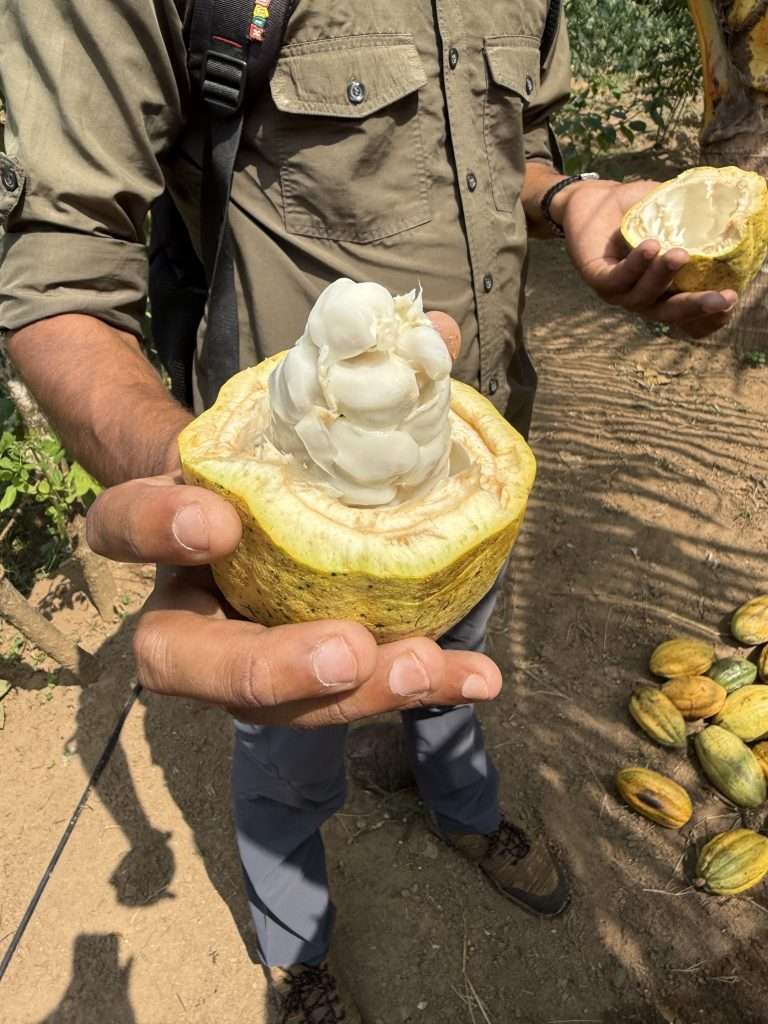
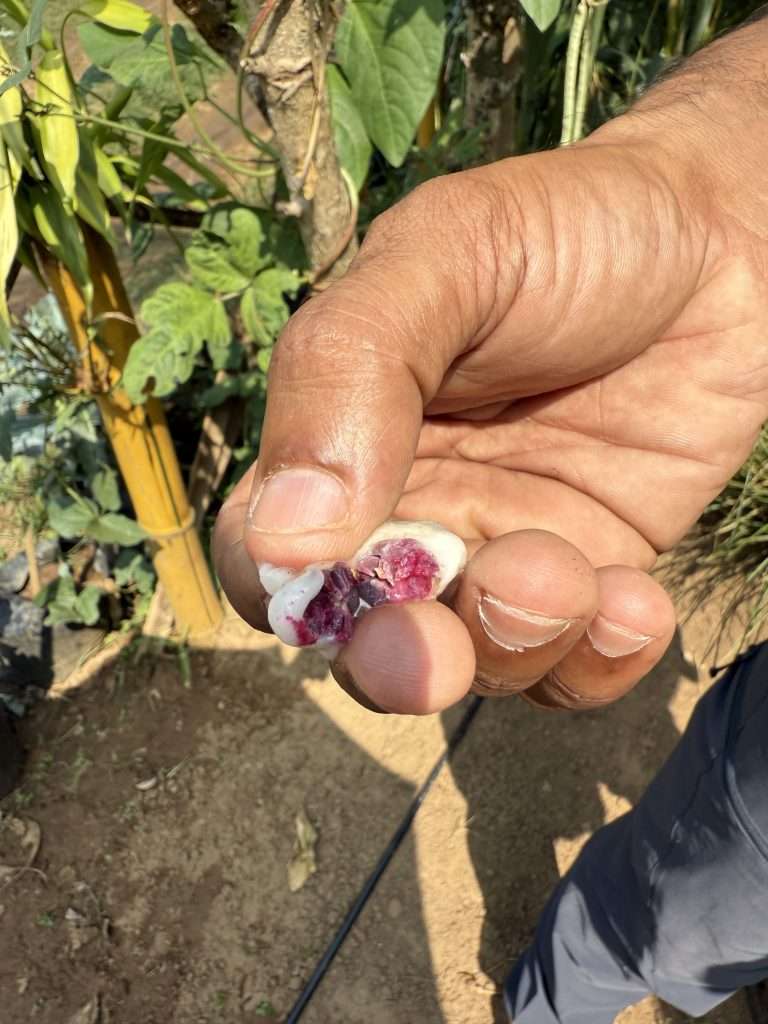
Kochi’s Agriculture Department has converted one of its farms at Neriamangalam into a farm tourism destination. The plan is to generate 50% of the farm’s total income from tourism. When it was opened, the stated aim was: “to transform agriculture into a source of joy, health and income.” DAFN specialises in producing high-quality seeds and planting materials, supporting agricultural needs. Our local guide took us on a two hour tour of the farm/gardens and we were given several demonstrations of the budding, grafting and layering processes by the very enthusiastic and friendly staff there.
Wish I Had Packed - an Umbrella
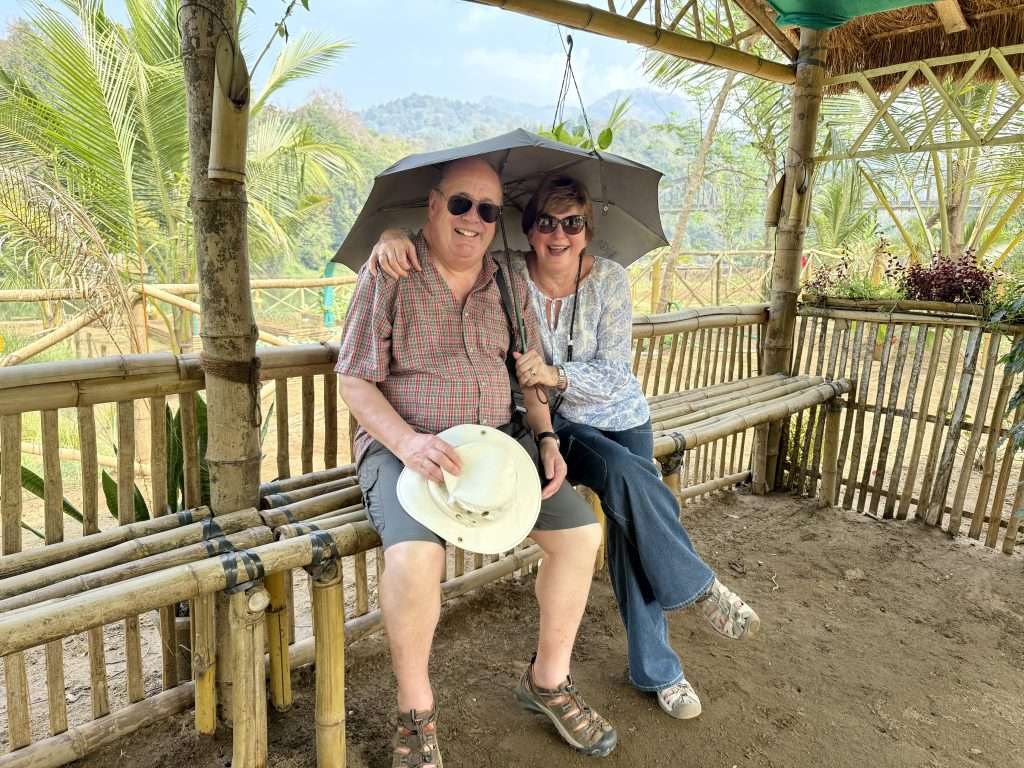
I was very grateful for the loan of one on a hot day – my hat was nowhere near big enough to protect me from the power of the sun’s rays. Umbrellas are an essential piece of kit carried by many people here to protect them from the sun – and no doubt also pretty handy in the Monsoon season. There are two monsoon seasons in Kerala: the Southwest from June to September and the Northeast from October to November, so it is best to avoid those times for your trip – unless rain is what you are looking for of course. Interestingly, many visitors from the Arabian deserts choose to visit Kerala during the monsoon season.
It’s High Time for a Cuppa - 2 Days in Munnar
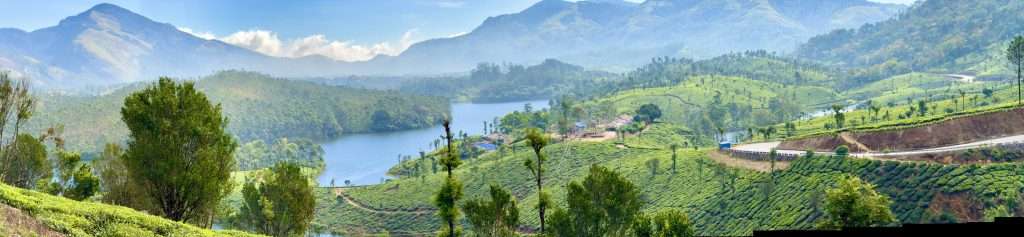
Today, we moved up into the welcome cooler temperatures of the Uplands and the hill stations of Munnar – prettily clothed in neat geometric blocks of acre upon acre of bright green tea plantations.
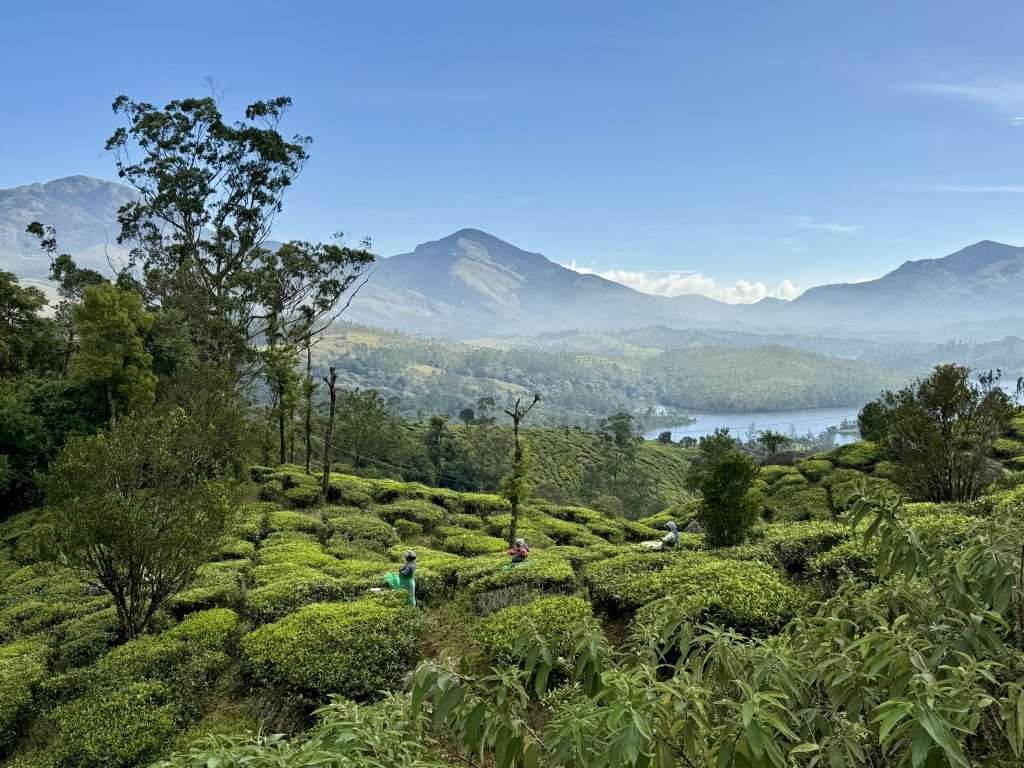
The tea industry in India began with 42,000 seedlings germinated from a consignment of 80,000 seeds procured from China. 2000 were planted in the hill districts of South India, and 20,000 each in the hill districts in Kumaon in North India and Upper Assam on the Northeast frontier. These days, the Chinese strain is used to produce Darjeeling tea and the remainder of the tea in India is the indigenous Assam tea.
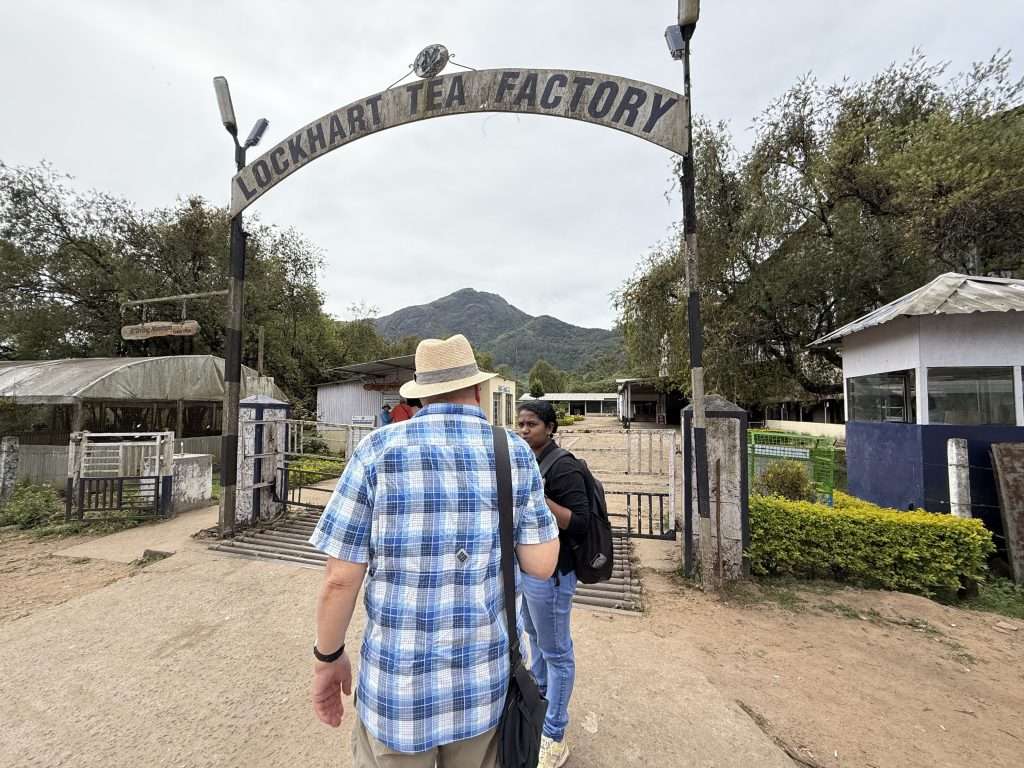
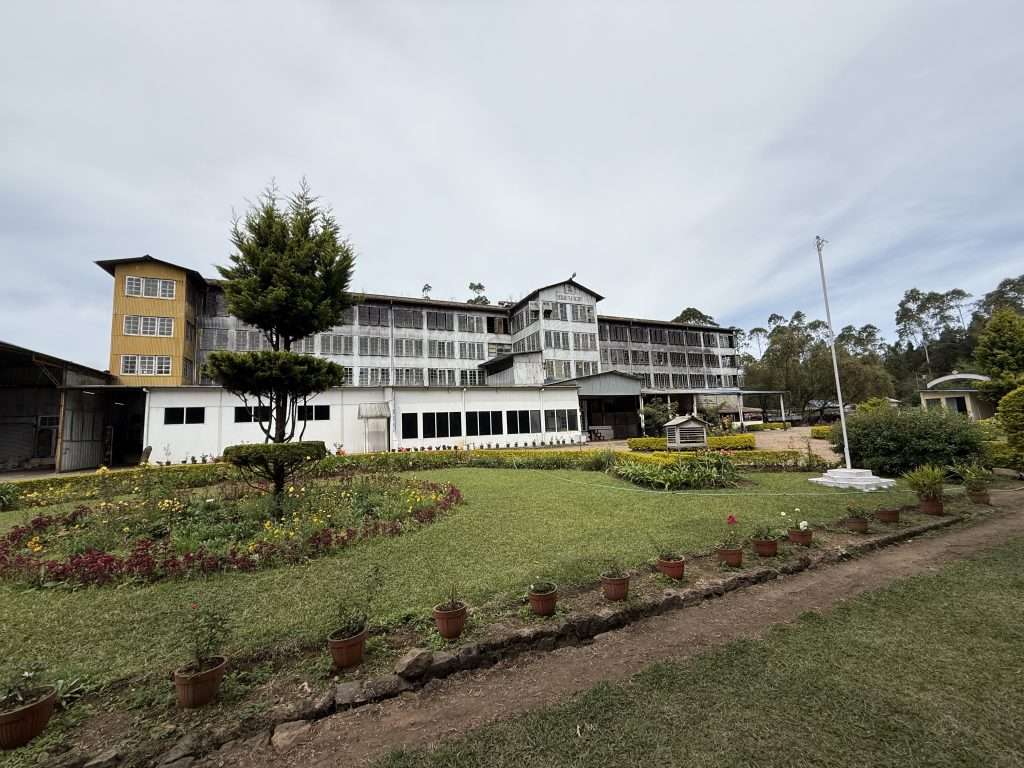
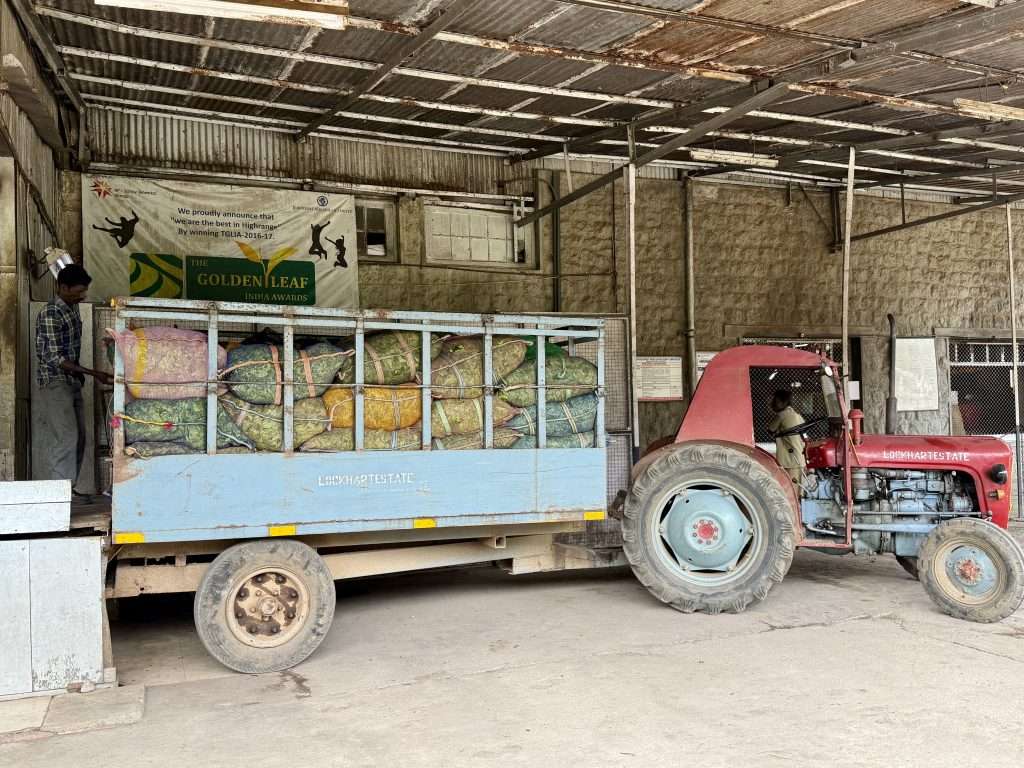
A visit to the Lockhart Tea Factory is like taking a step back in time. It is one of the original tea factories dating back to 1879 and operates as a live museum still making tea today in just the same way as it was done all those years ago. It was first established by the British East India Company and then by Harrisons Malayalam Limited.
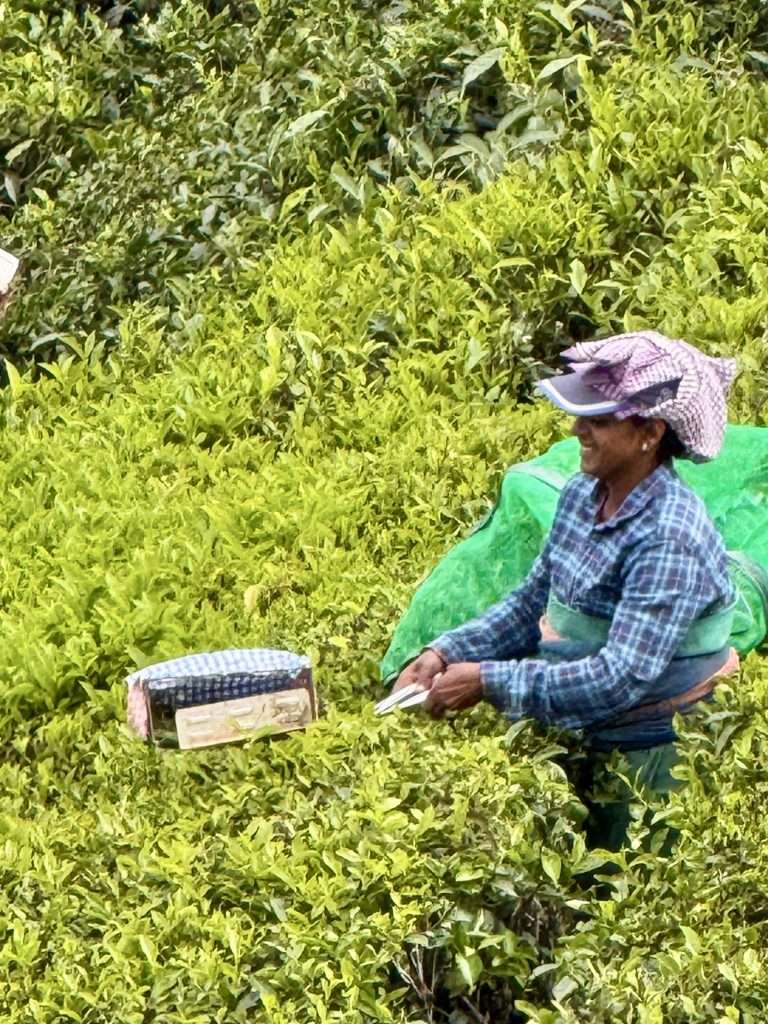
Producing tea is a highly labour intensive process. Fine-leaf tea is hand plucked. The majority of the workforce (circa 80%) are women because their fingers tend to be more nimble than men’s. Hand shears are used on mountain slopes and in other areas where tractor-mounted machines cannot go. A skilled worker using hand shears can harvest between 60 to 100 kg of tea per day, whereas machines cut between 1,000 and 2,000 kg.
Machine cut tea usually goes into low grade tea for making into teabags. The tea “fluff” and waste from processing is used to produce caffeine for soft drinks and medicine. It certainly made me appreciate the huge amount of effort that goes into making my daily cup of tea. I resolved to drink tea more mindfully in future – appreciating the hard work involved with gratitude rather than taking it for granted.
Mechanisation began to be introduced gradually as the CTC (Crush, Tear, Curl) method was introduced. This is much faster than traditional methods, but produces tea with a reduced aroma. Automation is developing all the time. I saw a sign advertising the opening of Kerala’s first fully automated green tea factory as we drove away from the hill station.
I wonder what work all the tea plantation workers will find to do if all the other factories follow suit? Just as the laundry workers in Kochi dream of a brighter future for their children, the tea workers will also want to find work that is better paid and less arduous. It is really all a question of determining what exactly that will be? The tea export market has been declining in recent years and many of the tea bushes are over 50 years old – some are more than 100 years old. They will not last forever – I wonder who will take responsibility for replanting them?
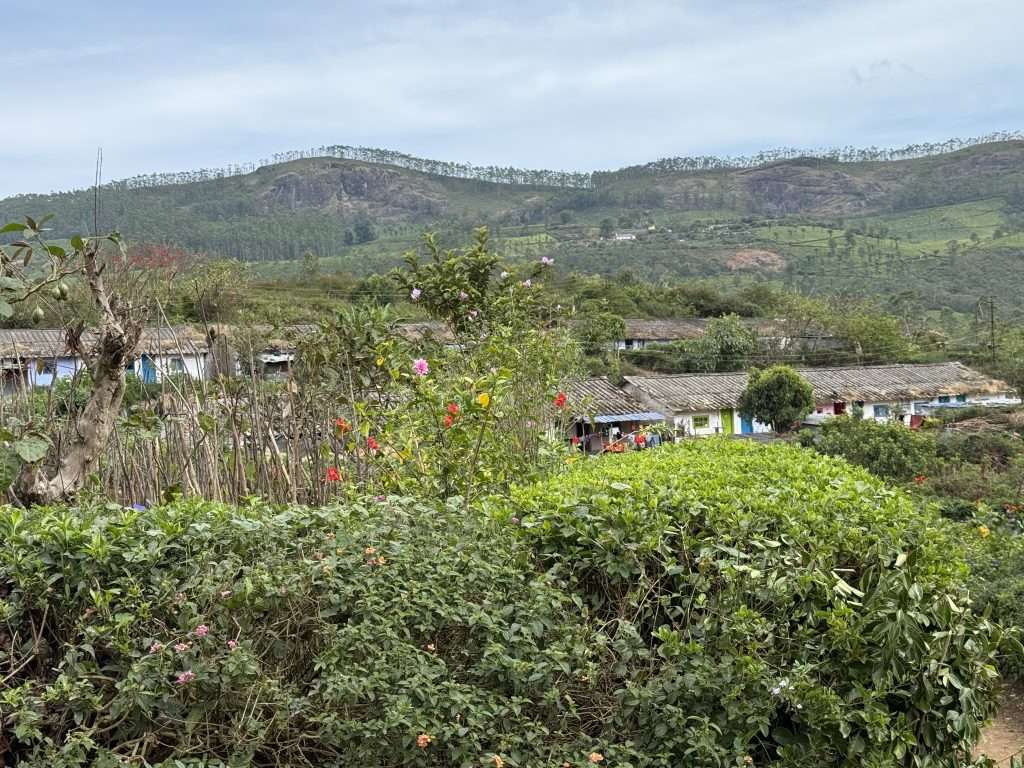
A 2 hour guided walk around the Lockhart Tea Estate will get you far enough into the plantation to see the living quarters of the tea workers. Granted, they are by no means luxurious – but they are clean and tidy and each family house has its own market garden which caters for the family’s needs. The church and temple stand high above the worker’s village and – along with the canteen built between them – form the fulcrum of village life.
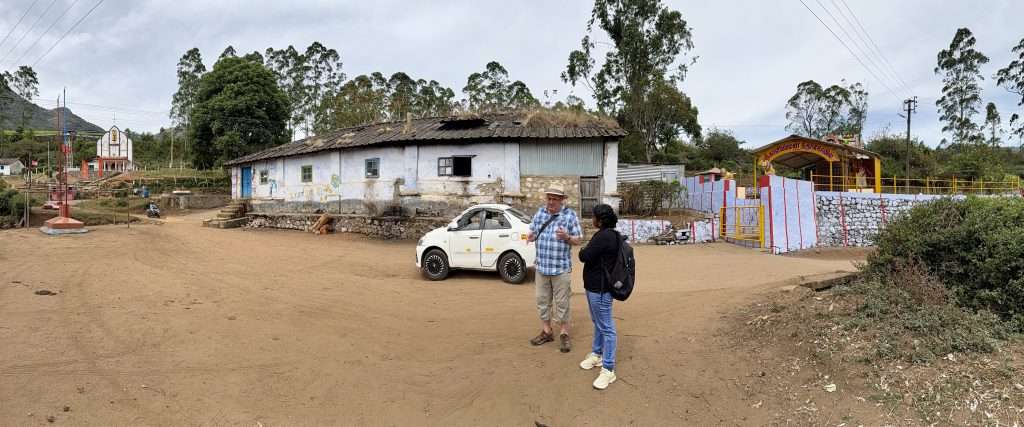
Although wages are low, workers seem to be well looked after with education, recreation and health facilities all available on site. From what I could see, health and safety also gets high priority. What I also noticed was the smiles on people’s faces and the laughter of children playing in the little market gardens growing around each of the houses. This seemed to be a happy and contented community – and they were pleased to give us a friendly wave and return our smiles too.
It’s Tea Time - What’s in Your Cuppa?
The factory visit also included a tea tasting experience, so now I understand the real difference between the variety of teas I have sampled over the years.
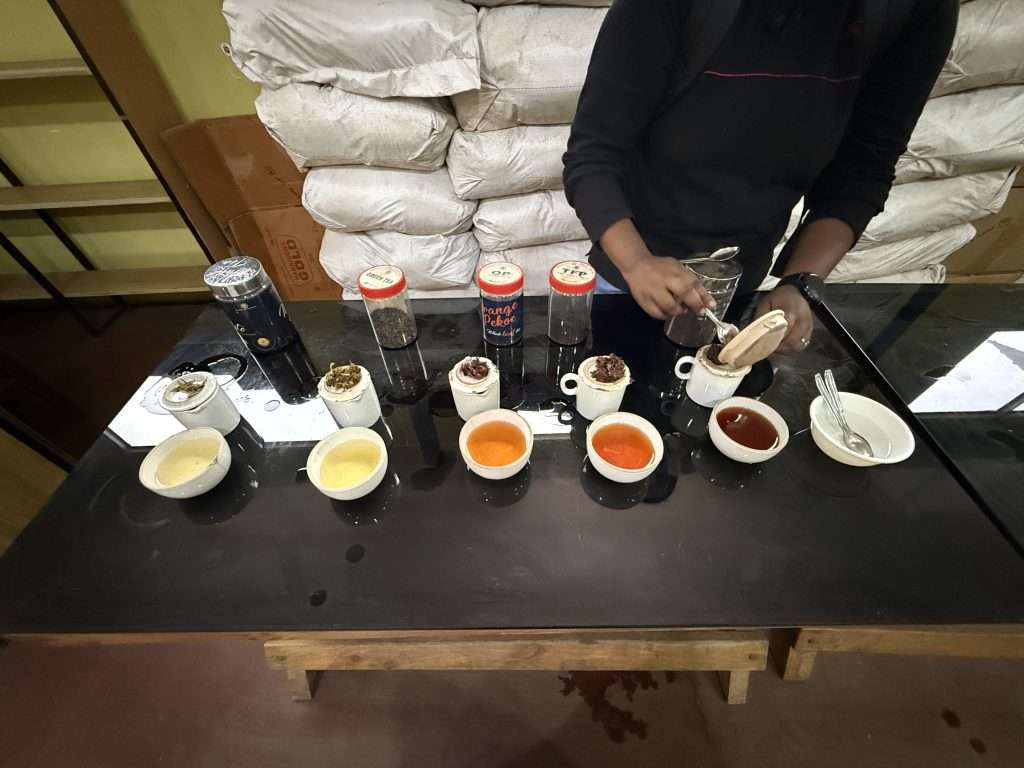
First up on the tasting experience was white tea. This is NOT tea with milk! White tea is made from the youngest leaves and buds of the tea plant and is delicately flavoured with a subtle scent. Next in line was Green Tea – made from the unfermented leaves of the tea plant and known for its flavour and health benefits. Next came a tea I had never heard of before – Orange Peko Tea, which is a medium grade of black tea which makes a distinctly orange shaded cuppa. Black tea is fully oxidised – the tea leaves have been exposed to oxygen and moisture turning them a dark brown colour and giving your cuppa a strong, rich flavour and a full body. Tea bags are usually made from fine black tea leaves and tea dust.
The British Raj - should we be Proud or Ashamed?
There are always two sides to every argument and the debate about whether Britain should be proud or ashamed of the period of the British Raj in India (1858 – 1947) is no exception. Starting by looking at the positives is always the way to go in life?
For starters, the British brought tea to India. In the Tata Tea Museum in Munnar, there is a fascinating film show giving all the history of tea production in India. When the British arrived, they were struck with the tremendous beauty of the hilly Munnar region. Exploring the area on horseback and making friends with locals along the way, they were also impressed with their knowledge of the wildlife and climate.
It must have taken some guts to decide to work with the local people to clear the forest, plough the land and plant so many tea bushes there. A big investment in plants and machinery, a huge risk and years of hard work would be required before a profit could even be dreamed of let alone actually generated. The British saw the opportunity, acquired the land by peaceful negotiation and set about recruiting workers to cultivate it from the neighbouring Tamil Nadu state as there was no one really living up in the Munnar hillsides at the time. The tea estates were developed with a careful respect for nature and the chequerboard green hills look really beautiful today. It is a commercial business, but one that has not ruined the environment that supports it.
Life was not easy for anyone in the early days of the hill plantations. The need for good housing with gardens, sanitation, education, healthcare and welfare was gradually understood and great efforts were made to be a good employer. You can’t take away the fact that the work was unskilled, manual labour and attracted a correspondingly low wage, but the history of developing the tea plantations seemed to me to be nothing like the exploitation of Africans during the slave trade or the violence with which the Wild West was won.
The tea plantations are now in Indian hands. Tata Tea was one of the biggest employers, but in 2005 transferred its factories over to the Kanan Devan Hills Plantations Company Private Limited (KDHP) – the first tea company mostly owned by its workers. India is currently the 4th largest tea exporter (behind China, Kenya and Sri Lanka). Indians love their tea just as much as the British do and 70% of production is consumed within India. Now that’s what I would call a good legacy?
Much of Kerala’s infrastructure – roads, canals and railways – was British built too. The Neriamangalam Arch Bridge, providing a vital trading route for tea and spices is a fine example of that. The British also brought schools and healthcare to India. So, there is an awful lot to be positive about.
On the flip side, it wasn’t all a plain sailing good news story though – what in life ever is? Conflict, violence and atrocities were sadly a grim part of the story too. The film The Viceroy’s House tells the tale of the growing discontent leading up to independence and the painful decisions surrounding partitioning India and Pakistan.
Maybe the way to answer the question is to ask what India would be like today if the period of British rule had never happened? Who knows, but my own view is that it would have been considerably poorer than it is today. It isn’t just my view either. As we travelled through Kerala, at the end of each visit, I asked every guide and hotel owner/manager we spent any significant time with during our travels to tell me honestly whether the British Raj was something we should be proud or ashamed of. Without exception, they all agreed that India was better off as a result of the period of British rule. Maybe that is why there is such a strong bond between our two countries – and why everyone is always so friendly to us here?
Shristi Welfare Centre
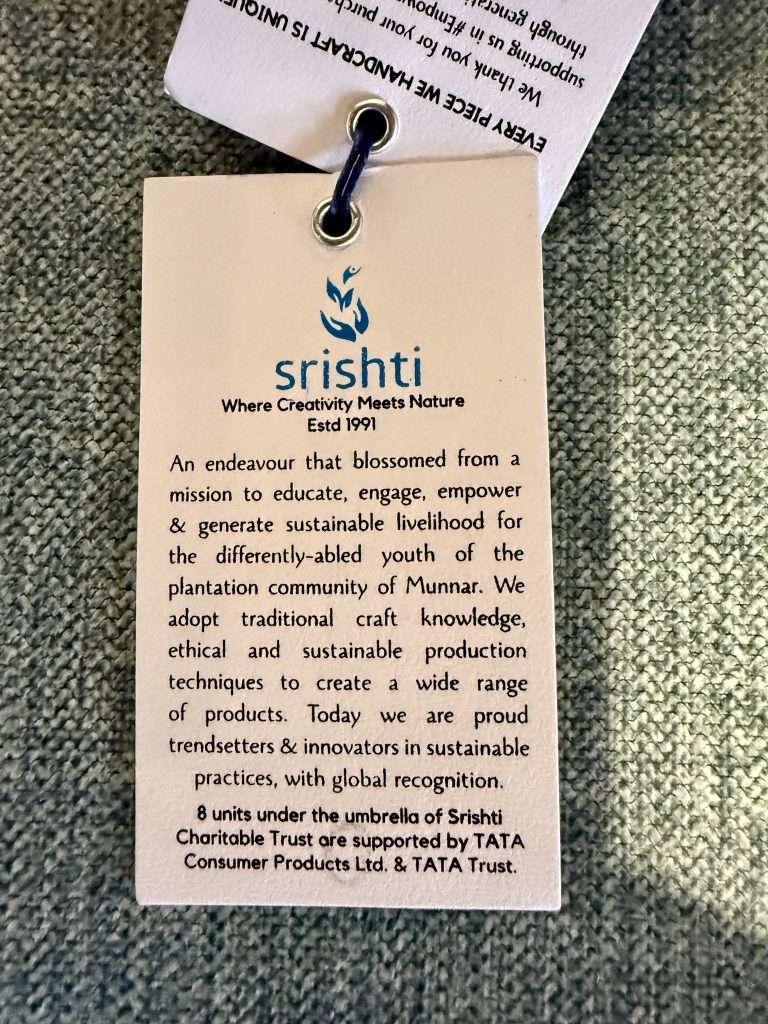
The tea plantation workforce is 80% female and their welfare is taken seriously. In the past, there were higher rates of differently abled children born to the female tea workers. Maybe this was because they had to carry heavy weights late in pregnancy? Maybe too because there tends to be a high level of inter breeding between the plantation workers?
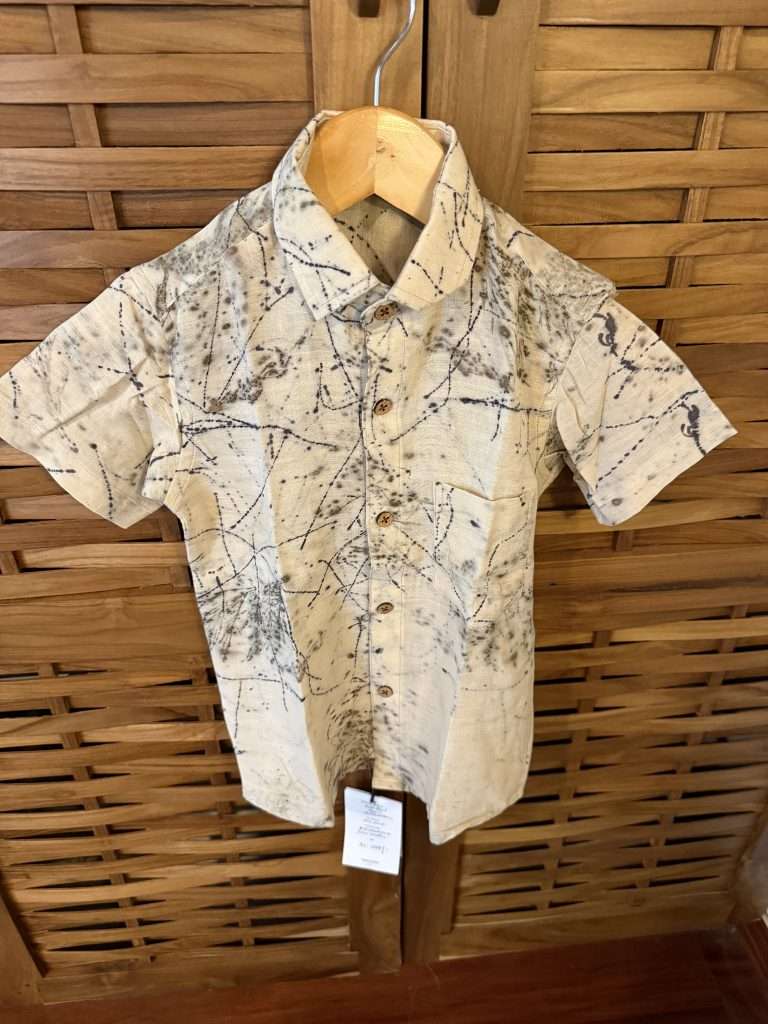
Whatever the cause, Tata Tea have done their best to reverse the stastics and have set up the Shristi Welfare Centre – an initiative which provides jobs and education to differently abled children and adults in the Munnar area. They produce various handicrafts and clothing using natural dyes harvested from the lush forests of Munnar. It is well worth a visit – they have a lovely range of Indian pashminas, hand dyed clothes and handmade paper products. You also get a close up view of the eco dyeing and paper making processes in action. They have secured a good contract to make Starbucks bags too!
Souvenirs I am Glad I Bought
A cute tie dye shirt for my little grandson and a present for my sister which shall remain a secret until her big birthday later this year.
Kerala’s Spice Capital - 3 Days in Thekkady
This morning, we made the long and winding 4 hour drive from Munnar to Thekkady – Kerala’s Spice Capital. The journey through the Western Ghat mountains was very scenic with photo opportunities opening up around every bend. Thekkady is around 1,000 meters above sea level and is rich in spices – 95% of pepper in India is produced from here. Our driver told us that 13 years ago, Thekkady had just 2 hotels and a few shops. These days there are many more hotels to suit all budgets and countless shops. Surely there is NOTHING you couldn’t buy in Thekkady?
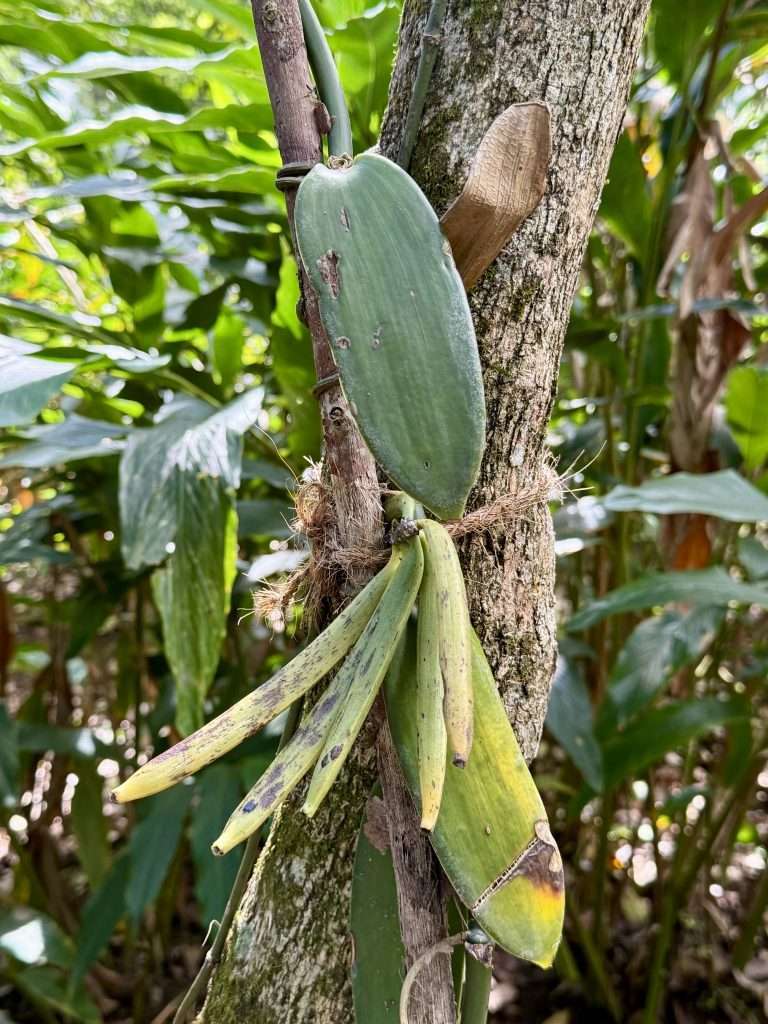
On arrival in Thekkady, we took a walking tour of the Green Park Spice Plantation whilst we waited for our room to be made up. As with all the tours on the trip, it was a private tour with an English speaking guide – not a group tour. It is such a lovely way to see the sights and something India provides at far more reasonable rates than any of the other countries I have visited which gives it a big thumbs up from me. Long may it last!
10 Fascinating Facts About Spices - Take the Quiz
I thought I knew quite a lot about spices before I came to India – but I found there was so much more to learn, which is always part of the joy of travelling for me. So how much do you know about spices? Here’s a quick 10 question quiz to test your knowledge. Find all the answers on the link below.
10 Facts about Spices
- What is the most expensive spice in the world?
- Who discovered how to hand pollinate a vanilla flower?
- How many types of peppercorn are there?
- Which spice was used to make Wrigley’s chewing gum because of its minty taste?
- What plant does mace come from?
- What spice is good for relieving tooth ache?
- Why did Cadbury’s choose the colour purple for their logo colour?
- How many spices are combined to make allspice?
- Which spice is good for curing insomnia?
- Which spice is good for alleviating all sorts of stomach sickness?
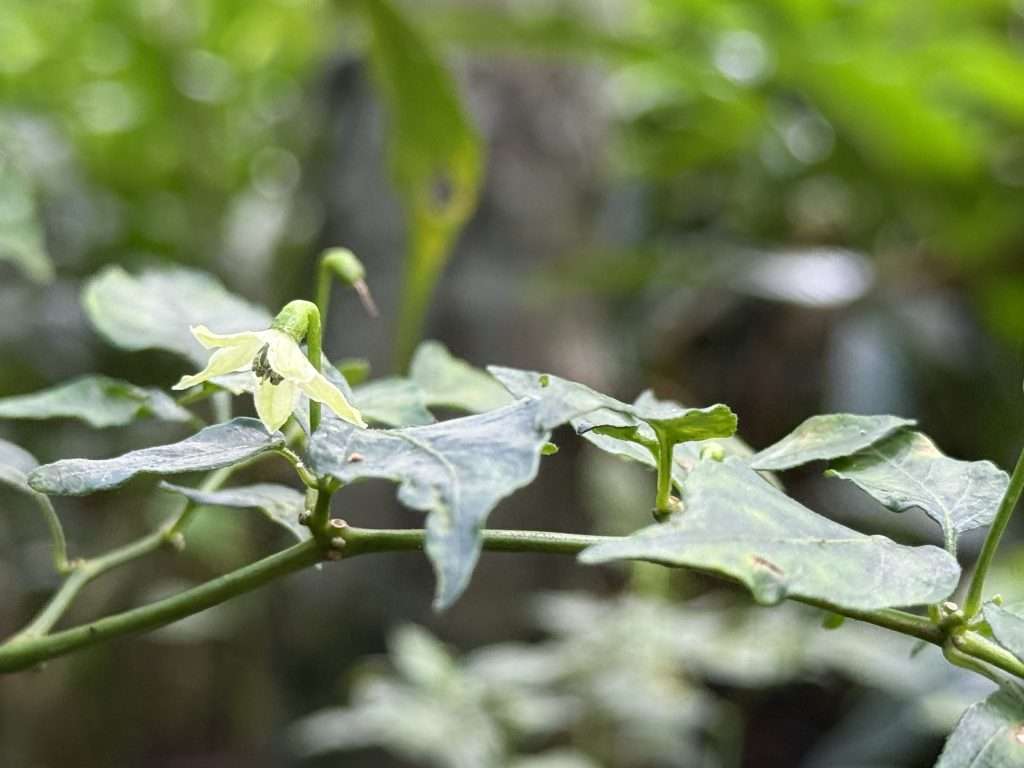
Well – how many did you get right?
Ayurvedic Massage - A Full Body Experience
Since our arrival in India, I had been intrigued by the ayurvedic treatments that are on offer here and this afternoon, it was finally time to try one out. On the recommendation of our driver, we both booked a full body massage at the Pranamaya Ayurvedic Hospital in Kumily, a short walk from our hotel. Overall, it was a very enjoyable experience – and quite unlike any massage I have ever experienced in Britain!
Ayurveda comes from the Sanskrit “Ayurveda”, meaning life and “veda” which means knowledge or science. Ayurveda doctors are university trained and aim to restore the balance between the three dosas offer, fire and water/earth to avoid health problems. Treatments are either herbal massages or purification/cleansing. The purification/cleansing treatments – or panchakarma – can be intense and are usually reserved for more serious medical conditions. You can ask for a consultation with an Ayurvedic doctor to determine which treatments might benefit you most.
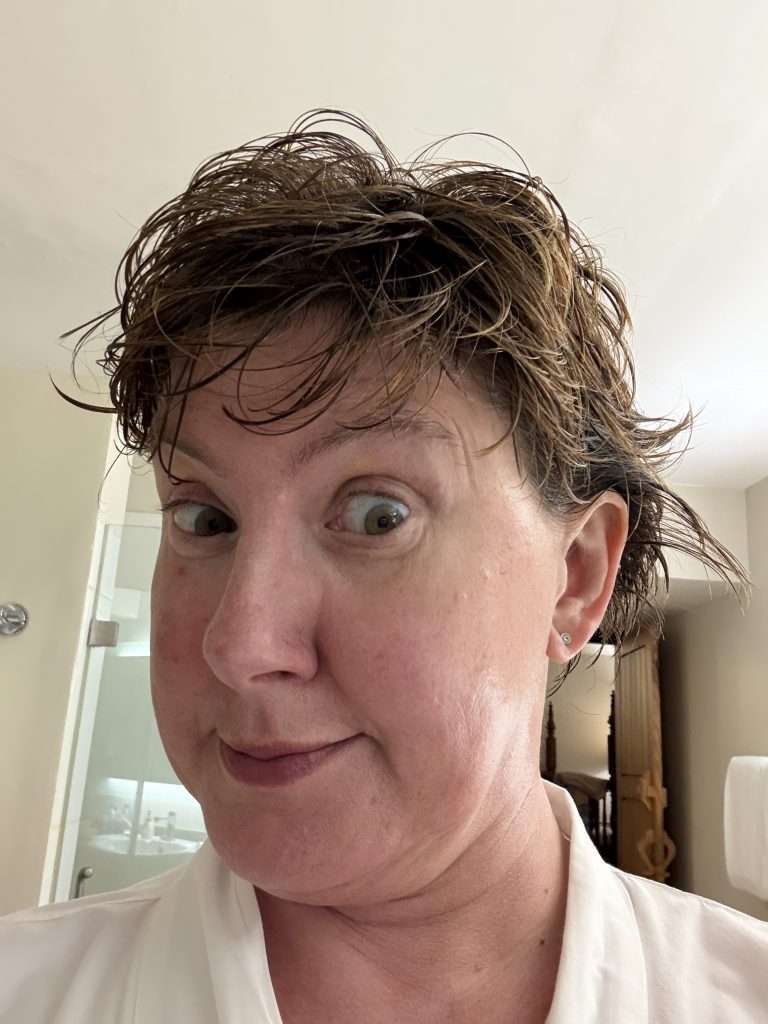
For a start, you are naked – not tucked under a sheet as I have experienced before. Secondly – full body means just that – back and front and a good going over of your head and hair with the essential herbal oils. The pressure was very firm – I could have asked for something more gentle I suppose, but I was keen to get the full on experience. As well as hands, a bound cloth ball soaked in the essential oils is used for the massage which certainly adds some oomph to the process.
At times, it was quite painful – but I think in a healing, therapeutic way. I have never had a tummy button massage before either. At one point, I thought the inside of my nostrils might get a look in, but my masseuse stopped short of that. A few hearty slaps on various body parts later and the hour of adventure was over. My skin felt tingly, my few aches and pains from the long journey had vanished and overall, I felt pretty good. The experience cost me 37,000 rupees (around £37) which was about half the price our hotel was charging, so that put me in a jolly good mood too!
Periyar Tiger Reserve
Periyar National Park and Wildlife Sanctuary covers 925 sq km and was established in 1982. Tourism is restricted to the relatively small area of 44 sq kms on the periphery of the Reserve – the core is free from human settlements. Most tours begin with a short bus ride to the Reserve from the ticket office in Kumily as no vehicles other than the Park bus are allowed inside. It usually requires an early start – we were ready to make the short walk from our hotel to the Park ticket office in town a 7am. The bus drops passengers off at Periyar Lake – a pretty man made lake surrounded by lush forest and guava trees. Many people take boat trips on the Lake, but the boats are busy – crammed full of visitors and it didn’t look like a serene experience at all.
We chose to take a hike instead with a very knowledgeable Park Ranger guide who was from one of the indigenous tribal communities in the area. The remote tribal communities depended on fishing, poaching, and illegal wood-cutting in order to eke out a living. The development of the National Park required working with the local communities to develop innovative and alternative livelihoods aimed at ultimately displacing the illegal activities.
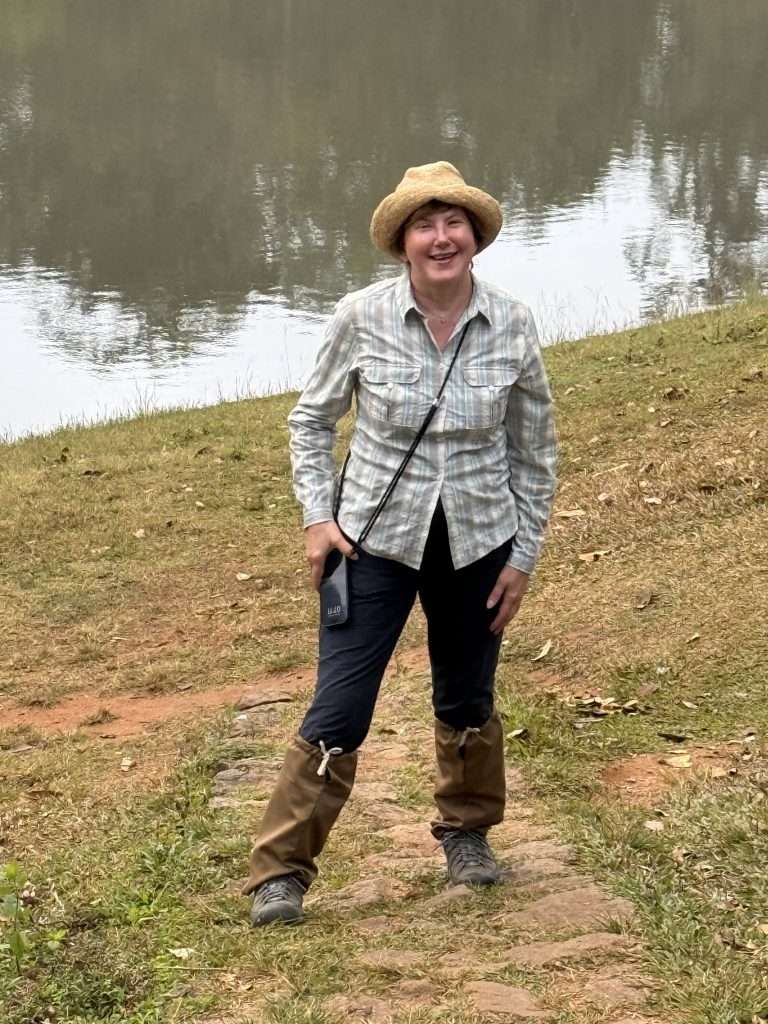
Once equipped with leech protectors – cotton bags that go over your feet and tie under your knees to protect you from leeches – a bamboo raft takes you across the lake and into the Reserve. You never know quite what you are going to see on a National Park trek and there is always quite a lot of luck involved. On our 2 hour trek, we spotted kingfishers, woodpeckers, laughing birds, a wild boar, Nilgiri langur long tailed black monkeys and – amazingly – a big herd of bison plodding through the Park barely 300 metres away. These are HUGE animals and 300 metres was quite close enough for me!
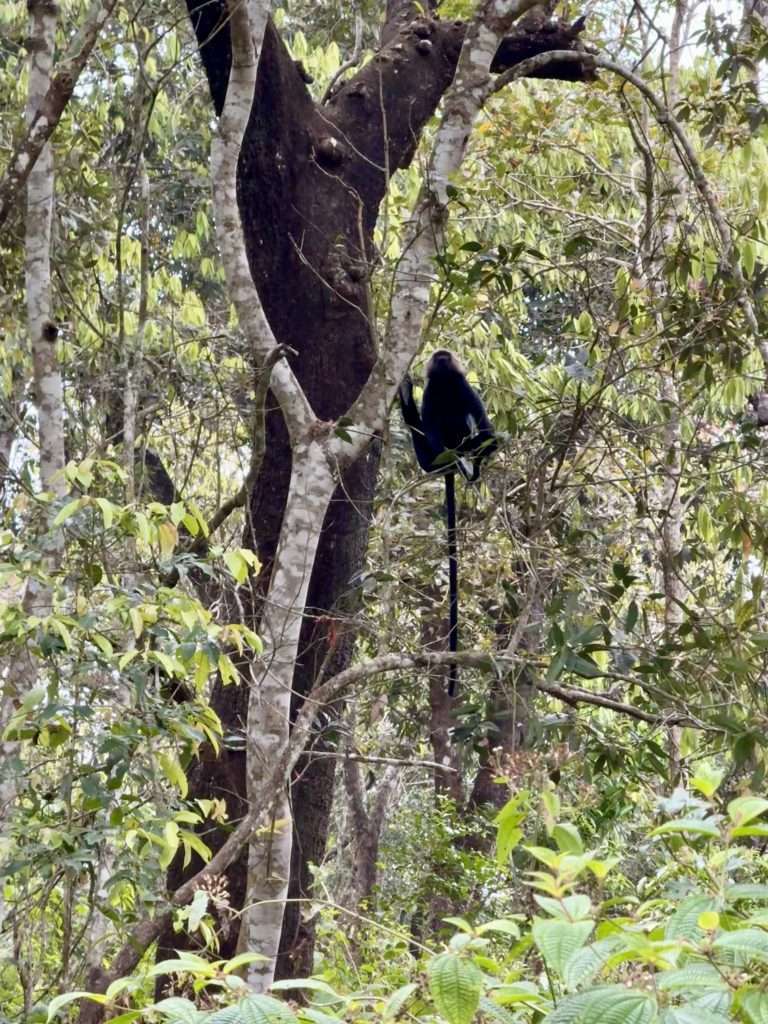
I was very grateful to have a knowledgeable guide with us because even though we were quite close, I hadn’t actually spotted them until he pointed them out to us. He was keeping a good look out for snakes too – there are some very venomous ones here that I did not want to meet! Other visitors saw elephants – albeit from a long distance away. No-one saw a tiger, which is not unusual, although there are apparently around 40 in the Park.
Kadathanadan Kalari Centre - “I Jumped Through a Burning Ring of Fire”
In the evening, we had tickets for an hour’s performance of a Kerala’s own martial art – Kalari given by the Kadathanadan family who have a centre in Thekkady.
Kalaripayattu (Kalari) is a martial art with a long legacy. It is the traditional martial art form of Kerala and is regarded as the oldest and most scientific of all martial arts in the world. As early as the 12th century, Kerala’s social system made training in martial arts compulsory from the age of seven. The training was rigorous and required high levels of dexterity, nimbleness and flexibility to master the chosen weapon: e.g. sword, spear or bow and arrow.
As cannon balls and guns were introduced, Kalari declined and was actually banned under the period of British rule, but the ban was resisted by the gurukkals (gurus) who continued to train in secret. The art form enjoyed a revival in the 20th century and these days a traditional Kalari show is a popular and spectacular tourist attraction in Kerala. The long training is not just for entertaining purposes but also to teach self defence. It certainly makes our judo sport look a little tame in comparison.
We were lucky to have front row seats again for the 6 pm performance. We were treated to an hour of clashing swords of all varieties and lengths. Spectators were then invited to take part by stooping over to touch their toes and lining up beside each other to form a human obstacle for the Kalari performers to taking a running jump over to land on a big mattress. The excitement built as more and more spectators joined the line. No spoilers – I won’t tell you what the final total was, but it was a pretty impressive display of athletic prowess.
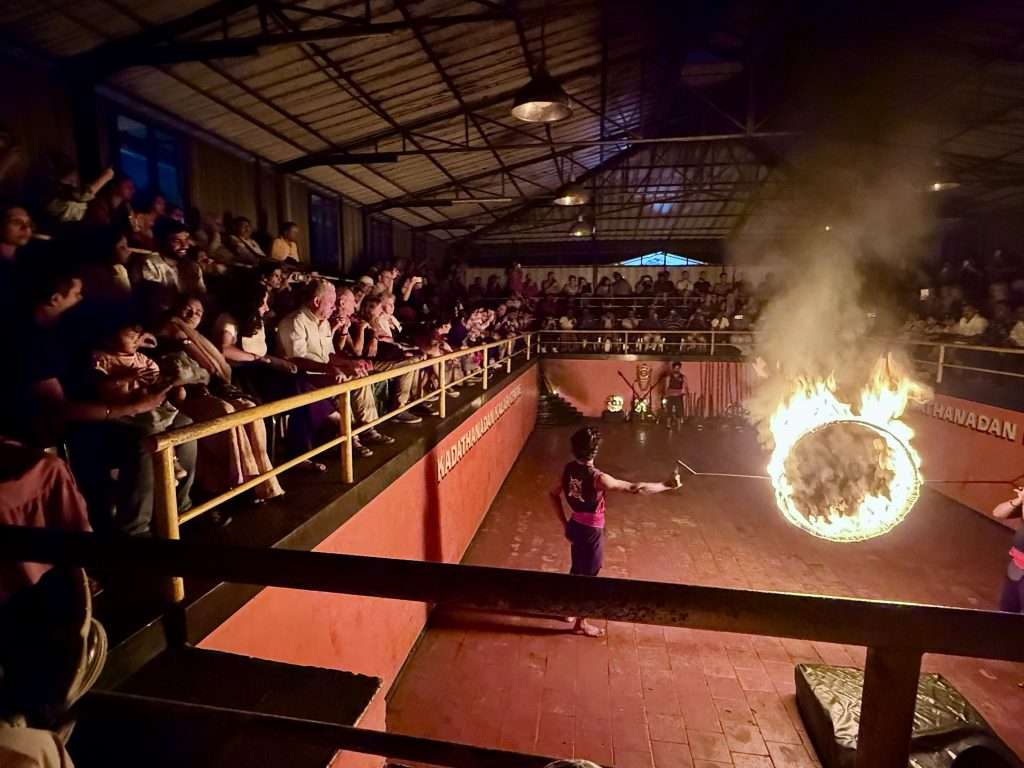
As the end of the spectacle approached, the audience was asked: “Do you want fire?” What a stupid question – of course we do – bring it on! I am sure we were in no danger, but that burning ring of fire was very close to the front row seats – close enough for me to get plenty of ash in my nostrils! It was exhilarating. For once – who cares about health and safety – let’s live a little? No spectator participation was invited this time!
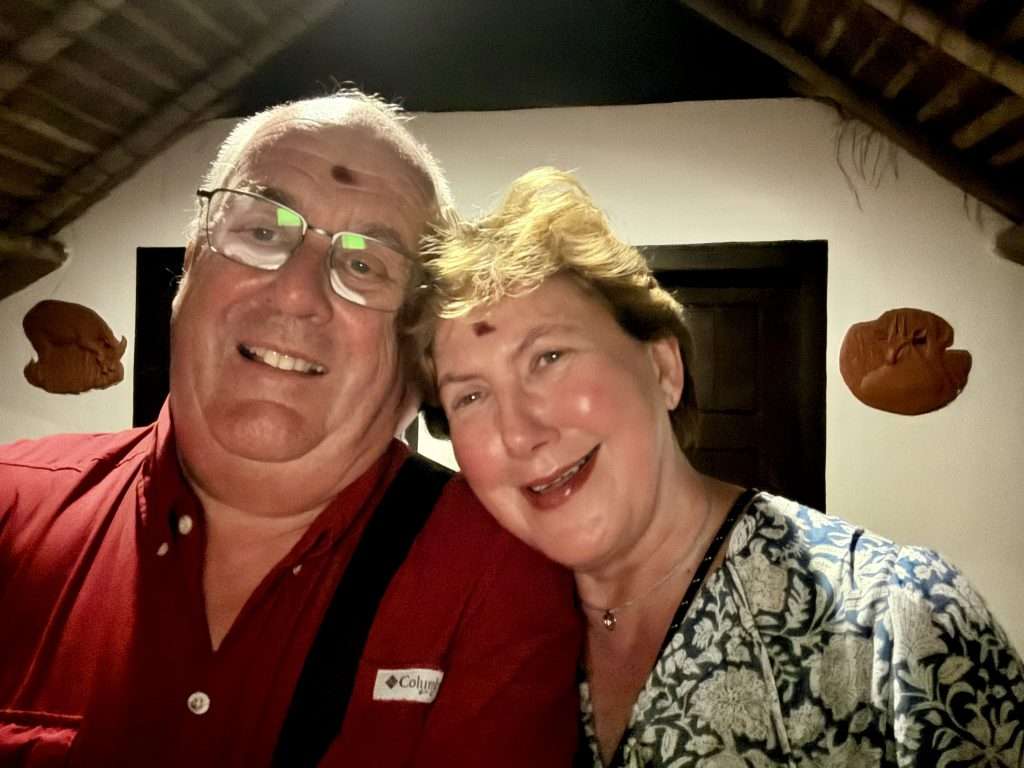
When we left a tip at the end of the performance, we were annointed with a red dot – a bindi – in the centre of our foreheads. Made with dye extracted from the turmeric plant, the markings are used in Hindu temples as part of the daily religious practice of visiting the temple and signifies a third inner eye, the eye that focuses inwards and serves as a constant reminder to keep God at the centre of one’s thoughts. So – we have now been converted. We are not coming home (well, at least until the snow has gone,)
Republic Day
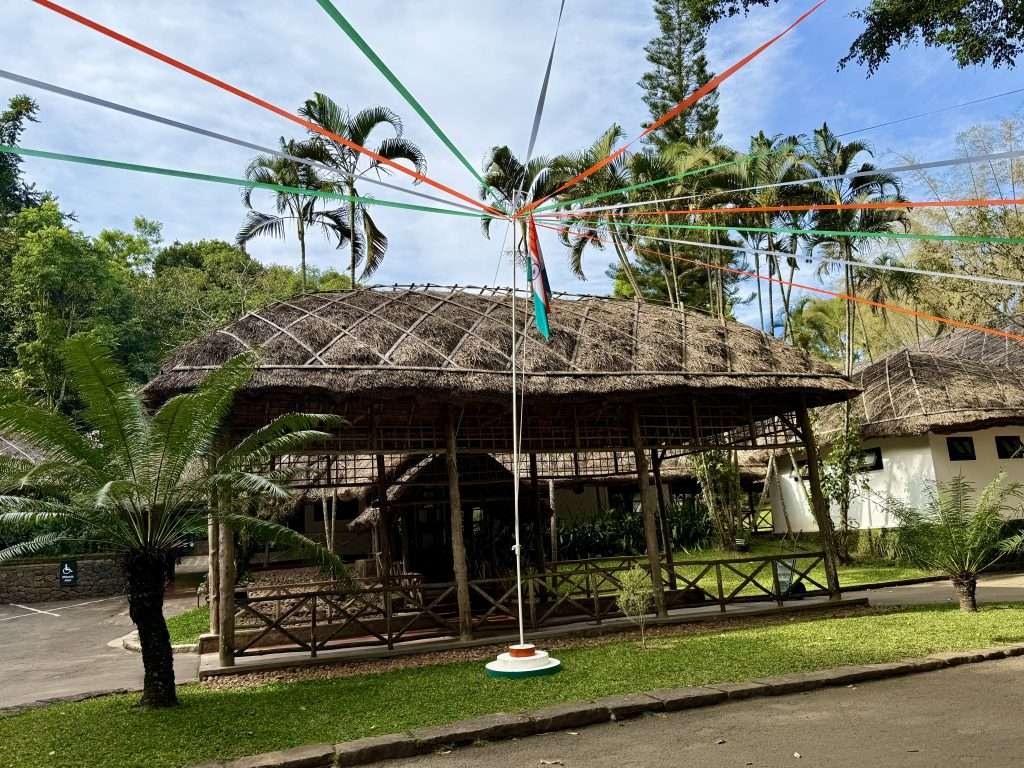
The following day was 26th January – a Sunday, on this day every year, many people throughout India celebrate Republic Day to commemorate when India’s constitution came into force on 26th January 1950 completing India’s transition to being a republic independent from the United Kingdom. Although independence happened in 1947, it took until 1950 to complete the drafting and final signature. Independence Day is also celebrated later in the year.
Indian flags are flown with pride across the country and many military parades take place. It is declared as a national holiday – national, state and local government offices, post offices and banks are shut. Shops and other businesses and organisations may well be closed or have reduced opening hours. The shops and restaurants where we were staying were all open though and it was a good opportunity to do a spot of shopping and prove my hypothesis that there is surely NOTHING you can’t buy in Thekkady?
I had 4 things on my shopping list:
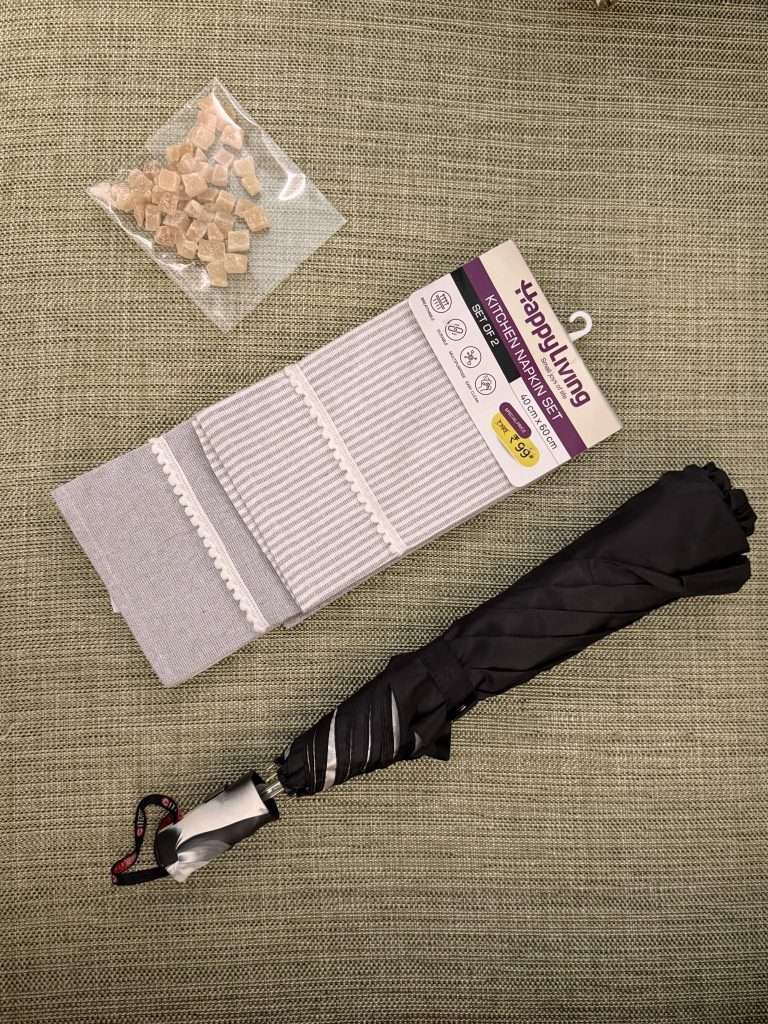
- An umbrella – for use as a sun shade after my experience at the DFN in Neriamangalam had shown me how useful they can be for that purpose.
- Crystallised ginger – now I have discovered it is a nausea remedy, I want to keep a supply in the car for the winding roads that lie ahead on the rest of our trip.
- Two tea towels – I always buy a couple of tea towels when I travel. I hate tacky souvenirs but a tea towel is one of life’s practical daily essentials and I love to remember a good trip when I pull a new pair out of the kitchen cupboard each week..
- Kingfisher beer – in preparation for our stay in the houseboat which has no alcohol licence.
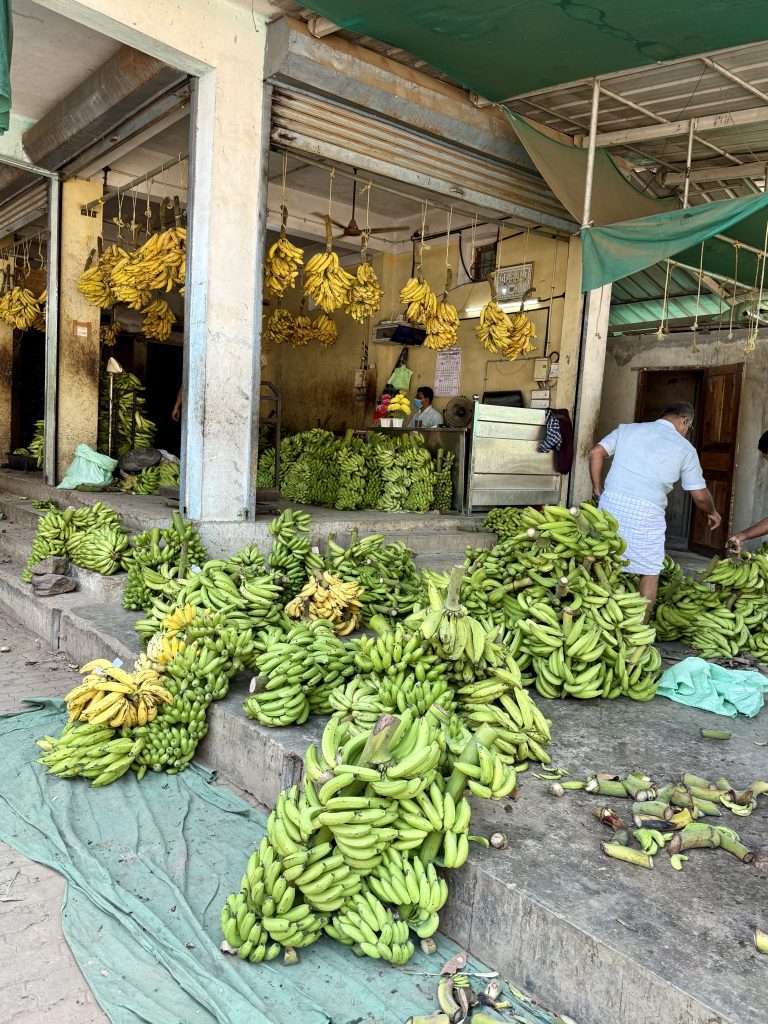
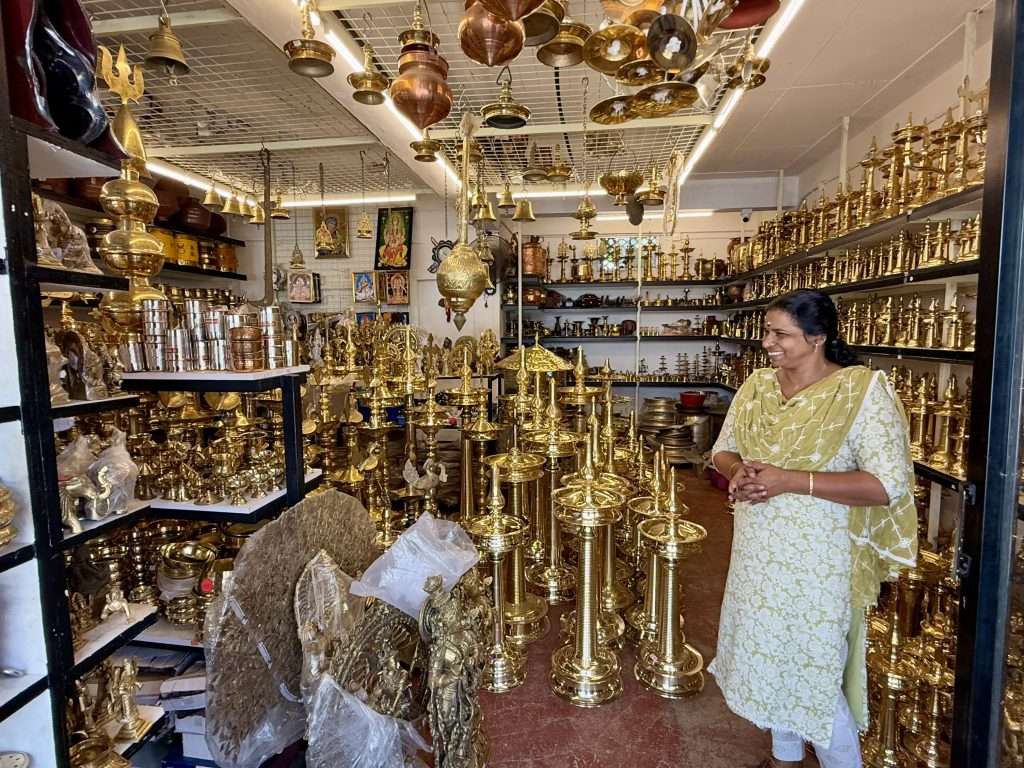
It is never quite as straightforward shopping in a foreign country as shopping at home. Here in India though, English is widely understood and often also spoken. Also, everyone is very pleased to welcome you into their little shop and help you find why you are looking for. Although many of the shops look small and a little rough around the edges compared to those we are used to in the West, they often spread out into huge areas behind the front opening. The goods may be piled high, strung up or hidden in a cupboard drawer, but if you are prepared to pop in and have a chat about what you are looking for, you are pretty sure to find it – or be directed to a neighbouring shop who can help.
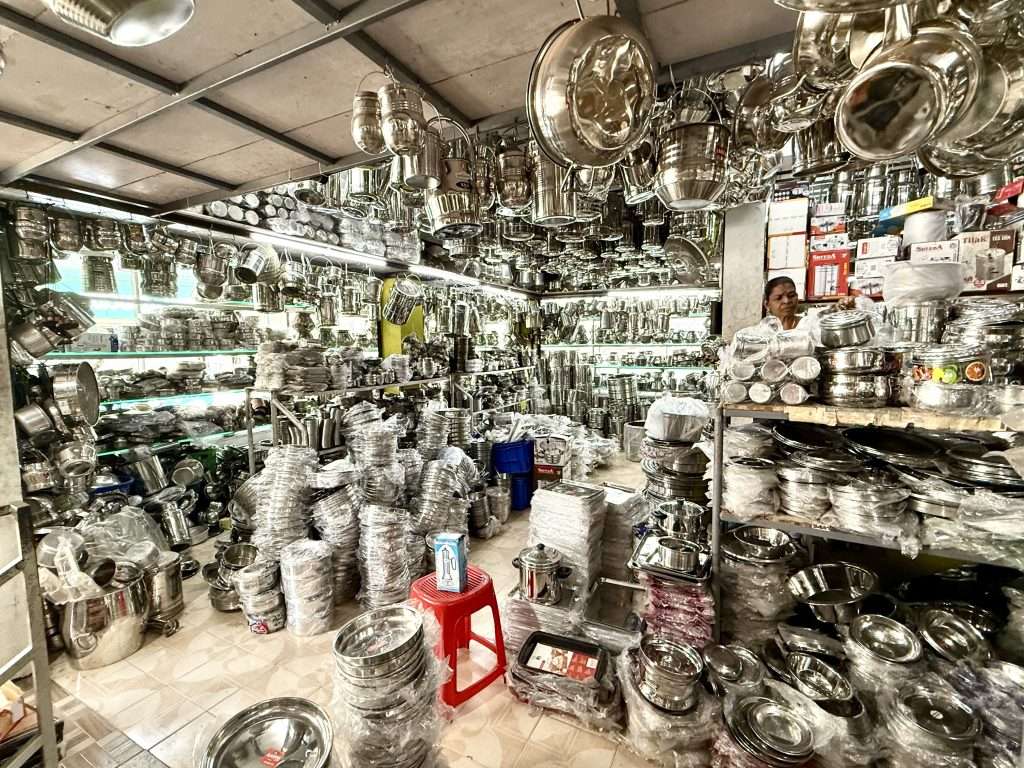
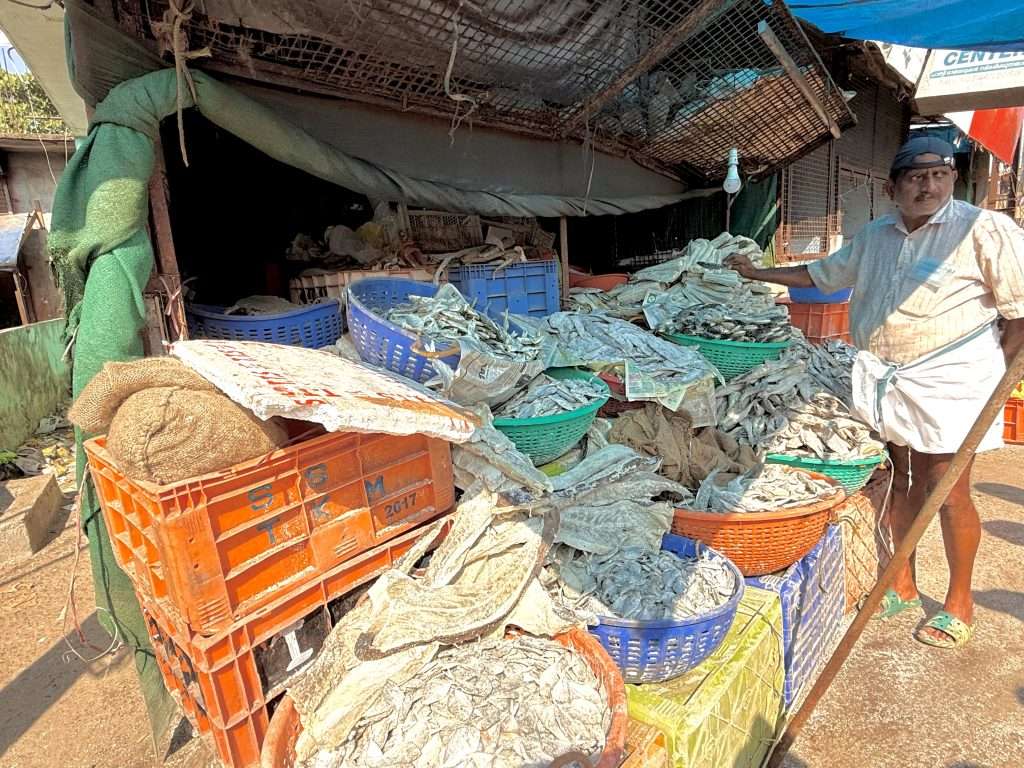
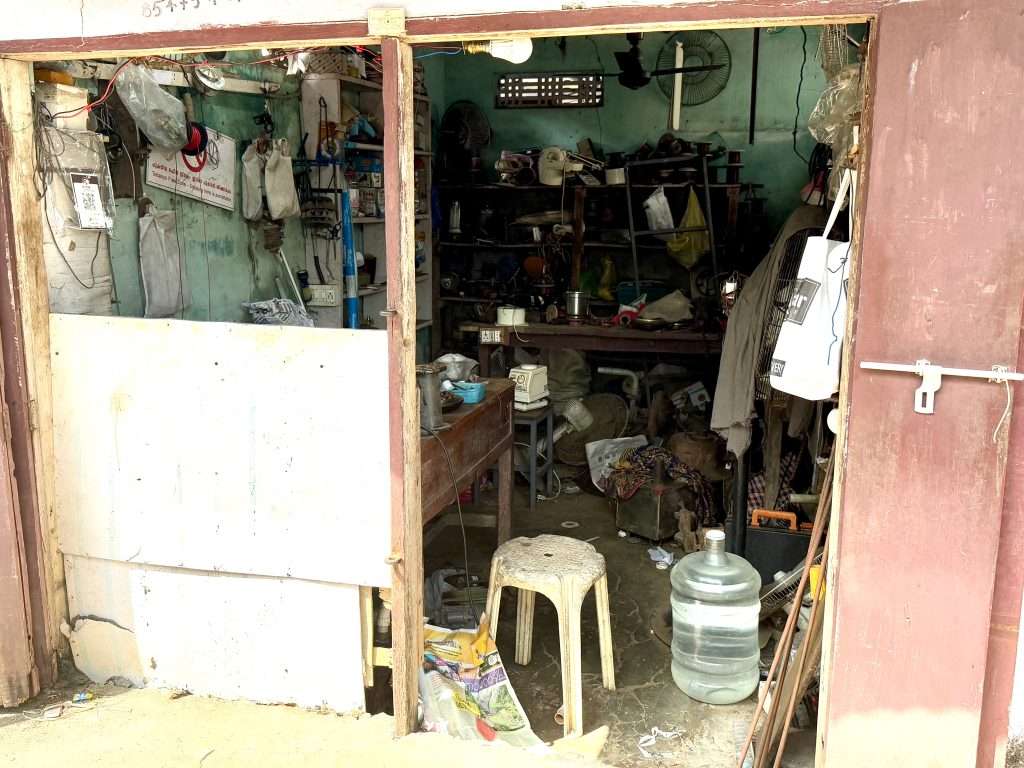
The shops are all a bit of a jumble and it is hard to know where to start to look to find what you want. Greengrocers, fish counters and egg shops sit cheek by jowl with shops selling roof tiles and drainpipes and spare parts for motorbikes. There is even a repair shop: it is refreshing to see that repairs are still carried out in India unlike to the throwaway society we have got used to in the West. It took me an hour and 10,000 steps in a big circle from the hotel, but I eventually bought 3 of the 4 items on my list which gets a thumbs up from me.
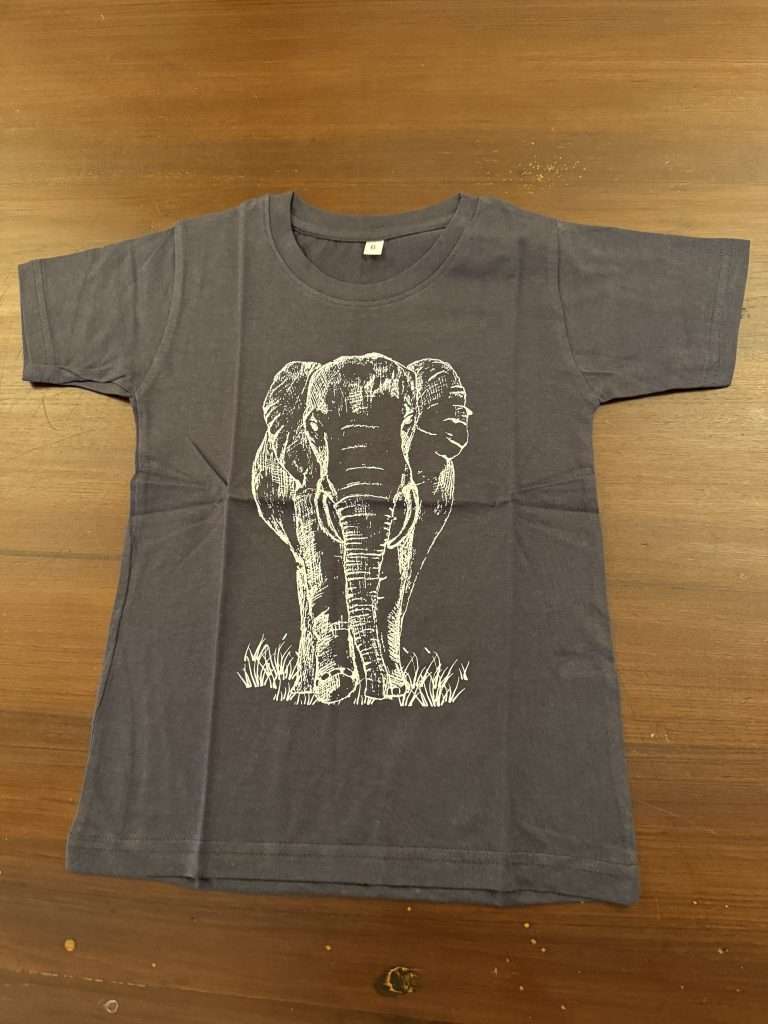
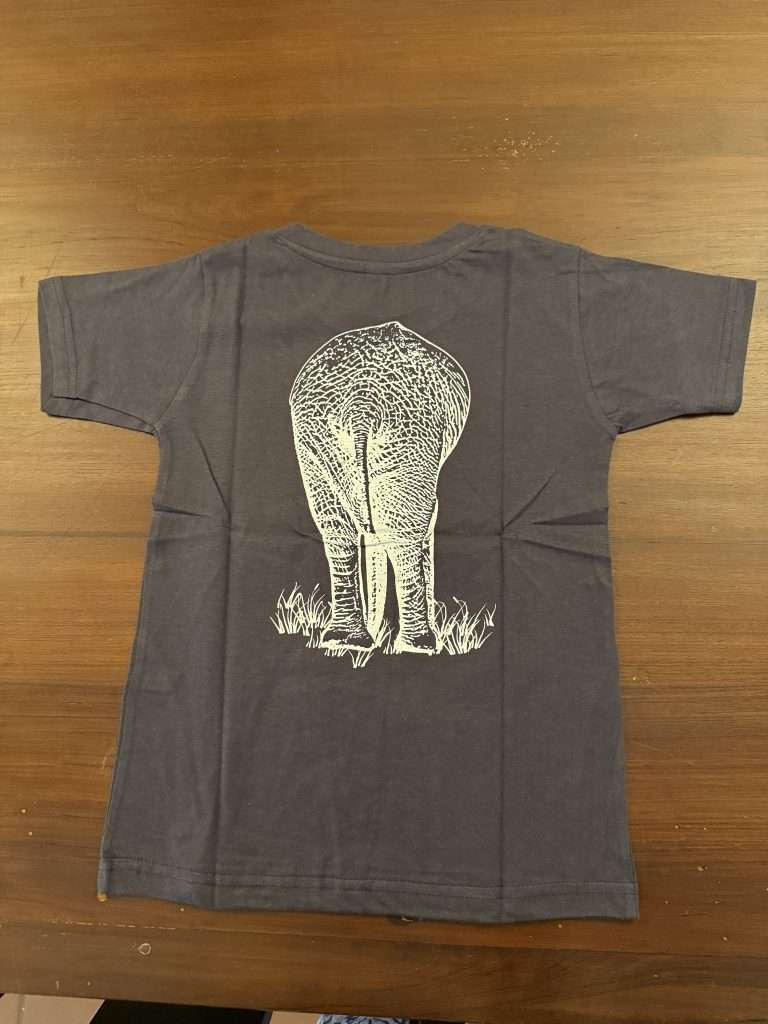
As a bonus ball, I picked up a cute elephant T shirt for 200 rupees (circa £2) from one of the touristy shops close to hotel. OK it’s maybe a bit corny as souvenirs go, but my 3 year old grandson who loved watching the video of the elephant eating an unpeeled banana will love it. It’s what grandmas are for?
There was only one thing I couldn’t buy – beer. Independence Day is a dry day in Kerala, so that’s maybe why?
Alcohol in Kerala
Buying alcohol in Kerala turns out to be impossible on a dry day – no surprise there – but actually quite a challenge on any day. Although Kerala has one of the highest per capita alcohol consumption rates in India at around 8L annually, alcohol can only be bought in government approved liquor shops and is very heavily taxed, so prices are not dissimilar from Western prices. If you drink, you are labelled an alcoholic – it’s black and white – there are no shades of grey here. Alcohol was completely banned for a time in 2014, but that was reversed in 2017.
These days, many hotels and restaurants have an alcohol licence, but many do not. On our stay, two of the hotels had no alcohol licence and in the remainder, a bottle of wine was extortionate – between 33,000 and 55,000 rupees (£33 to £55). Wine doesn’t really pair very well with spicy Indian food anyway, so we mostly opted for the local Kingfisher beer which comes in king sized 650ml bottles big enough for 2 and retails at around 400 rupees in a hotel and 200 rupees in the government approved alcohol outlets.
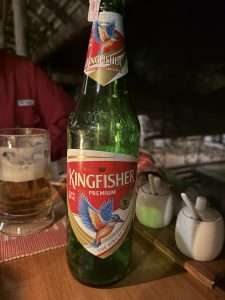

A visit to one of the government approved outlets is by no means a pleasurable experience. They tend to be surrounded by garbage and men lounging about begging you for a drink. Your purchases are swiftly concealed in a newspaper wrapper or buried in a discrete cardboard box.
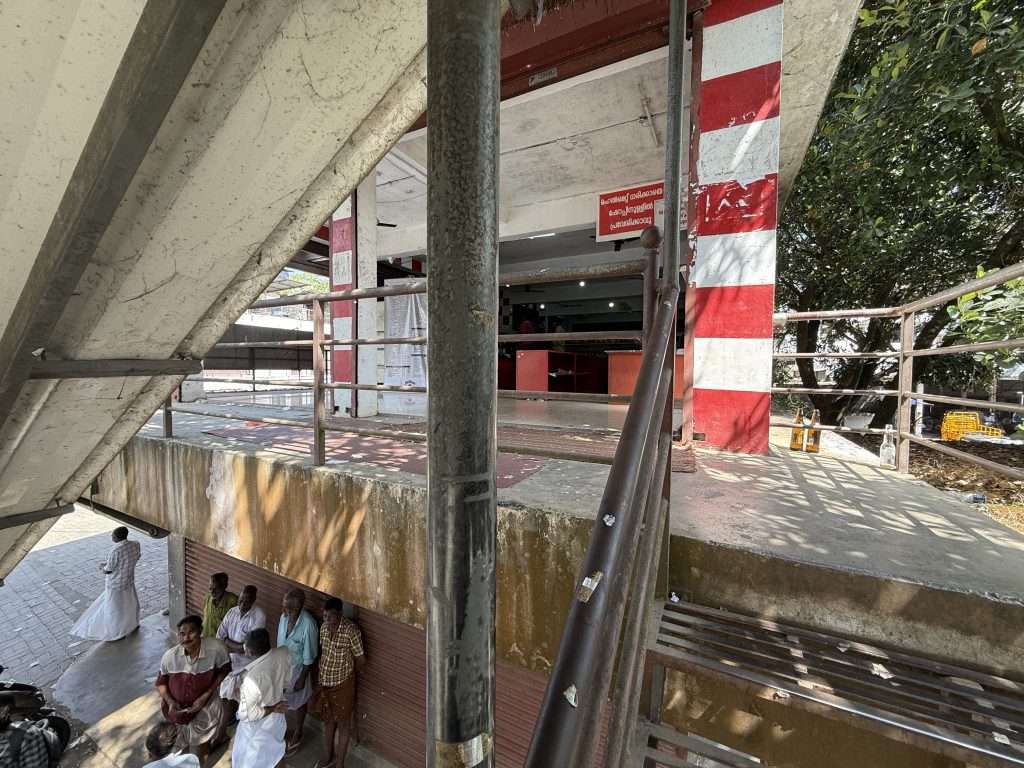
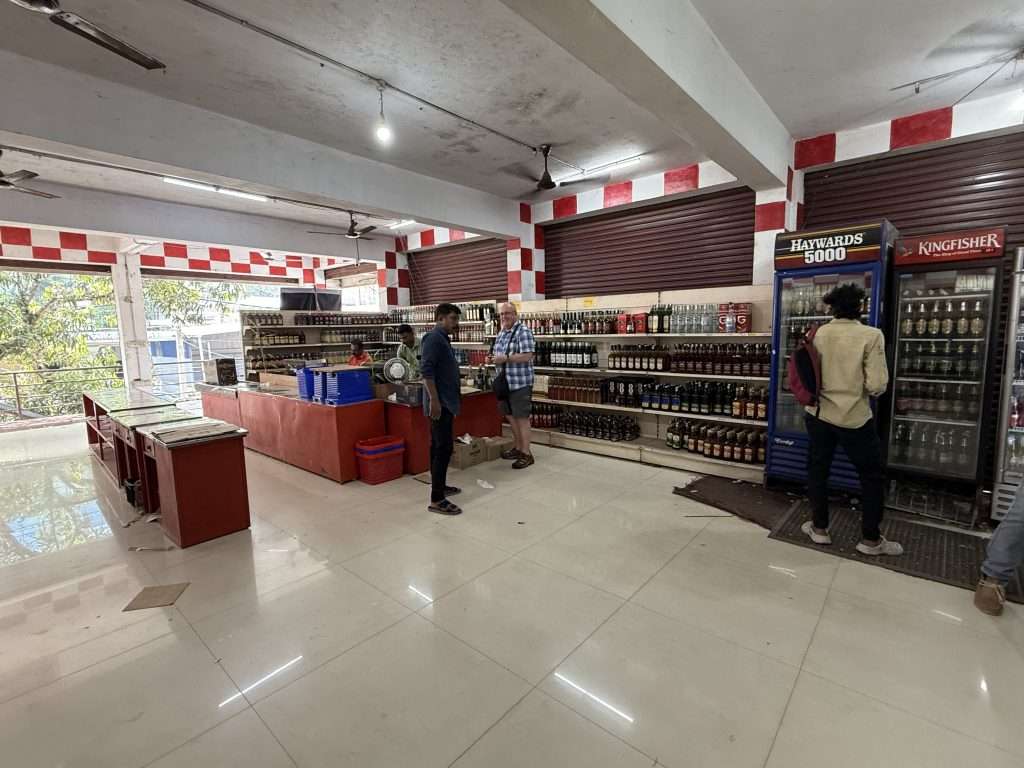
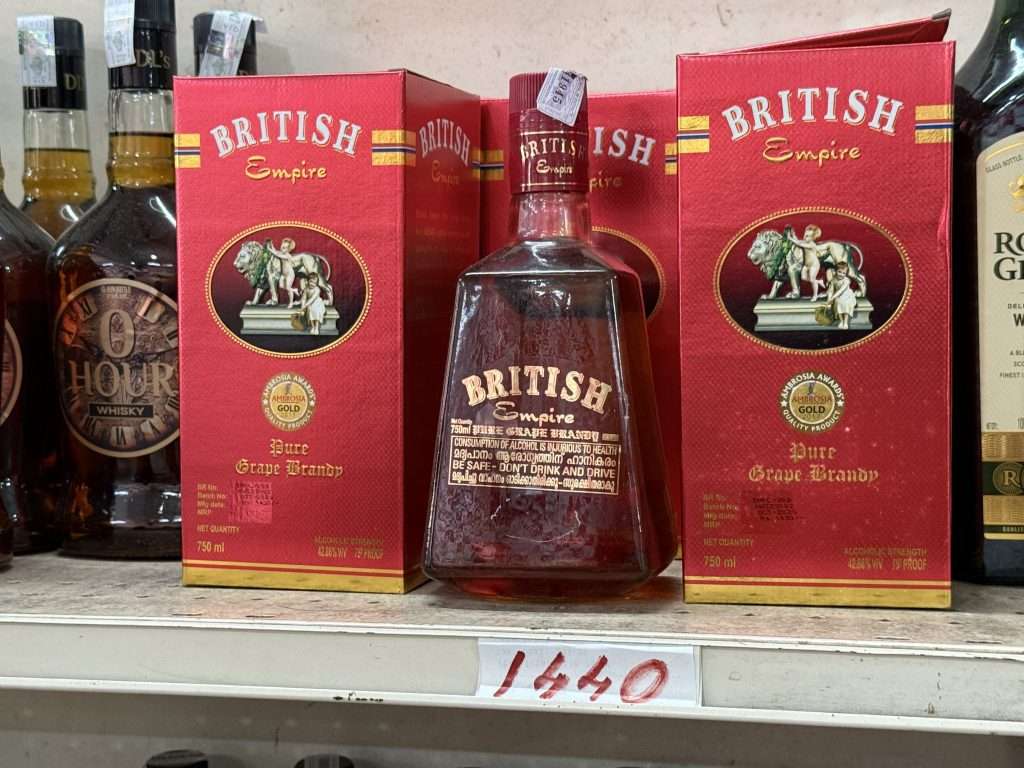
The first day of every month is a dry day in Kerala. Election days are also dry days as are a whole range of national holidays and significant festivals and celebrations. In Kerala in 2025, there are 18 dry days in addition to the first of every month. Every state has its own set of rules and the dates change year according to festival dates etc. It struck me as interesting that a India chooses to make festival and holiday times dry days In complete contrast to the West where we use them as an opportunity to enjoy a little more alcohol than we normally would.
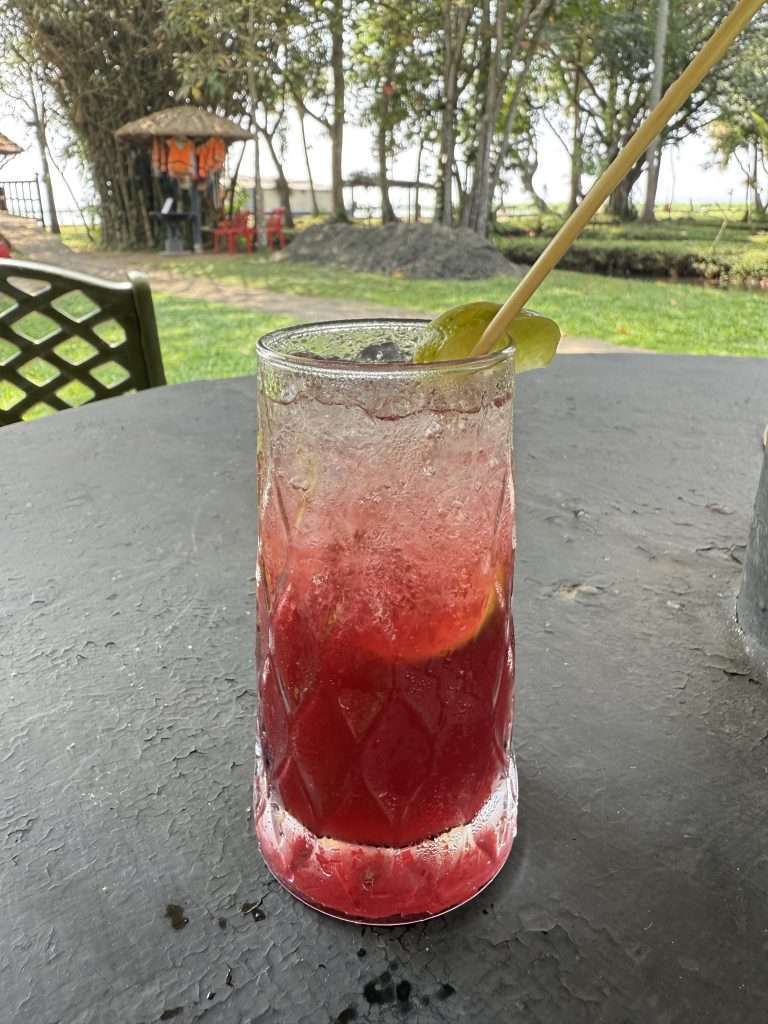
Every cloud has a silver lining though? On dry days, we enjoyed sampling a variety of lassis and mocktails. Banana and mango lassis are particularly lovely. As they are made from yoghurt, they are not to sweet and are served ice cold and fabulously frothy. My favourite mocktail was the Jamun Kalakhatta Granita – “a vibrant beverage crafted from the essence of Indian black plum (Jamun) and the tangy-sweet flavor of Kalakhatta, lemon, mint leaves and pinch of salt, topped up with soda water.” They are way cheaper than beer too and better for your health. What’s not to like?
Inside v “Outside”
This is probably a good point for a note about making purchases inside your hotel resort and “Outside”, as many guests who never left the safe confines of their allotted accommodation to explore any further afield often referred to it. I have already mentioned that beer in the hotels is almost double the price “Outside”. Here are a few other things that might tempt you to take a walk up the road rather than stay behind the hotel gates:
Changing money
On average, the rate of exchange in the hotels we stayed in was 97 rupees to £1 sterling versus 107 rupees “Outside”.
Eating Out
Lunch in a local restaurant totalled £11 for 3 (including our driver) and 2 banana lassis. Lunch at the hotel would have been twice that for 2 without any drinks.
Ayurveda Treatments
The Ayurveda full body massage at Thekkady cost 3700 just a few steps away from the hotel gates versus 6250 inside the hotel.
Laundry
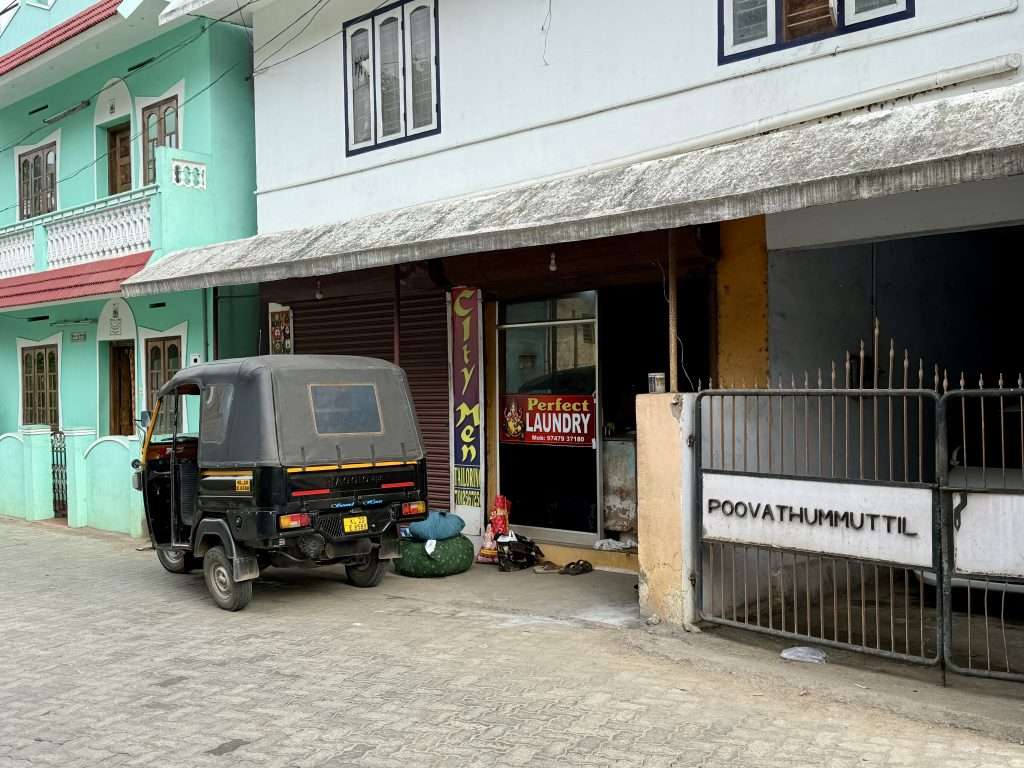
All the hotels we stayed in offered an overnight laundry service, but not at a wallet friendly price. “Outside”, a very friendly laundry with a great name (Perfect Laundry) offered an overnight wash and press service for 30 rupees per item, or a bargain of 5 rupees for a pair for socks. A full bag of laundry could be washed, pressed and packed into your travel bag as good as new for about £5. This is great to know if you want to travel really light.
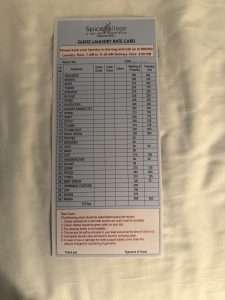
It does have to be said though that luxurious hotels do require an awful lot of labour and maintenance to keep standards high and if you do avail yourself of service “inside”, you can comfort yourself with the thought that you are contributing to the upkeep of somewhere where you are having an enjoyable holiday and to which you would like to one day return or recommend to friends?
Let’s Talk Money - aka Cash
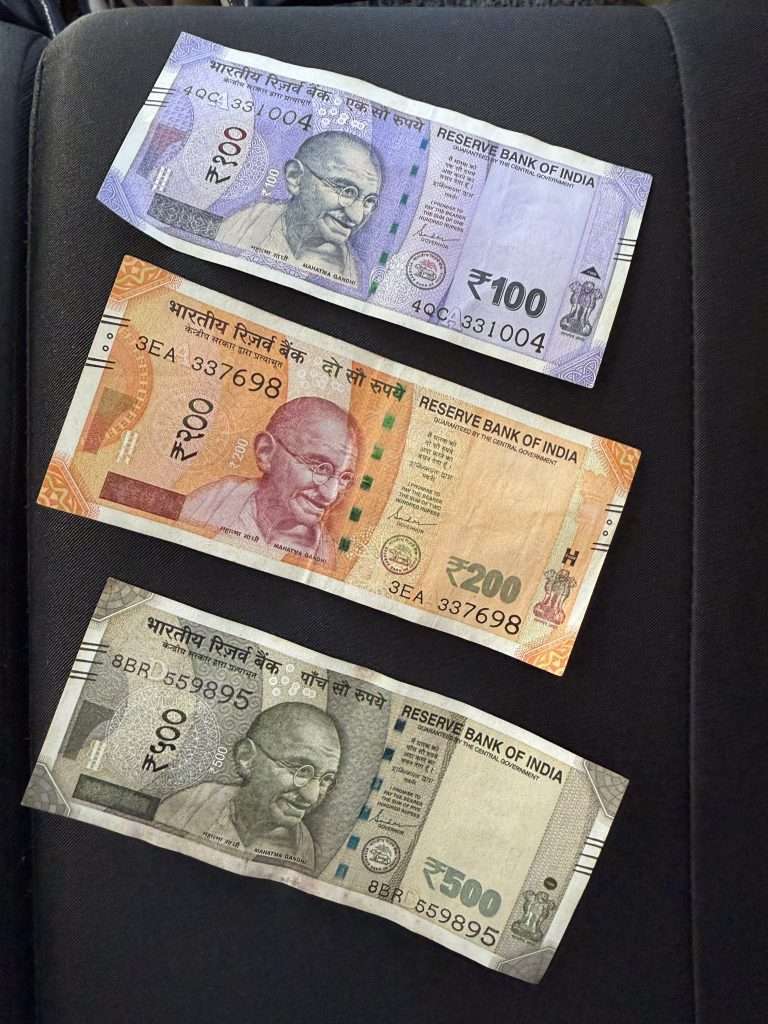
Kerala is still heavily reliant on cash and you really cannot get by without carrying some. Tipping is part of the culture and the right thing to do – for personal services (e.g. drivers/guides) and for hotel/restaurant staff (unless it it automatically added to your bill, which is increasingly the case). 10% is a good rule of thumb – or 1000 rupees a day for a private driver fully at your disposal,
The money exchange service at Kochi airport did not accept our Visa card. We found ATM machines did not work reliably enough route either – sometimes they did, sometimes they did not – for the same card. Card readers in shops also frequently failed to connect. Only the hotel receptions were 100% reliable. Unfortunately, you cannot obtain rupee notes before you leave home either – they can only be obtained once in India.
Tips for Future Travellers
- If you can, bring some rupees into India with you. We obtained some from a friend before we travelled.
- As soon as you can, get your high value notes changed into lower denominations so you can tip appropriately and avoid the embarrassment of not having any small change and the expense of tipping way over generously.
- Only use ATMs in reliable banks and be prepared for them not to work- carraying a couple of credit cards isn’t a bad idea.
- If you haven’t already got one, consider opening a Revolut account. You can pre load it with sterling before you travel and convert it into rupees on the move using the app free – with no exchange charge levied (in working hours). If you don’t use all the rupees, you can simply change them back into sterling. – or any other currency for that matter – when you return. If your card was ever stolen – or scammed – the maximum cash at risk is only what you have loaded onto your card. You can use them in ATM machines, but remember, they do not work reliably.
- It is a really good idea to have a supply of sterling in cash with you too as this is easy to change at designated foreign exchange counters.
Coconut Country - 3 Days in Coconut Lagoon - Kumarakom
Kerala (or Keralam as it is known in Malayalam) means Coconut: “Kera” means coconut and “Alam” means “land of. For this leg of our trip, we were based at Coconut Lagoon for 3 days – a relaxing few days where you can enjoy the scenery and chill out after all the excitement of the first weeks in India. It is also conveniently located to enable a pick up directly from the jetty by a Houseboat – where we will be spending the next 2 nights.To find out more about the hotels we stayed in on this trip, follow the link below to Accommodation Reviews,
Coconuts - Kerala’s Wonder Crop
Coconuts have so very many uses and not a jot ever goes to waste.
10 Uses of a Coconut Tree
- Drink the milk – it has many health benefits.
- Grate it – and use the “meat” to flavour curries and make gorgeous desserts like Coconut ladoo – traditional sweet balls made primarily with coconut and an added sweetener like sugar or jaggery and lightly scented with ground cardamom. Coconut is high in dietary fibre and aids digestion, so this is a delicious sweet that is actually good for you! It reminds me of Bounty bars – and I always did love to bite off the thick milk chocolate and then devour the sweet coconut inside “neat”!
- Extract the oil and use it for cooking – it differentiates Keralan cooking from the curries up north which are usually cooked in sunflower oil. It also makes great skin and hair conditioner.
- Mash fresh coconut with water and pass it through a fine sieve to extract coconut milk which can be used to reduce the level of spice for a milder curry.
- Tap the tree to collect the sap into an earthenware pot and then ferment it to make toddy – a sweet, alcoholic beverage with a sweet-sour taste. Distilled into liquor, it can be used as vinegar or to make jaggery.
- Use the fibre to make coir rope, which can be woven into all manner of useful everyday objects. It’s great for tying garden plants, improving heavy soils, solving to create matting for floors and walkways, making fishing nets and all manner of useful everyday objects. It is naturally resistant to moisture and salt water , bio degradeable and 100% environmentally friendly. It is also the perfect material for making a roof for a houseboat!
- The strong trunks cam be turned into house and furniture or used to build infrastructure such as bridges,
- The branches make efficient brooms and are a good roofing material.
- The leaves can be woven to make baskets, hats, mats and other useful household objects.
- 10.The shells can be hollowed out to make useful bowls/ cups – or even bags.
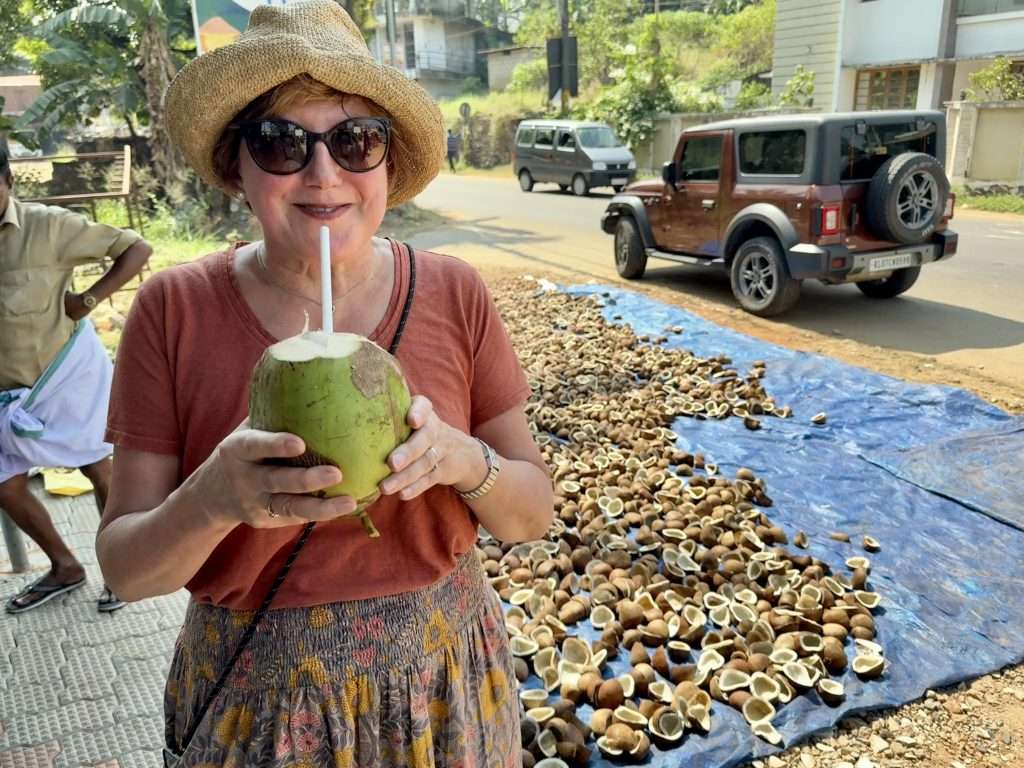
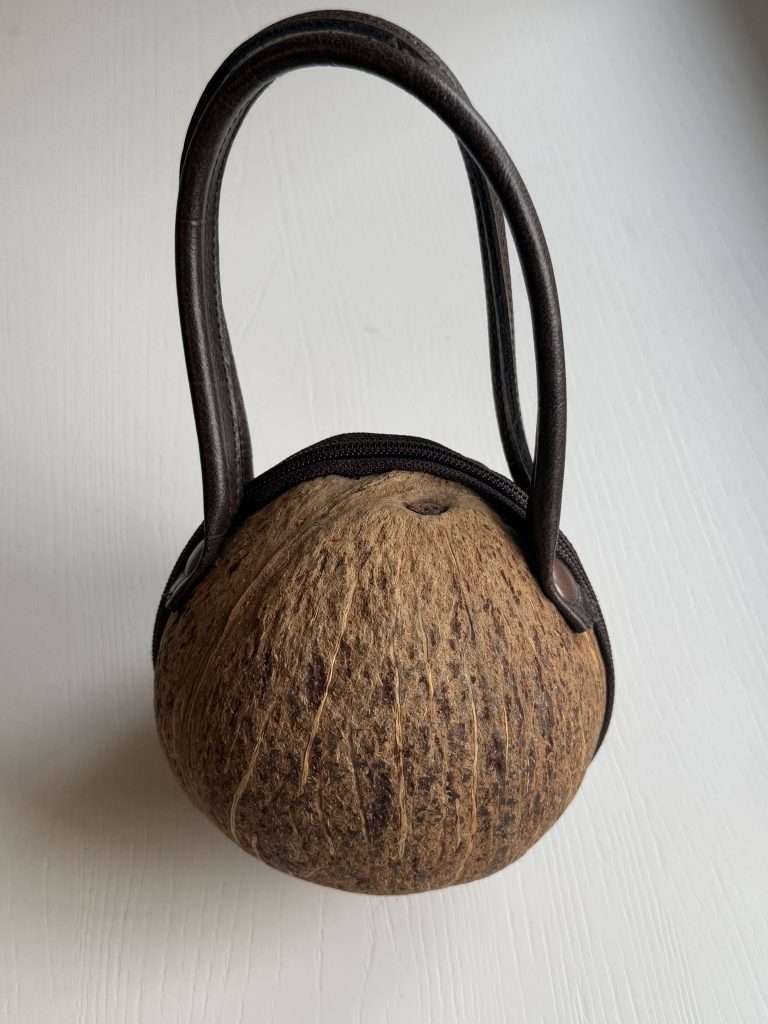
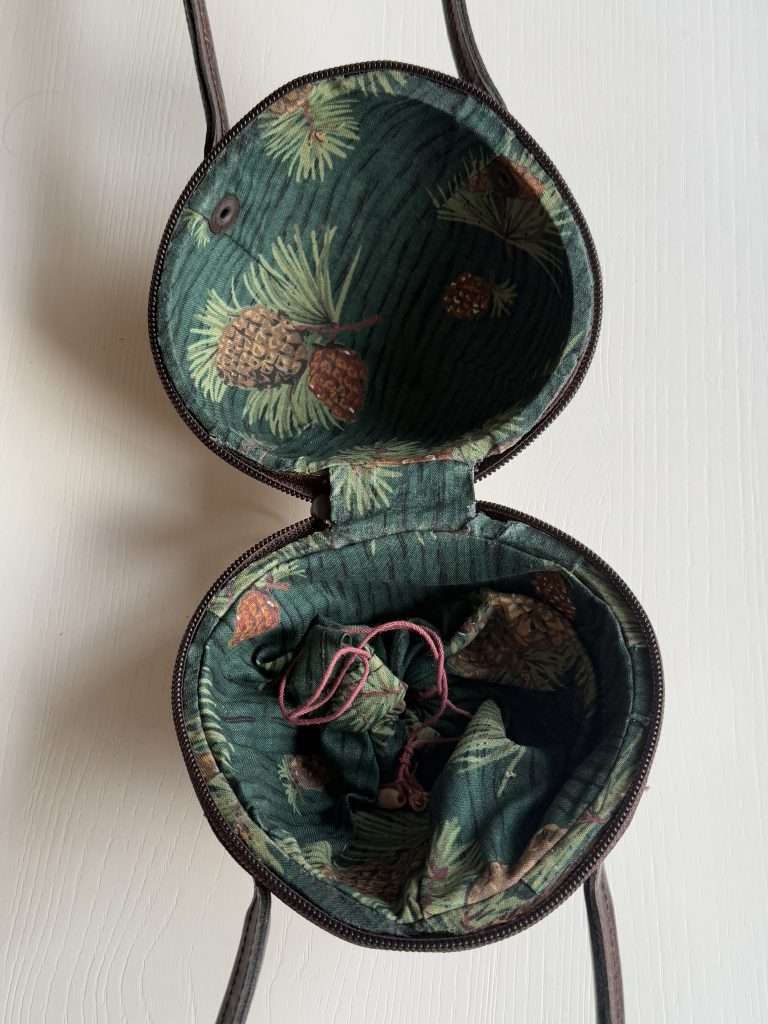
Fascinating Fact
Traditional coconut trees are VERY tall, which makes harvesting the coconuts difficult and dangerous – a job for an unfortunate coconut tree wallah. Dwarf varieties are now being introduced to make the collection of nature’s bounty a much easier task.
Weaving Workshop
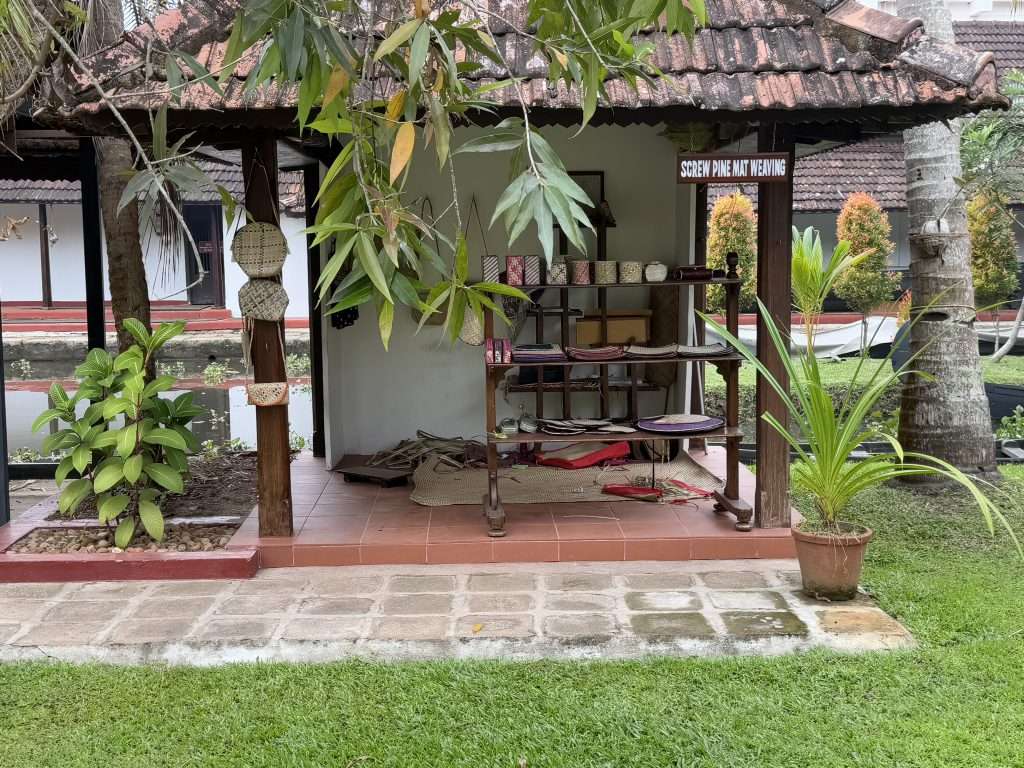
One of the many complimentary activities on offer at the hotel where we were staying in Kumarakom – Coconut Lagoon – was a weaving workshop. Every day between 10 and 3, one of the local ladies from the village twigs cross legged on the floor in the shade in a quiet corner of the hotel grounds and contentedly weaves a variety of pretty and useful objects using only her hands, a pair of scissors and a couple of her toes – yes really!
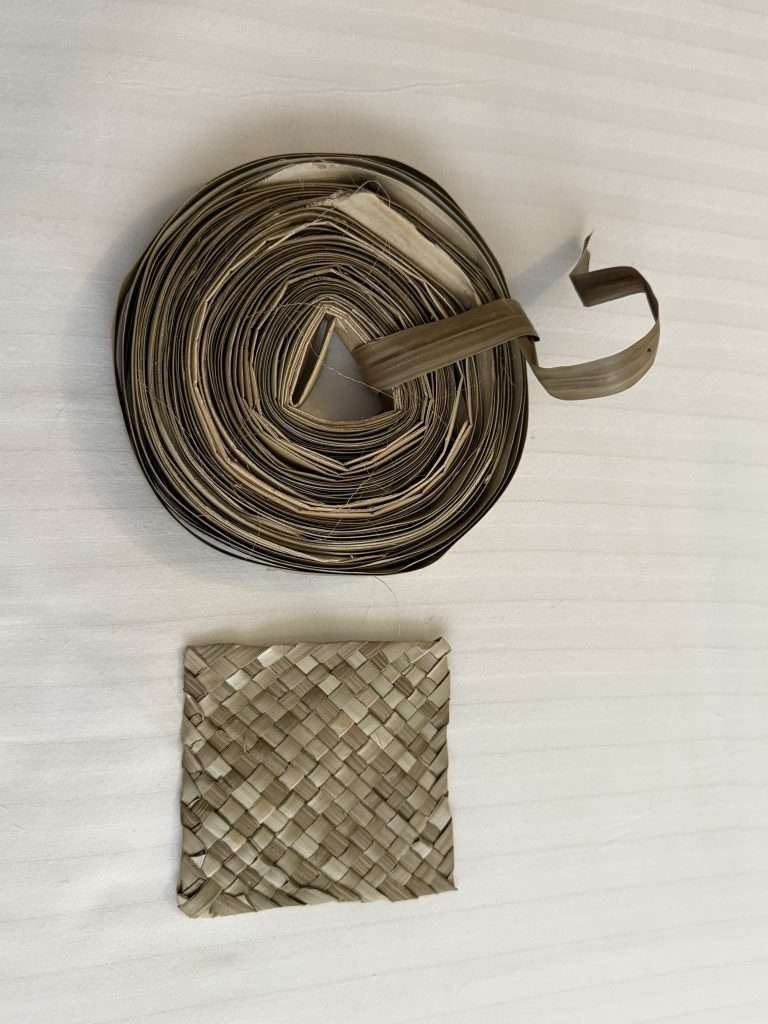
Though neither of us spoke a word of each other’s languages, we bonded as friends as we weaved a coaster together and I gradually learned the techniques and skills involved. I would have liked to buy something as a thank you to my new friend, but I couldn’t find anything I really needed and I hate wasting money. If only there had been a little bag just big enough to carry my mobile ‘phone to dinner at night, now that would have been really useful on this trip, but all the bags on offer were too big.
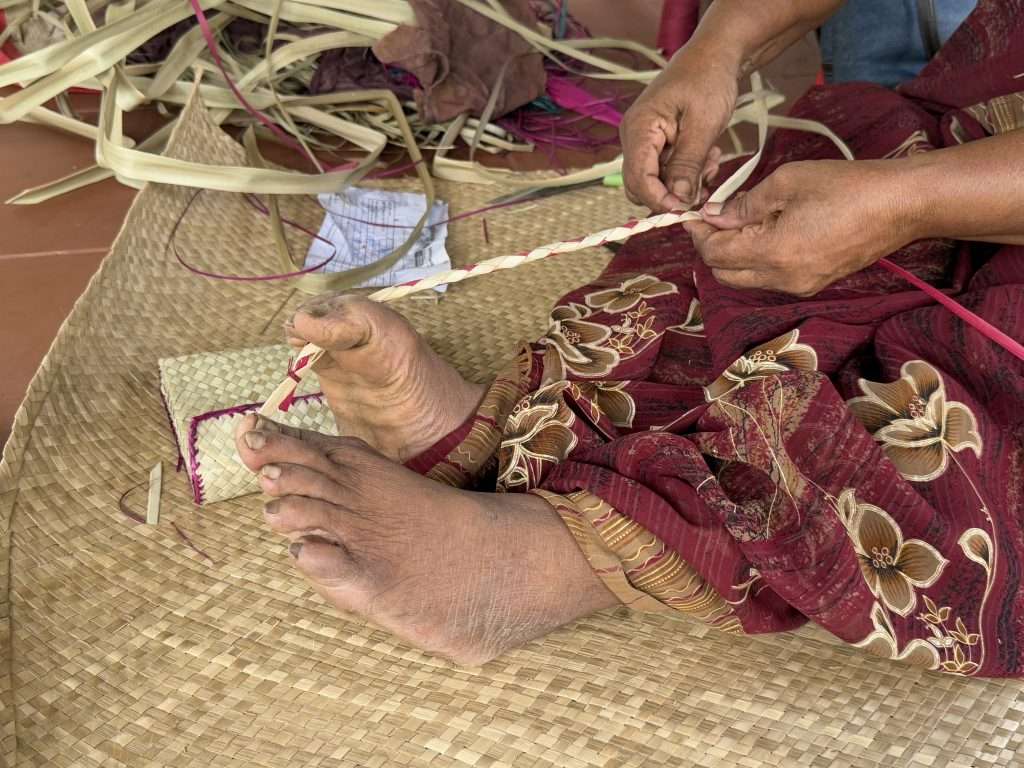
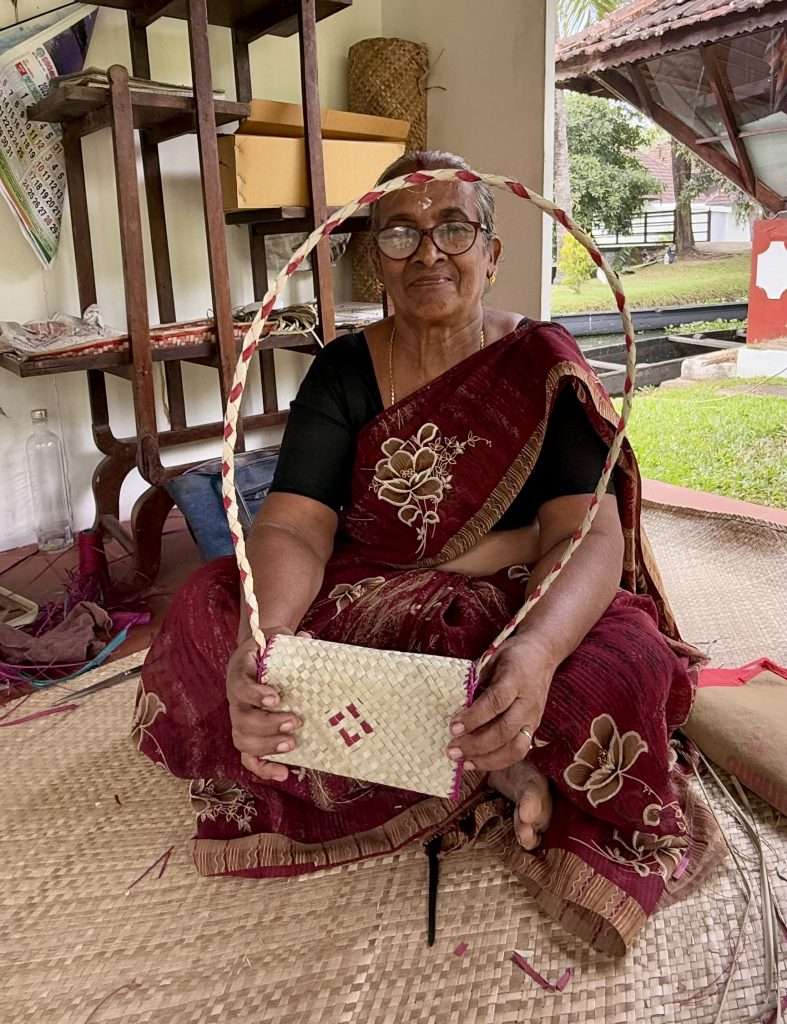
On the day we left, my friend presented me with the perfect sized bag which it had taken her a day and a half to make. All that was required was to add a magnetic clasp and weave a handle, which is where her two flexible toes came in handy! I sat with her for a final hour before gladly paying my dues and walking away happy with my new bag – a useful item for sure, but worth far more to me for the happy memories I have of its production process. We exchanged a Namaste and a waved goodbye as we made our way to the hotel quay to board our home for the next 2 nights – a houseboat on a Kerala’s backwaters.
A Houseboat on Kerala’s Backwaters - 2 days in Alleppey
The next segment of our journey was the part I had been looking forward to most – spending 2 days on a leisurely cruise through Kerala’s Backwaters. Our Lakes and Lagoons houseboat and its friendly 3 man crew came to collect us from the jetty at Coconut Lagoon at lunch time and set off to cross Vembanad Lake towards Alleppey – Kerala’s Rice Bowl and the centre of Backwaters Tourism. Actually, Alleppey isn’t its original name – it is Alaappuzha. which means land of the rivers.
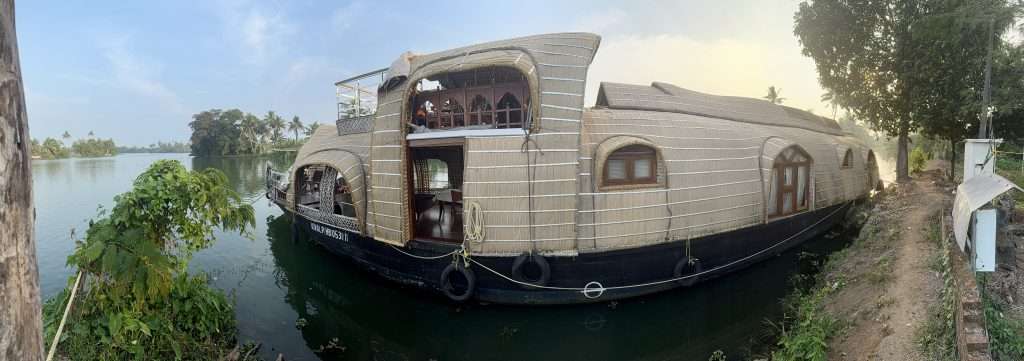
The first part of the journey was something of a traffic jam. Since tourism started on the backwaters back in the early 1990s, the houseboats have become a big tourist draw and over 1000 vessels cruising the waterways today. Many tourists enjoy taking a day trip on a houseboat or just stopping for an overnight stay, so the waters near Alleppey are something of a traffic jam – thank goodness houseboats don’t have horns! It is still a very relaxing and peaceful place to be, but the odd pool of diesel lying shimmering on the surface of the water in places and the odd plastic bottle making a path slowly through them tell a cautionary tale of what could happen if tourism is allowed to get out of control here.
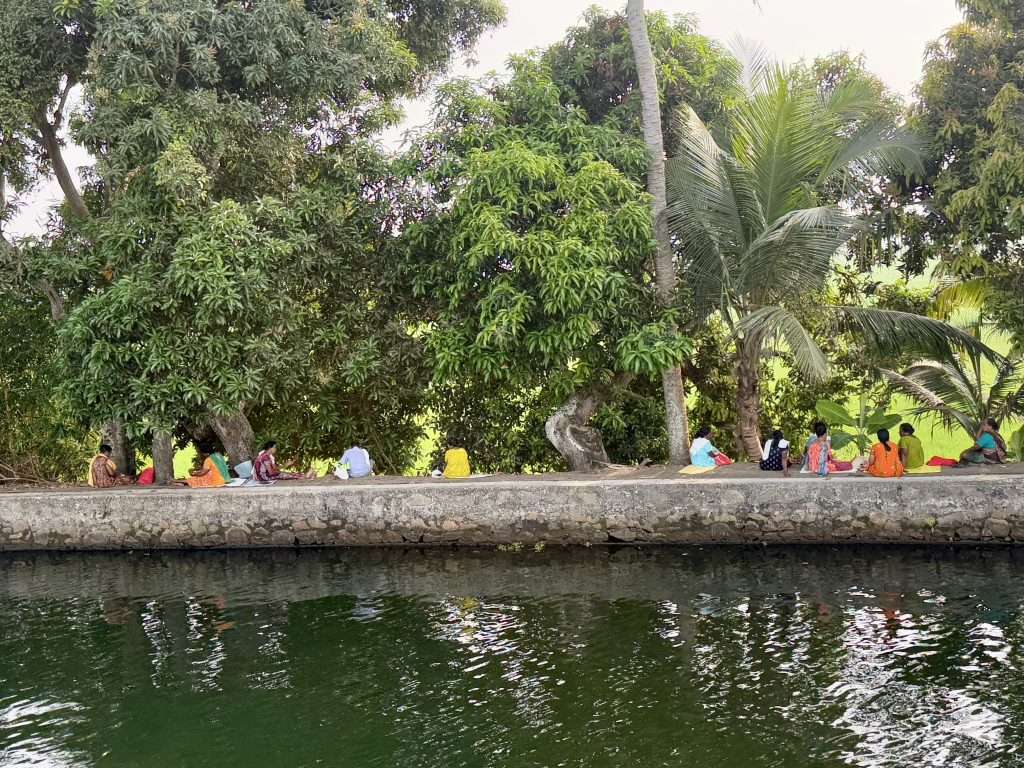
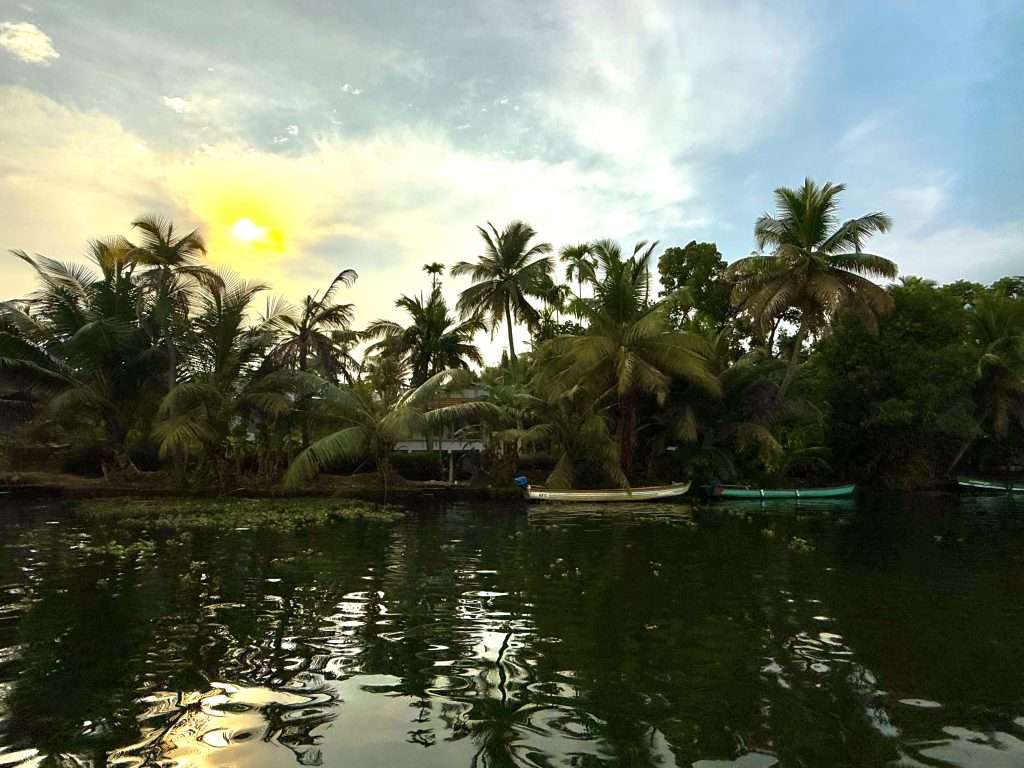
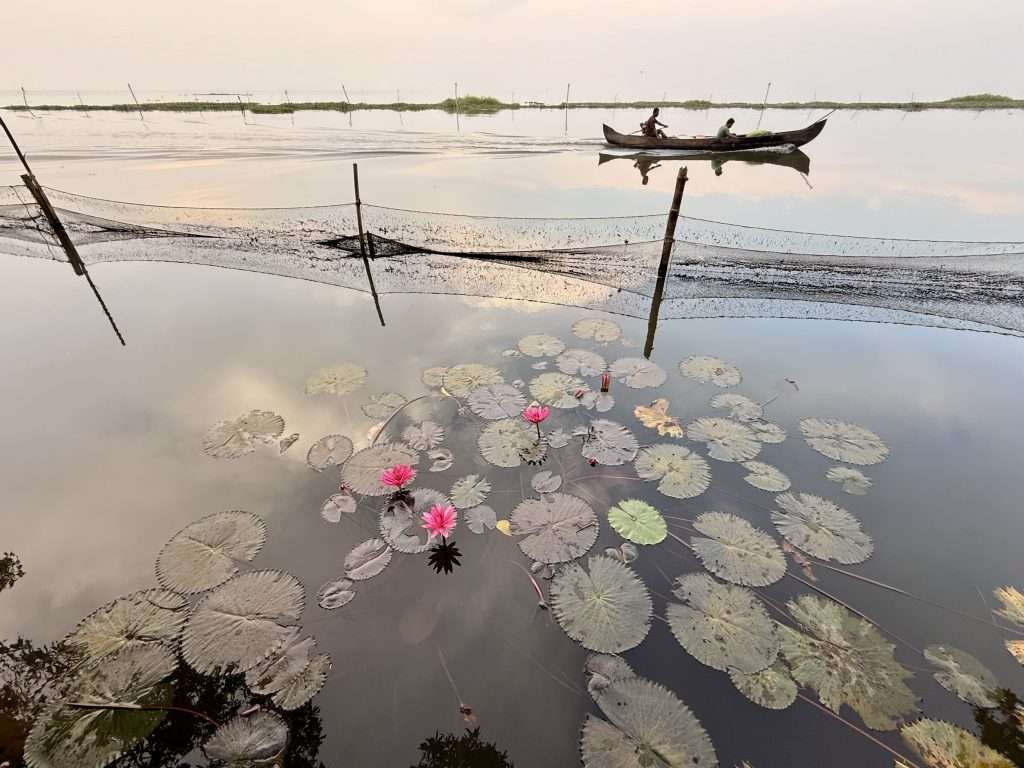
Acre upon acre of bright green paddy fields line the route with coconut trees and mango trees providing a both a partial screen and valuable agricultural crops. A 2 night stay means you can venture deeper into the backwaters and discover more peaceful waterways. It’s a fun experience – a bit of an adventure. For 2 days, we and our 3 man crew (our driver, the chef and the waiter/housekeeper) took a leisurely cruise with no wi fi to distract us from gradually soaking in the atmosphere, enjoying scenery and respecting the privilege of having a bird’s eye view into everyday village life in the rural backwaters. Villagers are happy to see us and often give us a friendly wave as we pass, so we gradually feel more comfortable with the fact that we are sailing right past their back gardens.
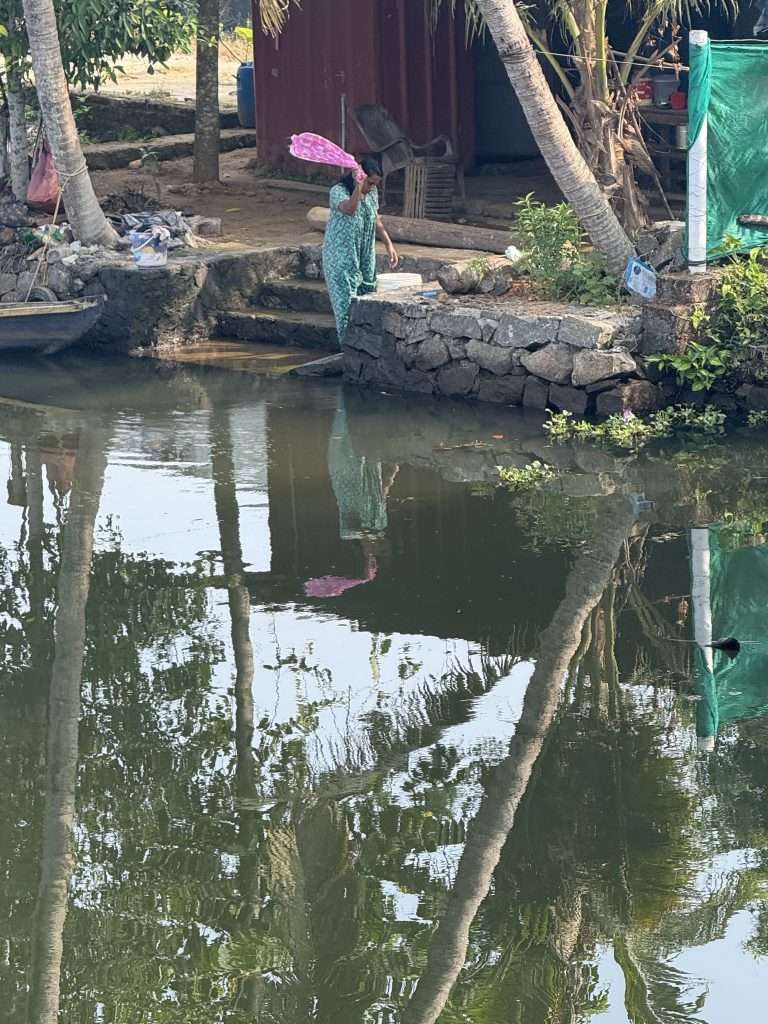
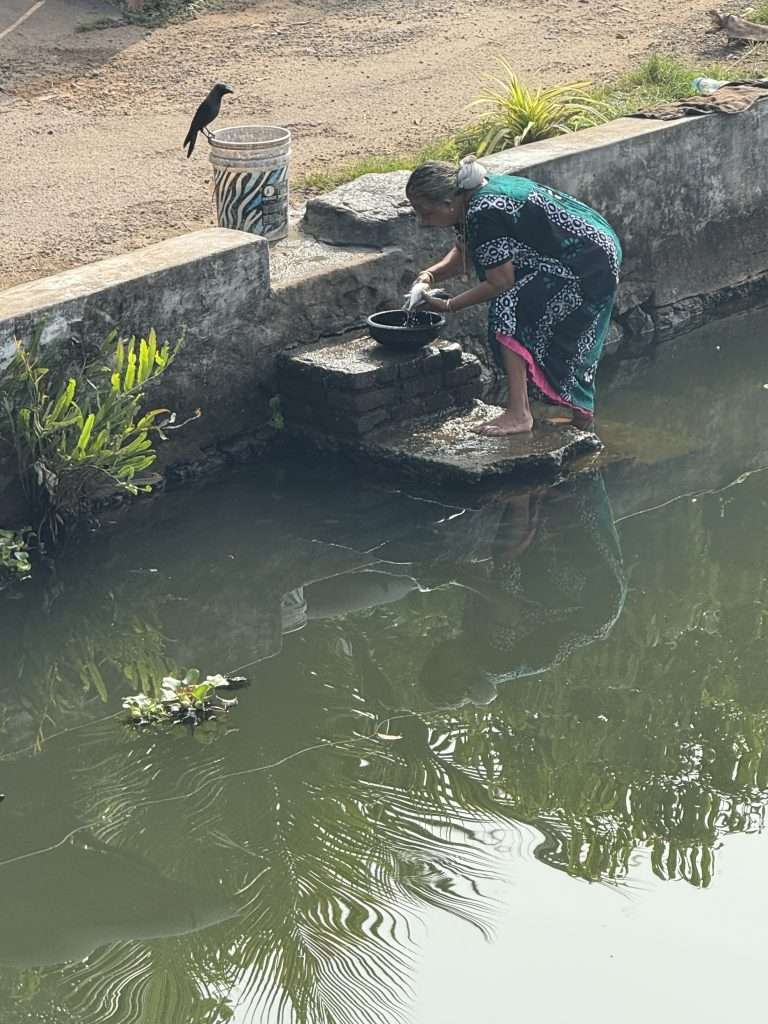
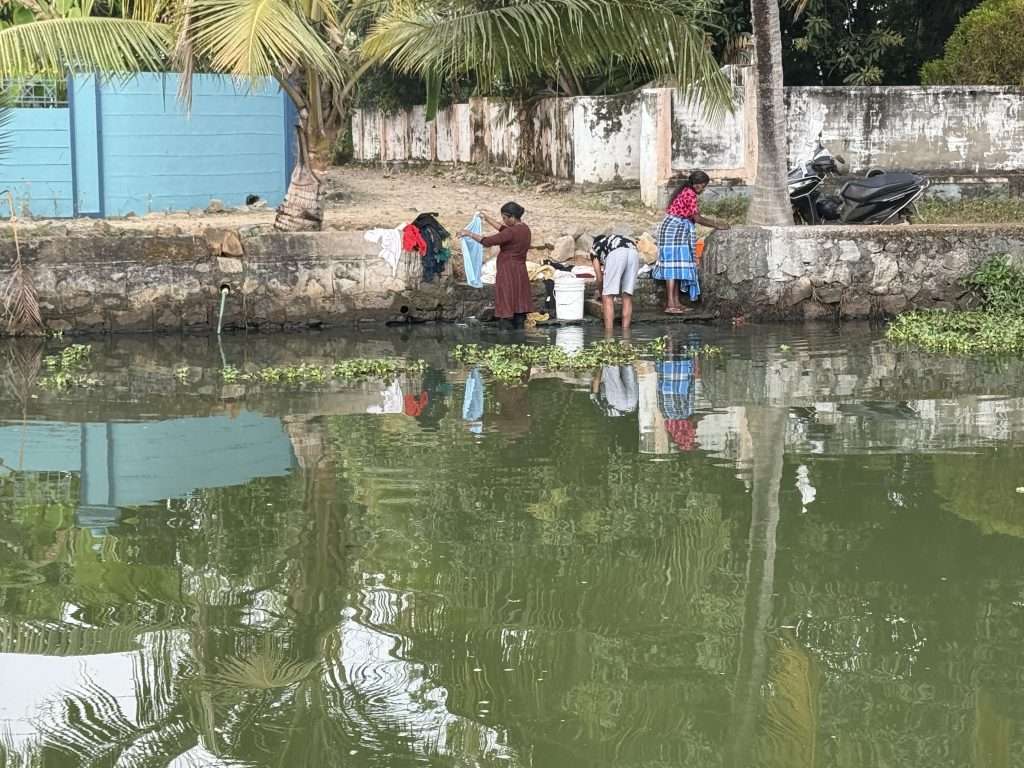
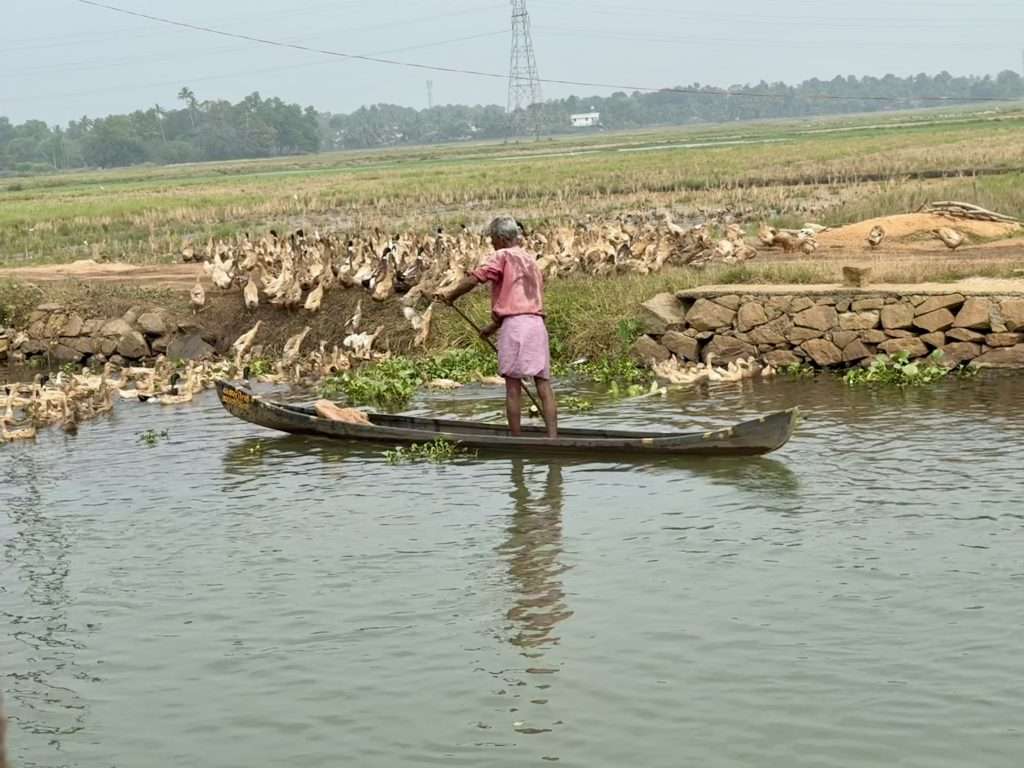
Rather like in Venice, everything happens on the water here – Alleppey is often labelled the Venice of the East for good reason (except I hear you need to buy an advance ticket to visit Venice these days it is so over crowded with tourists). All life is here – lived out by the water’s edge. Early mornings are particularly captivating, when people are doing their laundry in the river, having a wash and a shave and gutting fish ready for lunch. We watch the school bus sail past and the children chorus a loud halo and wave frantically. A flock of ducks waddle up the river bank back into their farm, encouraged by the shouts and and a friendly thwack from their keeper. Snake birds, kingfishers, egrets, herons, storks, and bee eaters are plentiful. Every now and them, music from a temple fills the air transmitted through speakers tied high up in a coconut tree. The music carries for kilometres and is almost deafening when you are close to a speaker.
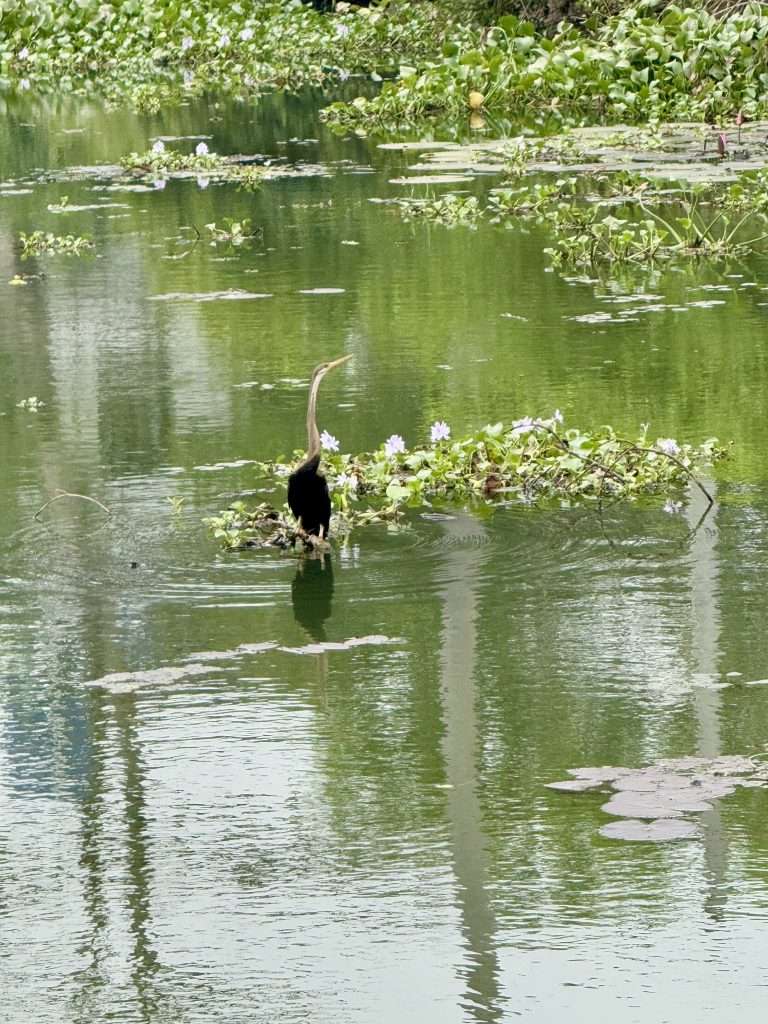
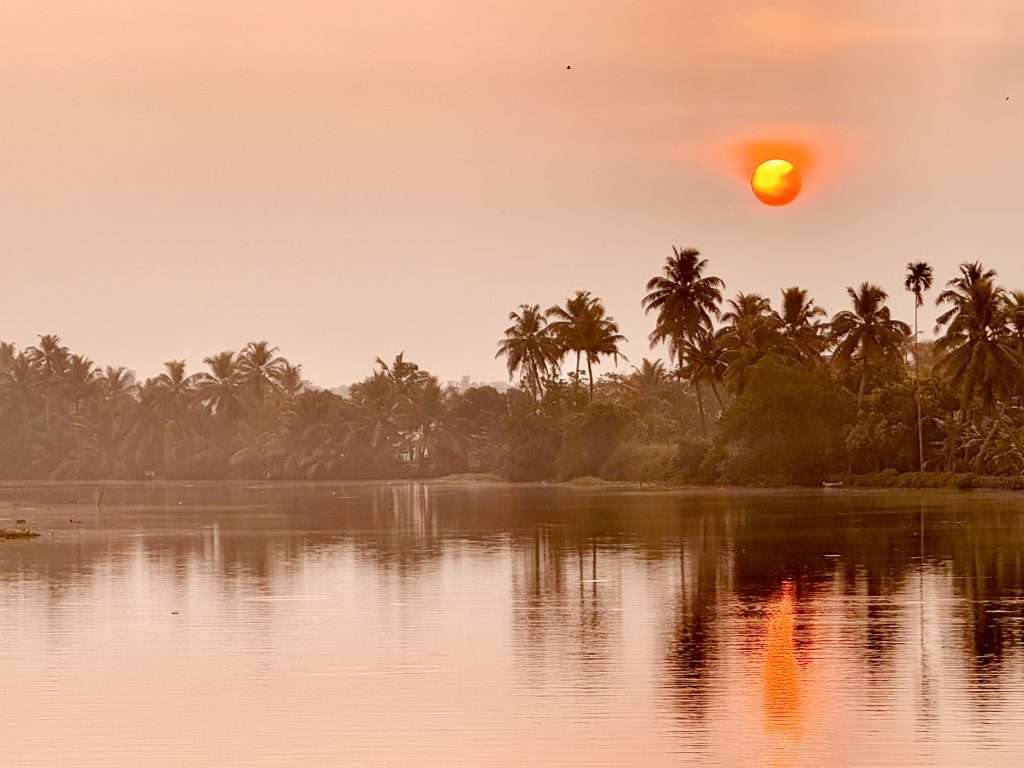
The mango trees are in flower now in late January. The tiny gardens often have two or three mango trees and sell the surplus above their own requirements when the regular collection cart comes around. Early morning is a particularly lovely time on the waterways. We watched from the viewing platform at the top of the houseboat as a deep orange sun gradually emerged and painted the sky and the river a warm shade of gold. It is a short display, but somehow all the more enjoyable for that – a few fleeting moments in time that once passed will never return. The many water lilies open their flowers in the early morning too. Delay too long and you will miss that show too, so forget a shower, breakfast and whatever else is on your mind and enjoy the magic of an early morning on the waterways.
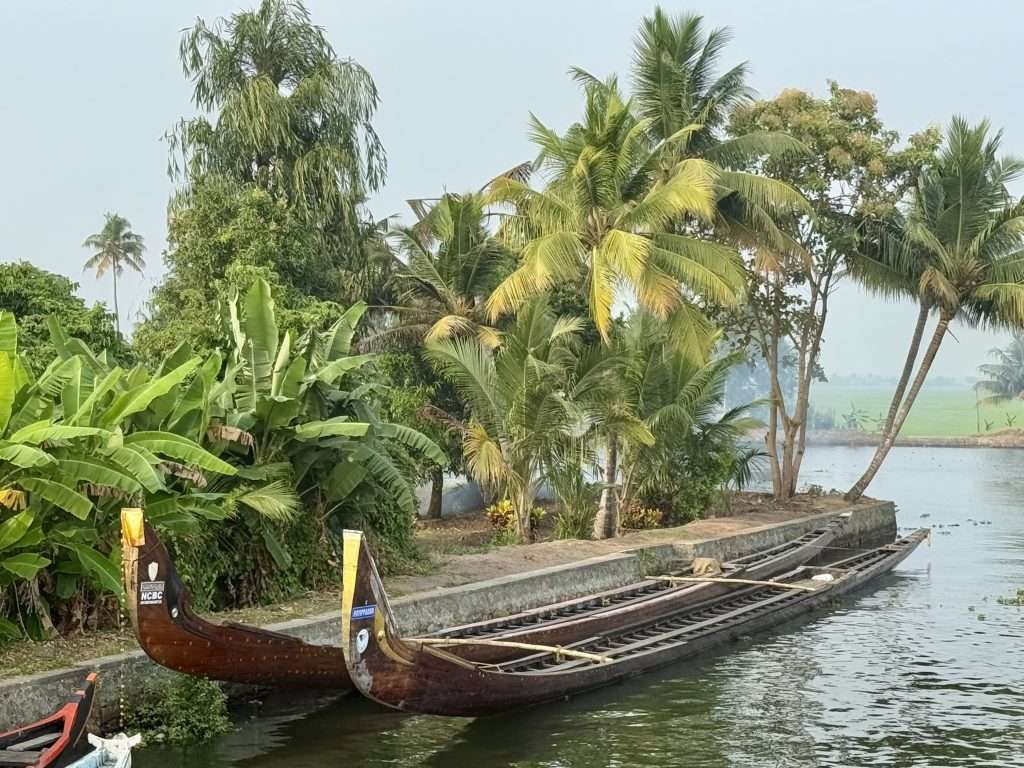
The Snake Boat Race
Every year during the Onam harvest festival, Kerala’s answer to the Oxford versus Cambridge boat race takes place. The Kerala snake boat race – also known as Vallam Kali – celebrates Kerala’s pride in its maritime history. The long boats (called Chundan Vallams) hold up to 100 rowers each and are paddled head to head in synchronised unison while the rowers all sing the boat song. All we saw was 2 snake boats moored for a rest – they must be spectacular in action.
St. Mary’s Basilica - Champakulam
We stopped half way through our cruise to visit the village of Champakulam which is the sight of a beautiful church. Unbelievably enough, the churches foundation stone was laid in 427 AD. Inside the peaceful church there is a beautifully painted blue ceiling. This used to be the only church for miles and people had to travel quite a distance to worship there. There are more churches now, so it is used less than in the past but is still packed out on festival days.
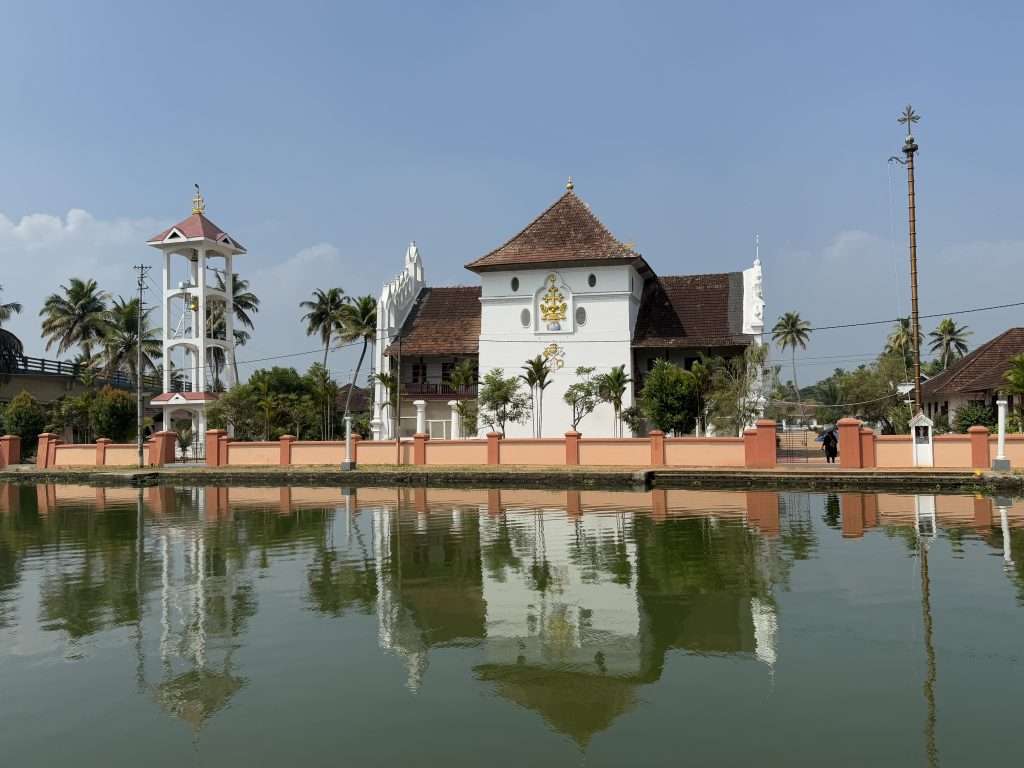
Everywhere I have been in Kerala, I noticed that the churches and temples are very clean, with sparkling bright white paint making them stand out starkly from all the other buildings around them. Apparently, they are all given a fresh coat of paint annually at festival time which usually lasts a week a more – so that explains it and shows once again the importance that religion plays in daily life here.
Keralan Rice
Bright green paddy fields lined both sides of our route the whole way. Paddy fields are first ploughed, then levelled and finally flooded to make ploughing easier. Rice seeds are usually germinated in a nursery because transplanted seeds are quicker to mature than directly seeded ones. Water levels in the fields are carefully controlled until it is time to harvest the rice, which takes anywhere between 100 and 180 days to mature, depending on the variety
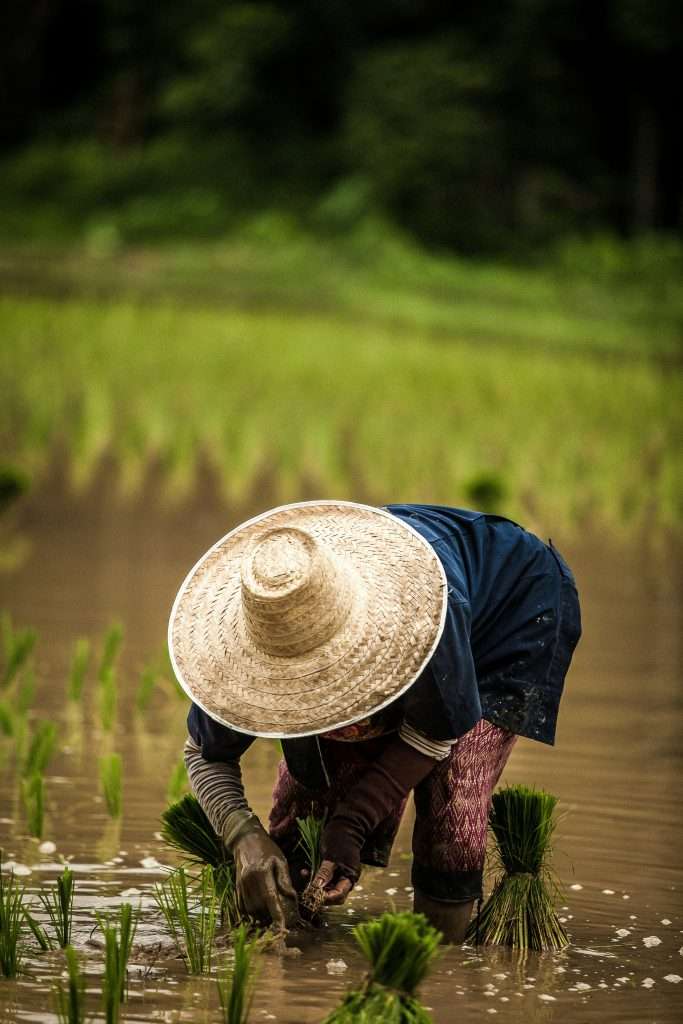
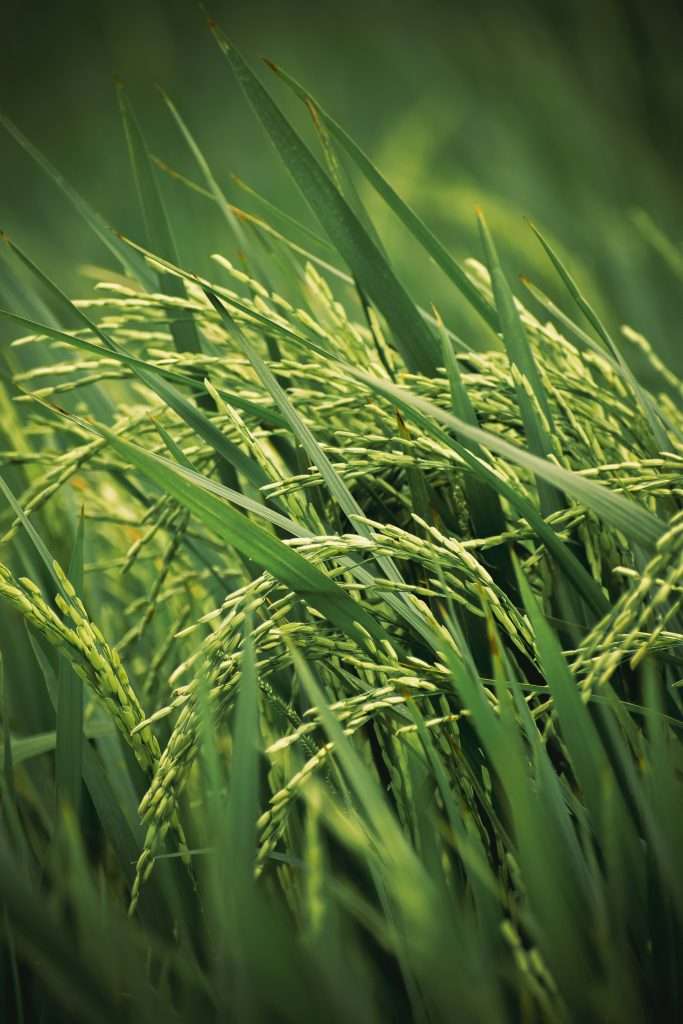
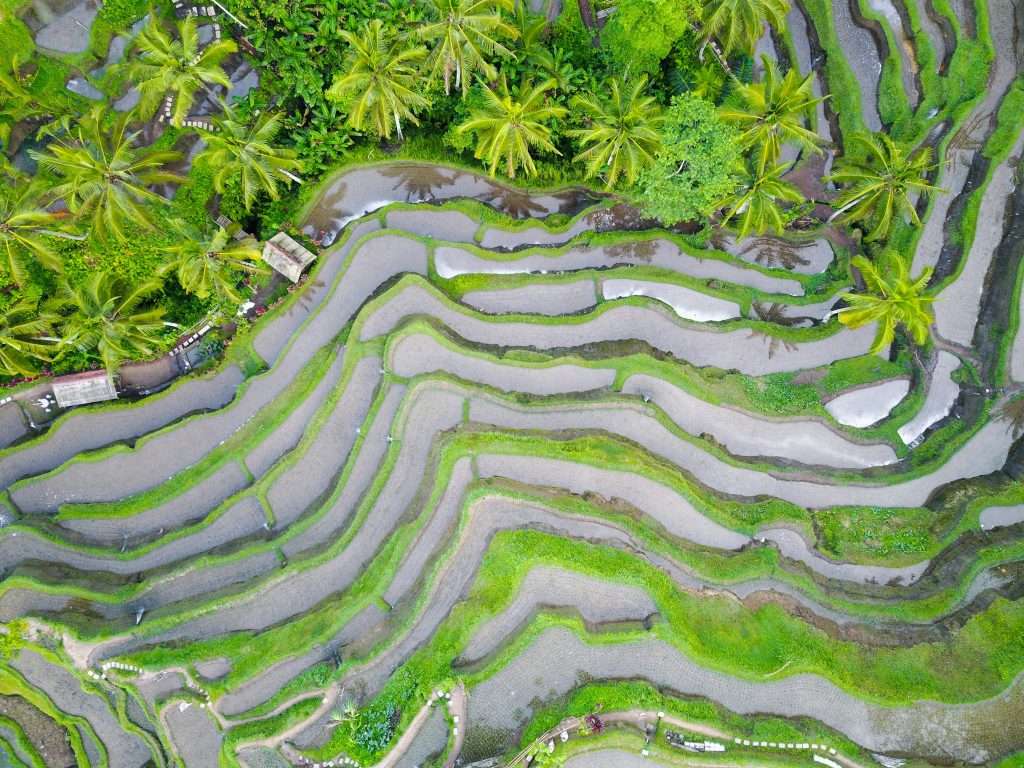
After harvesting, the green fields turn golden and the land is burned, ready for the next crop. We caught the smell of smoke on the warm breeze several times. Wet rice cultivation makes very efficient use of available land and Kerala’s monsoon climate and is the staple food of its rural population.
I’m Heading for the Beach - 3 Days in Mararikulum
Our penultimate stop was a 3 day stay in the beach resort of Mararikulum. – a short 11 kilometres from Alleppey which took us 45 minutes to reach. The resort where we were staying has direct access to the lovely long and sandy Marari Beach. It is a safe swimming beach – although caution is needed as the waves can come crashing in at times. The beach is quiet, has beautifully soft sand and clear waters.. There was no stone, gravel or seaweed to dig into your feet or wrap around your ankle here. The beach stretches for several kilometres and is nice to walk along, watching the fishermen cast their nets and bury their catch in the sand to protect it from the birds soaring overhead.
The stretch of beach closest to our hotel with two blue and white Xandari Pearl Resort brollies fluttering enticingly in the breeze with a pair of worn cotton deckchairs perched thoughtfully beneath them made a nice place to take our fist dip in the Arabian Sea. A walk along the beach through soft sand yielded amusement at the many camera shy beach crabs scuttling back to the safety of their holes as the vibrations from our footsteps reached them before we could capture their antics.
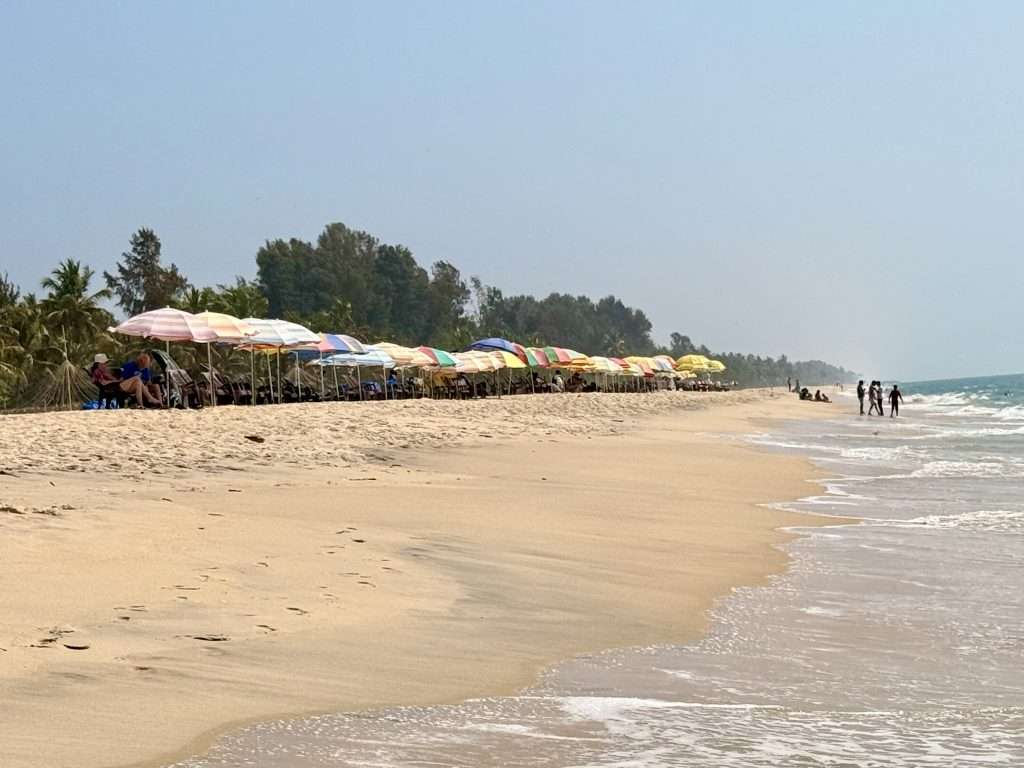
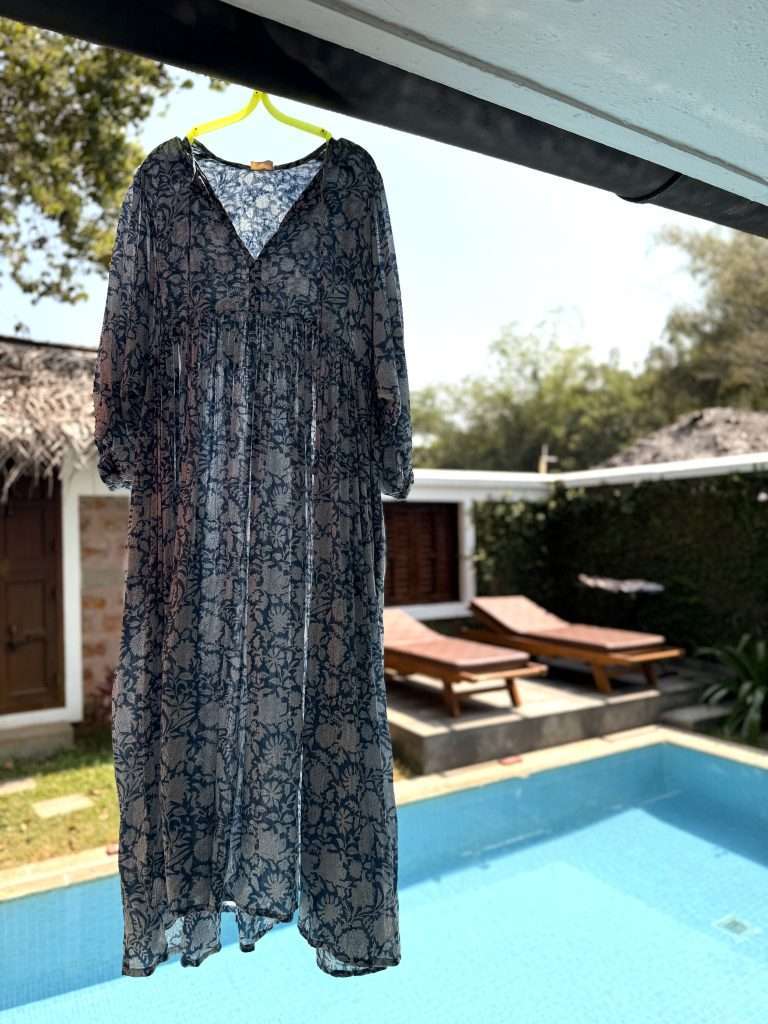
The beach is a public beach and a little further along, we reached a line of colourful brollies occupied with couples and families enjoying an afternoon by the seaside. There were no swimsuits or bikinis in sight here though. All the women I saw were dressed in long saris, often also with trousers underneath. They were still having fun paddling in the water though – the hot sun would dry everything out soon enough when it was time to leave the beach behind. I had read before our trip that modest dress is the custom in Kerala and I was glad of the long sleeved pool cover up I had bought at Spice Village in Thekkady.
Lowlights
There were some stray dogs on the beach when we arrived, which made me nervous, They had disappeared by our last day here, but nonetheless, they are a menace. Mosquitos can be a nuisance in Kerala too – you need to use a good repellent after dusk. Some of the local ones are worth getting a stock of – they are much more skin friendly than deet heavy sprays.
A Carrom Tournament
This was intended to be a quiet and relaxing stretch and the Carrom board at our hotel provided some fun entertainment on warm sunny afternoons when the beach was really too hot for anything other than a quick splash in the ocean. It’s a fun garden game – definitely something I will think about purchasing back home. It’s far too big to pack!

A Ride in a Tuk Tuk
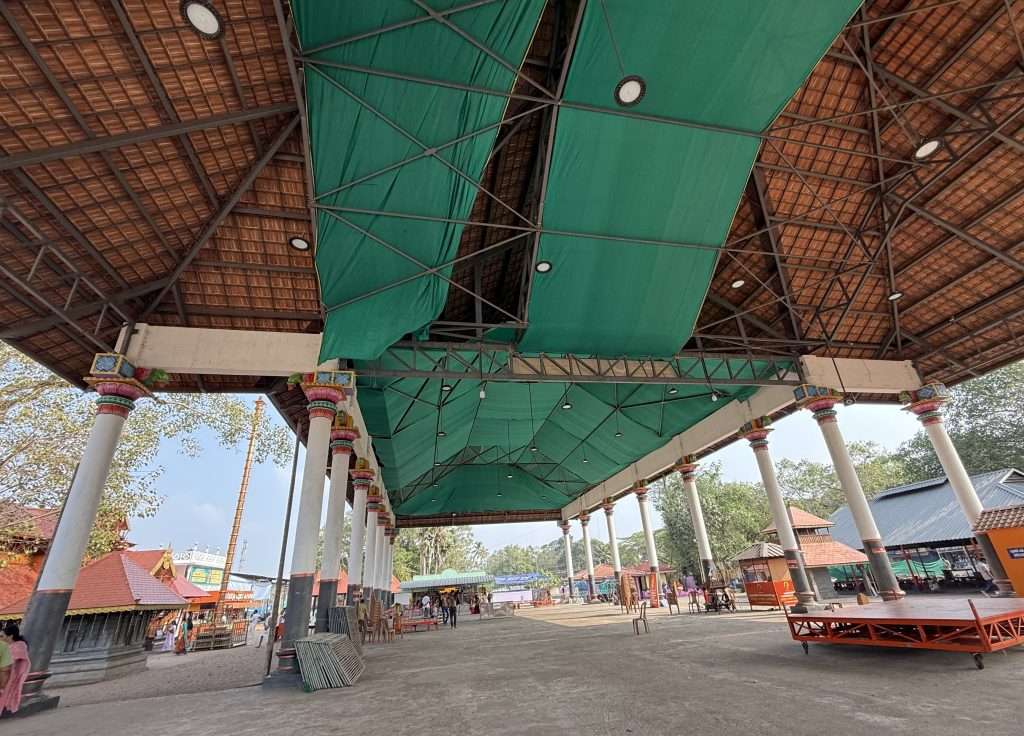
Mararikulam is conveniently close to 2 famous temples. We had visited a couple of churches and a synagogue so far, so it seemed the right time to make an early morning visit to a Hindu Temple.
The nearest temple to our hotel was Sree Mahadeva Temple or Mararikulam Shiva Temple. This age old temple is believed to be the only temple in Kerala where Lord Shiva and his consort Goddess Parvati can be seen sitting face to face. If you are a devotee, you can ask Lord Shiva to grant your wish. The temples was around 3 kilometres away and so too far to walk there and back in the Indian heat on a road with no pavements. It was time to flag down a tuk tuk.
Forgetting your air conditioned saloon with its modern suspension and WiFi for a while and hopping up into the back seat of a tuk tun is really a Must Do experience while you are travelling in India. The roar of many 2 wheeler engines, screeching brakes and honking horns are several decibels louder when you have no car windows to muffle the noise. If you are tall, you will need to bend your head, so a long trip probably wouldn’t be too much fun then. You will find yourself close enough to the traffic on the other side of the road to touch hands – or at least wave hallo. The back seat is a one way system – there are a couple of rails on one side which may – or may not – help to keep you and your belongings safe!
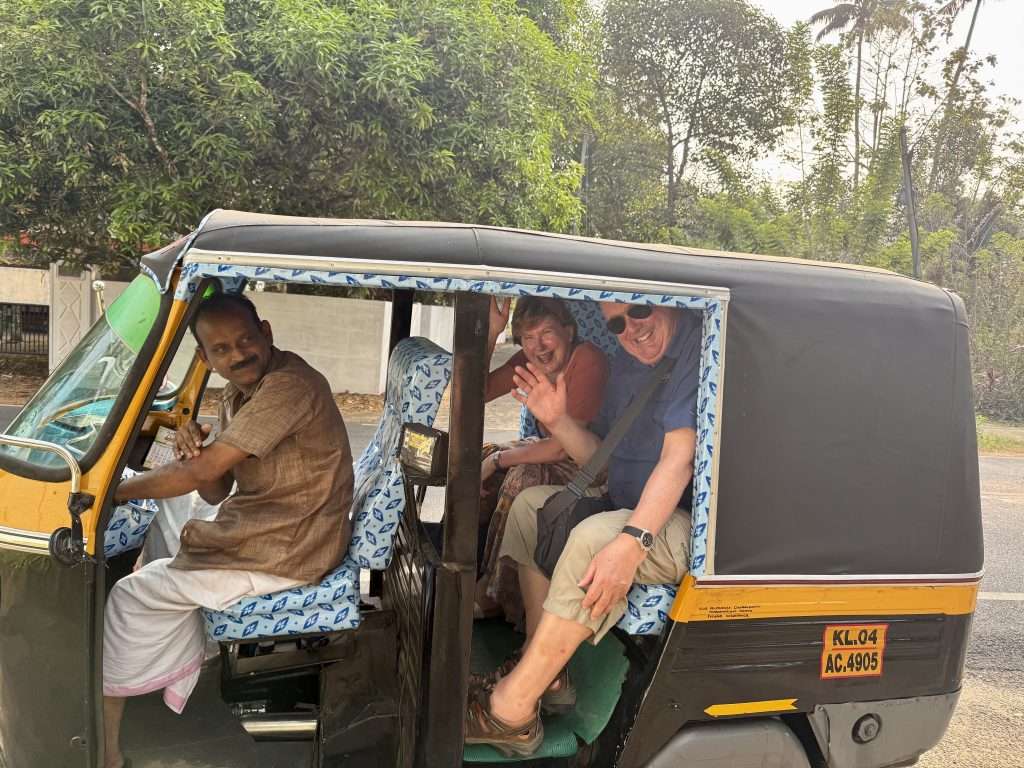

Our tuk tuk driver was happy to wait while we visited the first temple and then drove us on to Kanichukulangara Devi Temple (also known as Kanichukulangara Bhagwathy Temple), which is located a couple of kilometres further up the road. Kanichukulangara Temple is a famous temple of the Hindu mother goddess Bhagawathi. The round ride cost us 600 rupees with the waiting time included. It made a nice and economical half day trip.
Visiting a Hindu Temple - Do's and Don'ts
Etiquette is always important when travelling. If you aren’t aware of what the customs are, then you can unintentionally cause offence by appearing to disregard them. Here are a few things it’s good to know before you make a visit to a temple:
- Do remove your shoes: Entering a temple barefoot is a sign of respect. Remember that the temple often starts at the outside walls, so remove your shoes at the perimeter and walk on the sand barefoot. Backpacks should be left outside too.
- Do dress modestly:. Wear long trousers or a skirt and cover your shoulders. Shorts and skirts/short dresses are a no no. None of the ladies I saw in the temple were wearing scarves though.
- Do make an offering: As you enter the temple, you can make an offering of flowers, sweets or food to the deities.
- Do walk clockwise: Walk around the inner sanctum in a clockwise direction, paying your respects to the deities as you go.
- Do accept gifts/blessings from the priest. After the priest performs the prayer, sweets may be offered to visitors. He may also wash your hands as a sign of purification. If you are offered a gift of food, take it with your right hand and never your left (which is considered unclean).
- Do participate in the prayers: If there is an event going on, participate by listening and enjoying the music – no more is required.
- Don’t wear any leather: Some temples prohibit leather items due to the Hindu reverence for cows.
- Don’t take photos inside.
- Don’t talk – silence is golden!
All Good Things Come to an End - 2 Days in An Indian Summerhouse in Muvattupuzha
It was a 2 and a half hour drive from Mararikulam to Muvattupuzha. From the sweet smelling flower garlands and glasses of delicious and refreshing carrot lemonade that were bestowed on us on our arrival, it was clear that the Indian Summer House was going to be a grand finalé to a memorable trip to India. There are only 5 rooms and they are all beautifully decorated with the best of Indian style furnishings. The large swimming pool is immaculately maintained and well shaded.
A range of carefully thought out local excursions & activities ranging from yoga to an afternoon tea and a guided tour of the many shops in Muvattupuzha are available to guests. If you love cooking – you can even join the chef and help him to prepare the evening dinner for you and your fellow residents.
For more information on where we stayed during our 3 week stay in Kerala, follow the link below.
Afternoon Tea with Mohanan
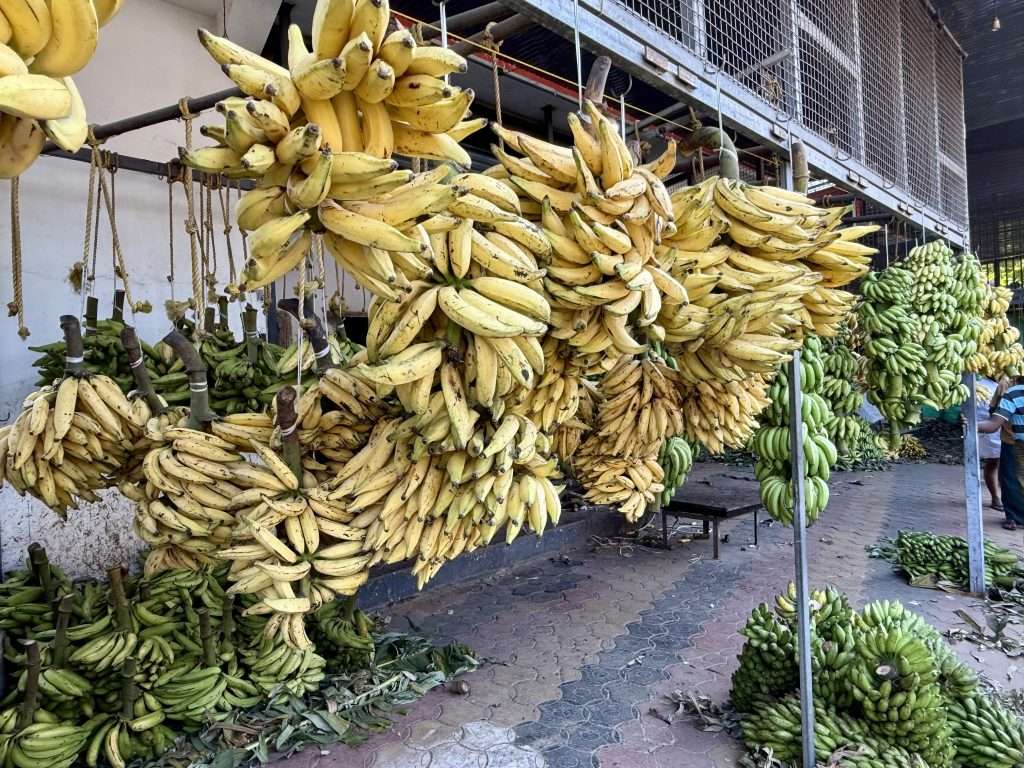
The boatman canoed us across the Muvattapuzha River to take a short walk through the rubber and tapioca fields to Mohanan’s Tea House – a family run enterprise for 3 generations. We enjoyed Mohanan’s freshly prepared chai tea (made with milk from powdered tea) and tiffin of Pazham Puri (banana fritters), Tapioca Chips, and spicy Parrippu Vada (lentil fritters). We sat under bunches of ripening bananas chatting with fellow travellers and locals for whom this is a regular haunt for a refreshing late afternoon cuppa. We returned via tuk tug with a stop at a fabric shop in town where I bought 10 metres of top quality Indian fabric for £4 a metre.
Souvenirs I am Glad I Bought
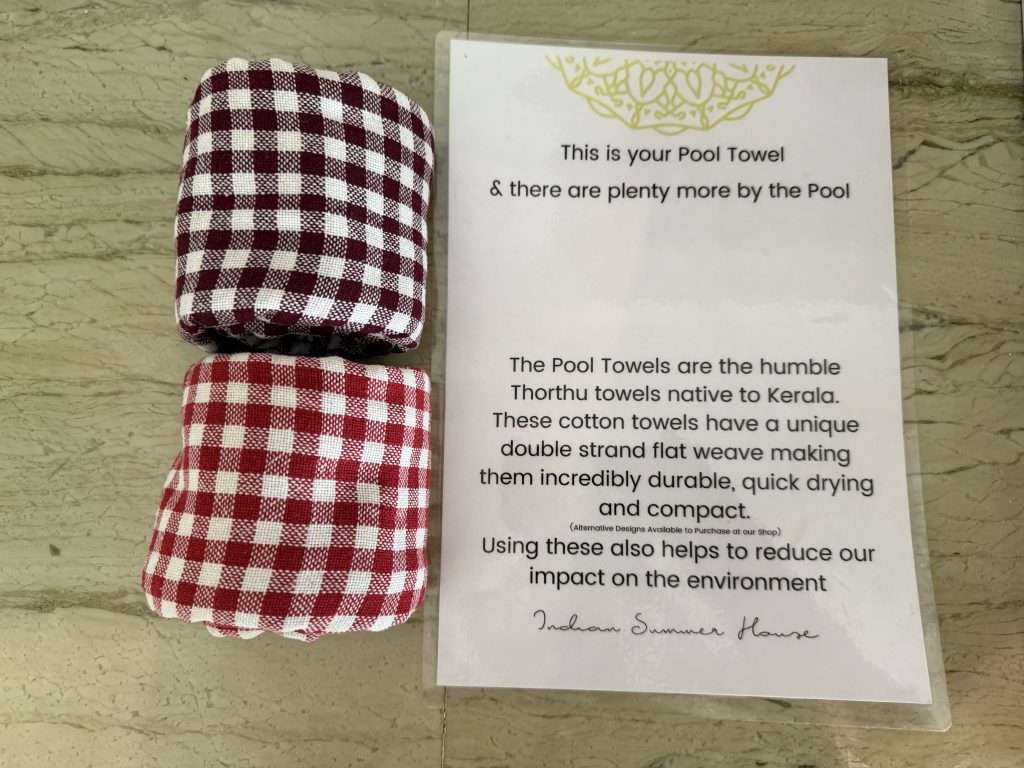
The tiny shop at the Indian Summer House is stocked with some beautiful items all handmade by the Virmala Welfare Centre – a Social Service Society established to provide education and provide a meaningful livelihood to marginalised women. I have never bought so many souvenirs on a trip, but there were some things that were just too good to leave on the shelf – especially as the purchase would help to support such a good cause, so I made room in my suitcase for 5 traditional Keralan thorthu pool towels. These cotton towels have a unique double strand flat weave making them incredibly durable, quick drying and compact and saving the planet at the same time. So that’s my 2025 Christmas shopping started!
Tips for Future Travellers
A definite tip is to pack light for a trip like this, because there are just so many souvenir buying opportunities to tempt you as you travel through Kerala. So do yourself a favour and make use of the laundry services en route to leave plenty of room for souvenirs.
Foodie Firsts - Keralan Cuisine
The magic of Indian cooking revolves around adding the right spices and herbs at different stages of cooking. We enjoyed a couple of cooking classes during out trip, one in Thekkady and one at the Indian Summer House.
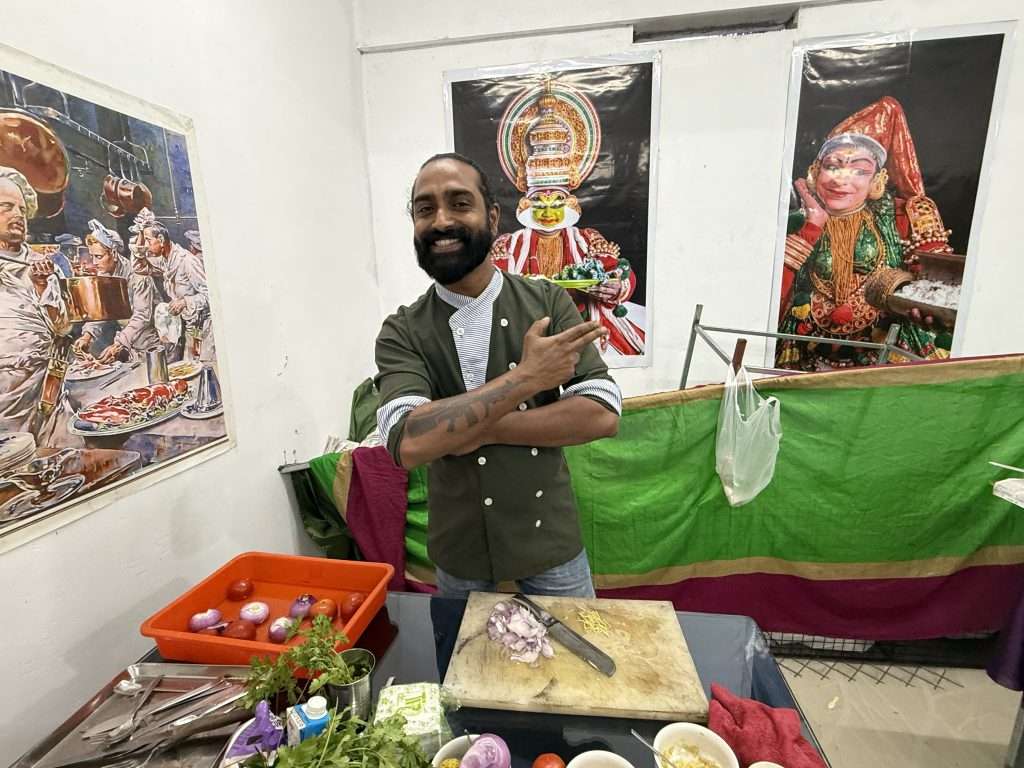
Tiger Chef - Thekkady
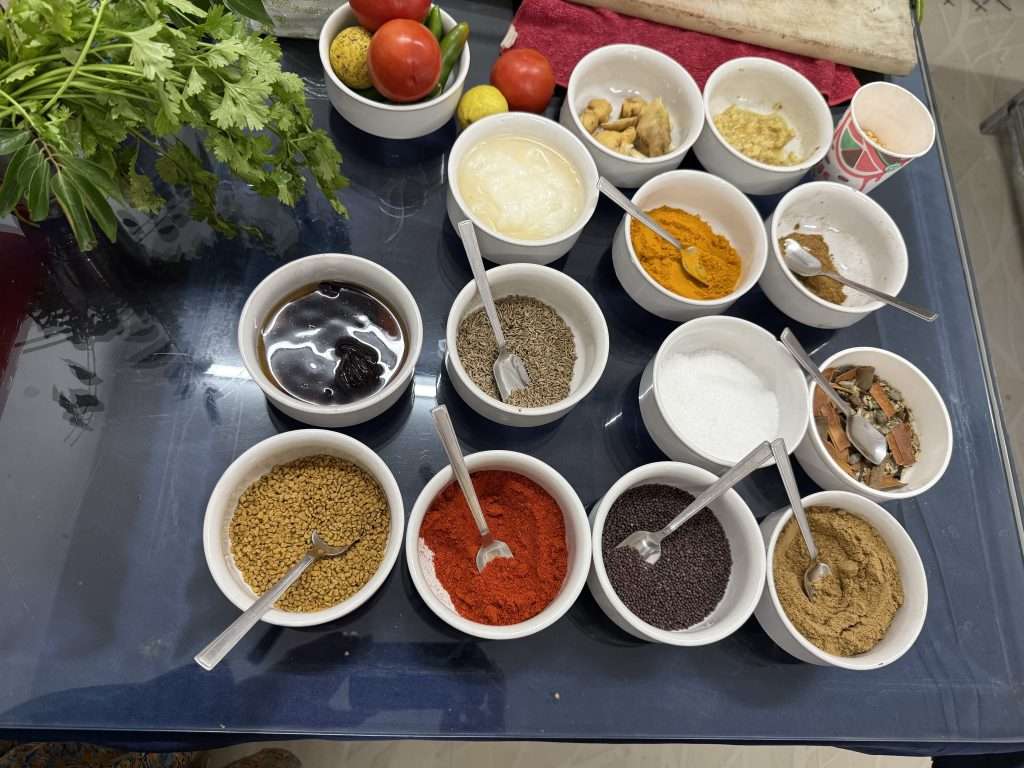
Joshy Joseph jokes that he calls himself the Tiger Chef because you are so unlikely to see a tiger at Peryiar Tiger Reserve he aims to make up for the disappointment by offering you a great cooking class experience. In the tiny open air space at the top of his house, the Tiger Chef took us through a range of recipes step by step. We learned how to cook Kerala Fish Curry, Thaw Grilled Chicken, Yellow Dal Fry and Beans Thoran. This was hands on cooking – not a demo. We even got to grate the coconut on the traditional old fashioned machine that his wife was still using. We learned about the importance of coconut oil and coconut milk in Keralan cooking and marvelled at the range of spices involved, each being carefully added in just the right quantity at just the right time to add sufficient flavour and heat to the dish.
After the class was finished, we enjoyed eating what we had prepared in the company of Joshy and his wife and their three kids. We had some fun making Origami paper birds with the children and learning some Hindi dance moves. An enjoyable evening all round and a great learning experience.
Indian Summer House - Cooking Class
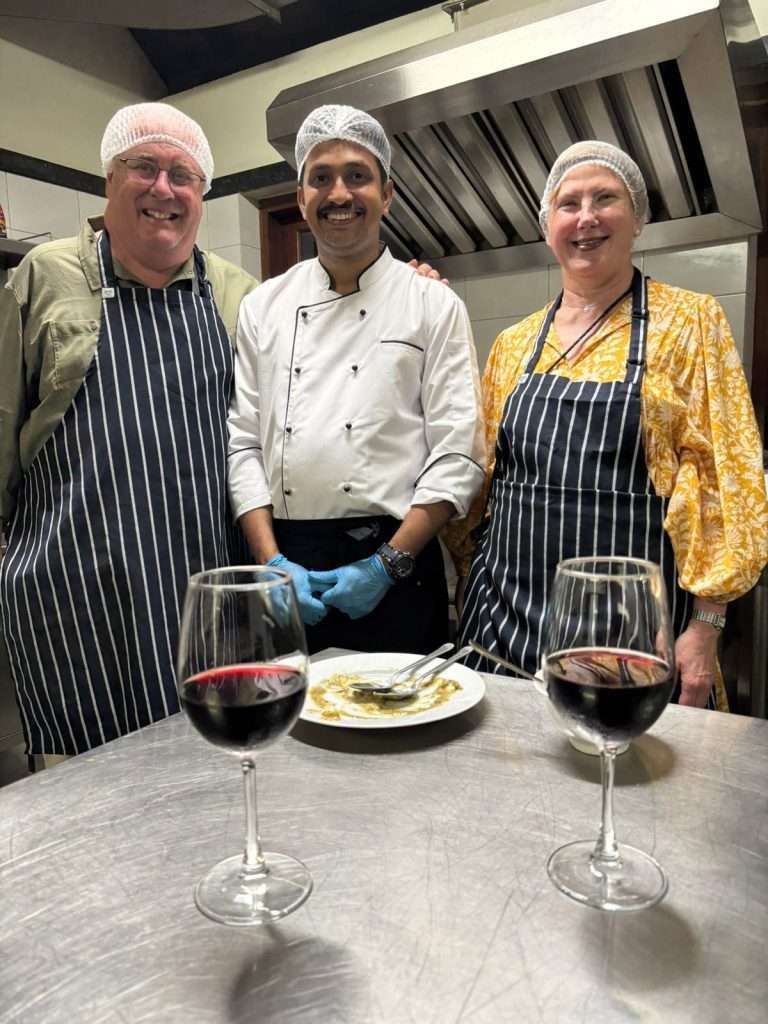
Our second cooking class was with the Head Chef at The Indian Summer House. The kitchen set up here was a little different from the Tiger Chef, but the techniques used were all the same. This time, we cooked a Beef Masala. I always thought that Masala was a type of curry, but in fact, masala just means a mixture of spices, so one chef’s masala mix can be quite different from another’s.
The immaculate, shiny, air conditioned kitchen at the Indian Summer House was a lovely place for our lesson and the chef was eager to help us learn how to master the secrets of Indian cooking. We wore aprons and a hairnet for our lesson too – hygiene was given top priotity. The mechanical coconut grater here was much easier to use than the traditional utensil at Tiger Chef’s too.
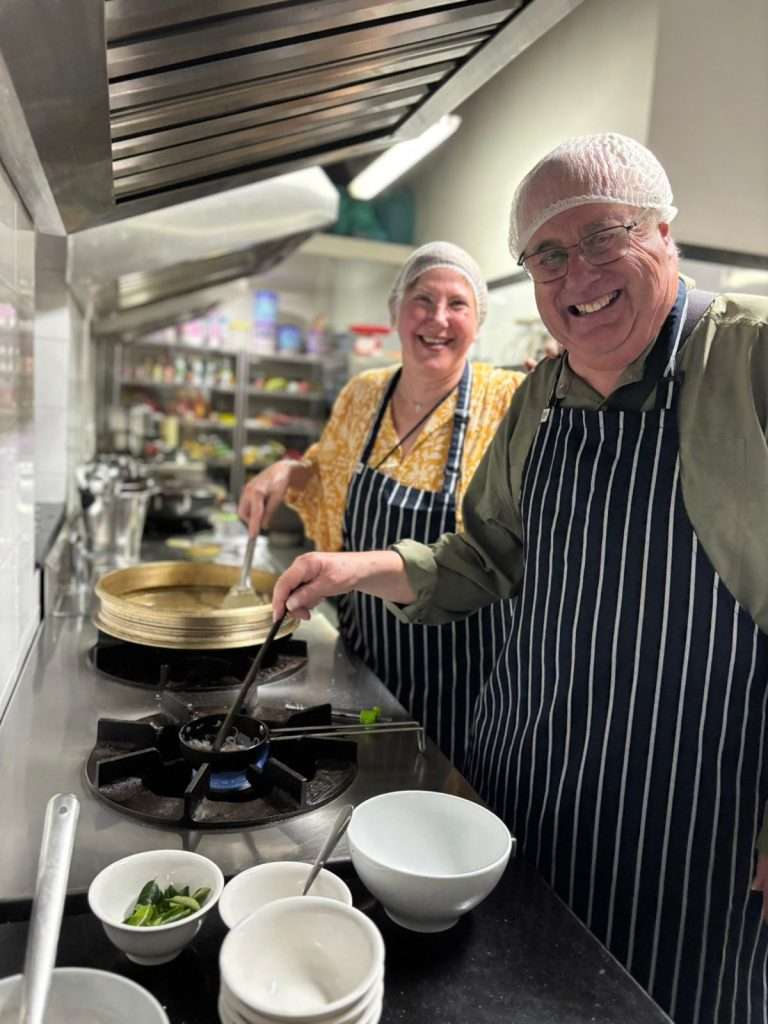
The required spices were prepared in a series of small bowls arranged in line in order of how they would be added to the deep, round brass pan with its pool of sizzling coconut oil. The beef as tenderised first in water in a pressure cooker with the addition of potatoes, which later disappeared into the masala sauce which helped to thicken it beautifully.
It took us a good hour to prepare the curry which made us appreciate the time it takes to cook a flavourful curry well. It needs to be freshly made, which means some patience and pre planning is required if you want to enjoy an authentic Keralan Curry. Our beef masala was served to the other residents of the hotel for dinner that night and seemed to go down pretty well.
Foodie Firsts
There were so many foodie firsts on this trip – at least a couple every single day of the holiday! Here is a small selection of my favourites:
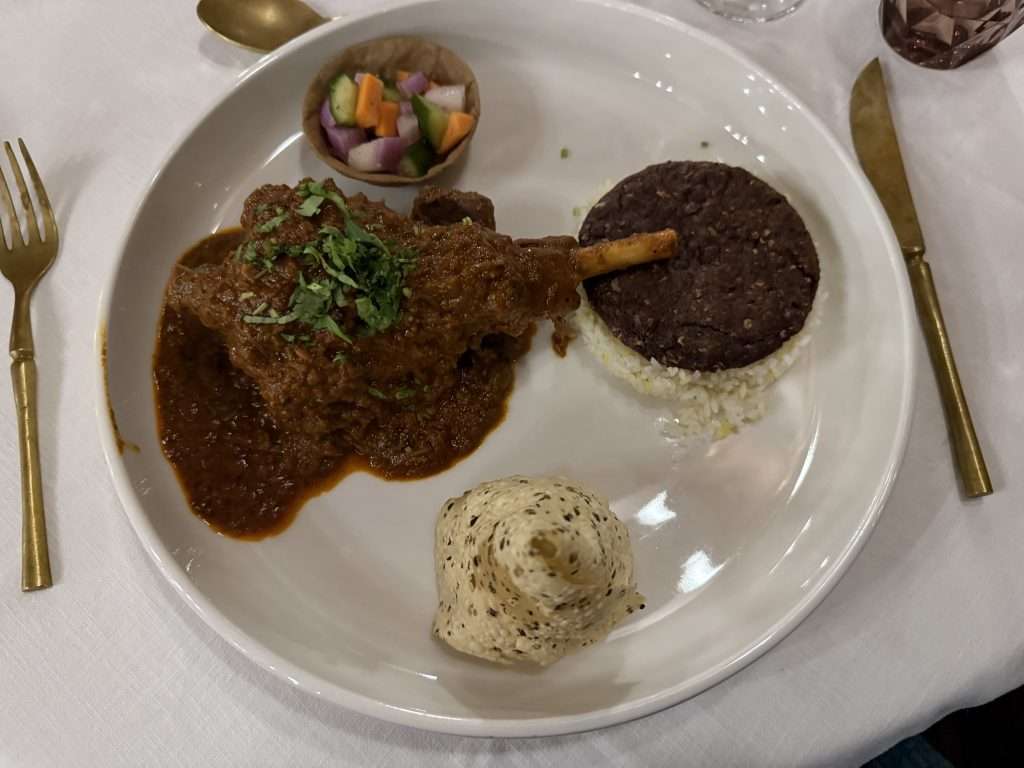
First Class Railway Mutton Curry
We sampled this succulent dish at the Brunton Boatyard in Kochi’s History Restaurant. As their menu explains: “The story goes that an English army officer, while travelling in a train, became ravenously hungry. He followed his nose to the pantry car, where a spicy mutton curry was simmering. He was offered a taste, whereupon he burnt his tongue because of the spices. The helpful cook reduced the pungency with some coconut milk and served it up. From that day on, this has become staple on all first-class train compartments. Our chefs use mutton shanks instead of just the meat and it is slow braised for over five hours in a special brass vessel and served with ragi roti, salad and papad.”
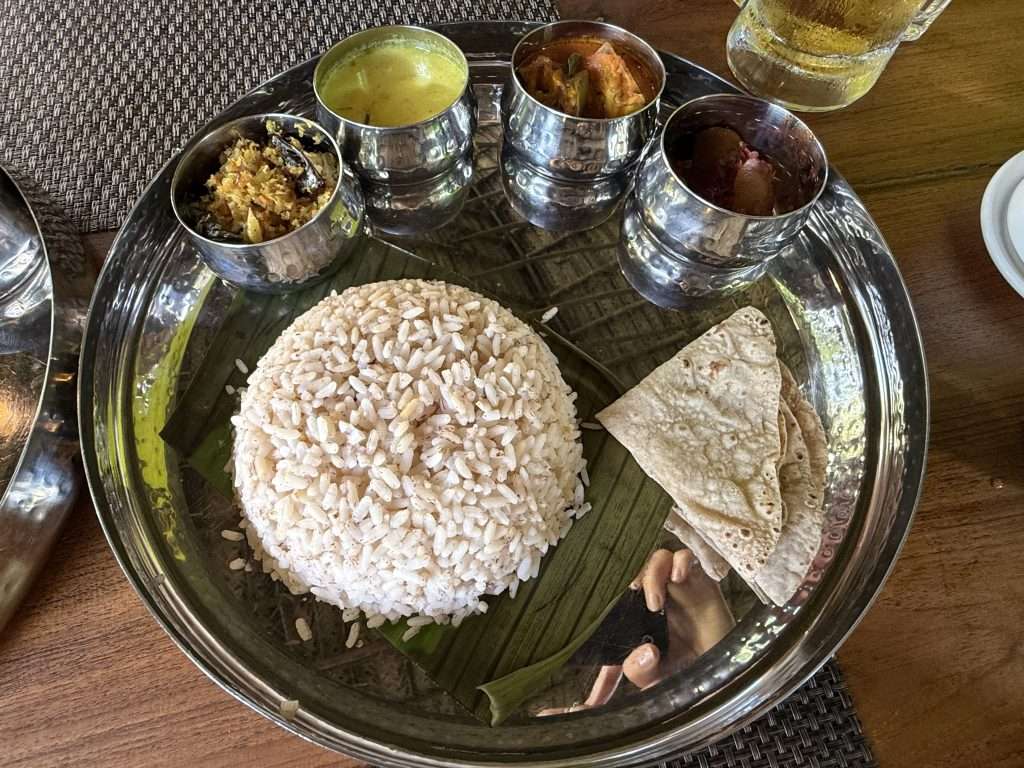
Vegetarian Thali Meal
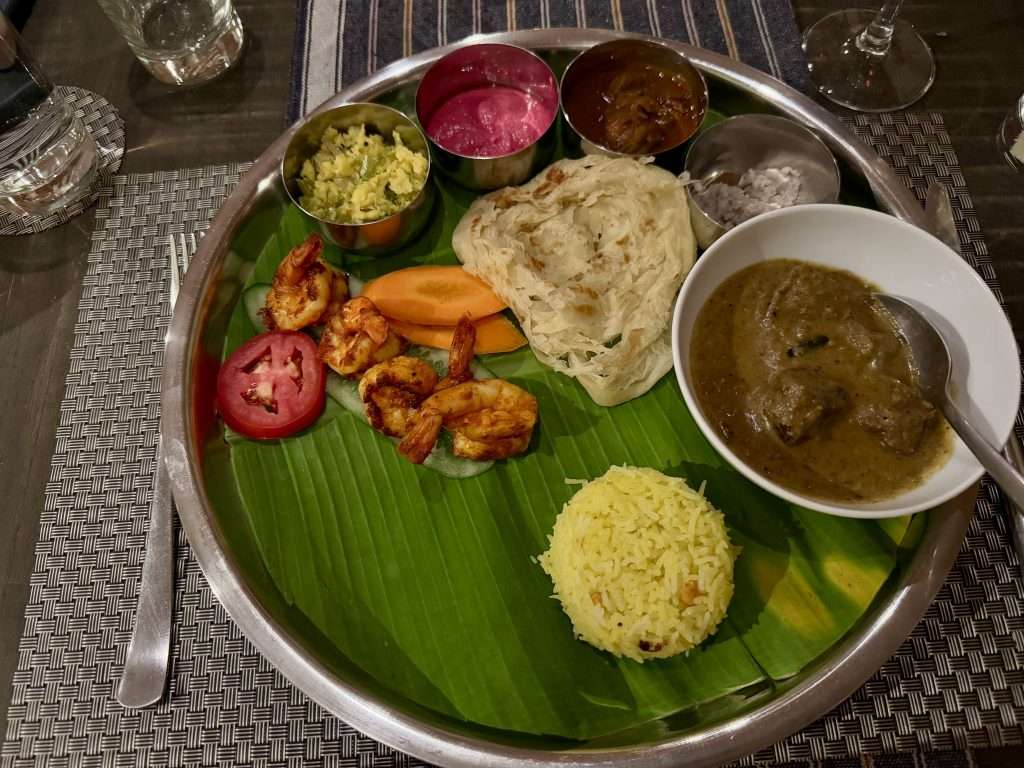
A Thali meal is a traditional assortment of traditional thali dishes – each meticulously prepared. It is a lovely way to taste a selection of India’s rich and diverse cuisine. We sampled a vegetarian thali meal at the Xandari Pearl Resort in Mararikulum It was a delicious combination of Kerala rice, chutney, dhal, coconut sauced cabbage beautifully presented on a banana leaf.
Masala Dosa
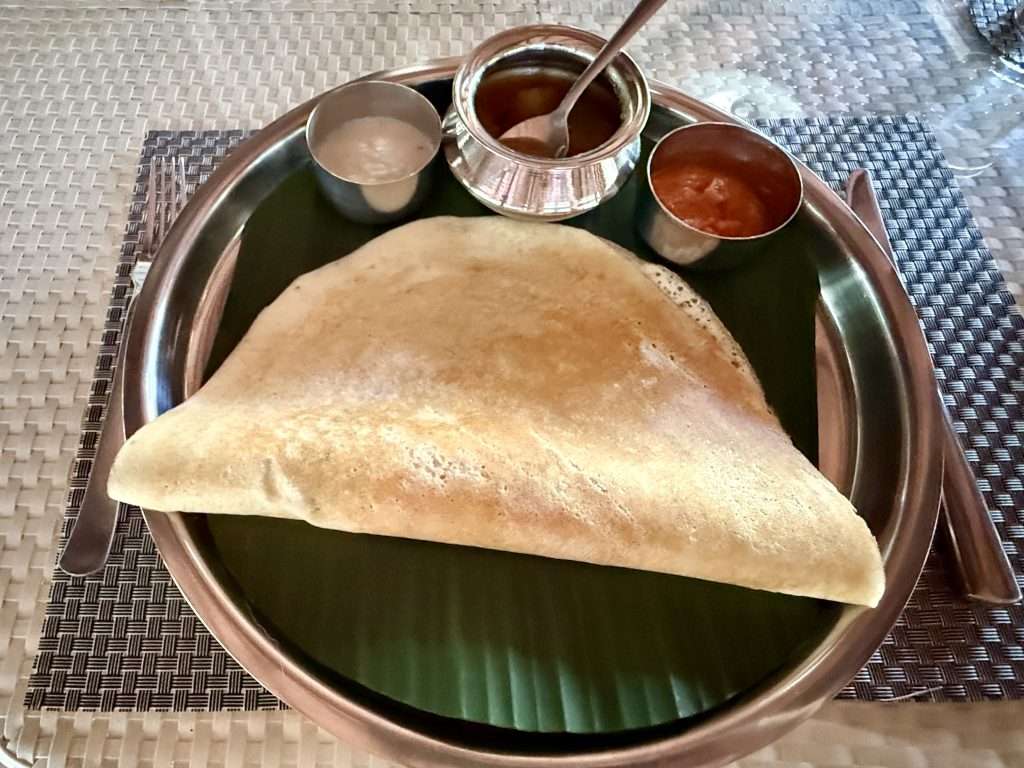
Masala dosa is a favourite breakfast dish in Kerala – but we were also served it for lunch one day. The basic recipe typically starts by soaking rice and lentils overnight in water and then grinding them into a smooth batter. The batter is fermented overnight and then spread thinly on a hot tava and pan roasted until it is crispy. The resulting light and airy pancake is then filled with potatoes and a selection of other vegetables with various spices added for flavour and some dry red chilli for a little heat. The masala dosa is traditionally served with chutney and sambar – a thick lentil based vegetable stew.
Glad I Packed
- Pro Biotics – I started them 2 days before I left home and they seemed to work!
- Mosquito Repellent
- Tissues – there is often no toilet paper in Indian lavatories
- Slip on shoes – great for visiting temples where you leave your shoes outside
- My Phone Cord – no worries of losing my phonon the houseboat or the tuc tucs
- Lightweight Cotton Dresses. Cinammon Junction have a great selection. They roll up small for pack without creasing, can be hand washed and hung to dry overnight in warm weather with no need for ironing and they are great for protecting your modesty at temples or on the beach as well as giving you protection from the sun and from mosquitos.
- An Umbrella – I bought it en route and used it as an effective sun shade on several of our walks.
- Apple Ear Buds – None of the screens were functioning on Air India and no charging facilities either, but my Apple ear buds held 100% charge through the 3 weeks of our trip (with no use during the trip), so I could settle back and enjoy a good audio book on the flight home.

Learning the Lingo
With few exceptions, everyone we met on our trip had some command of English and was eager to speak it – or to translate for their friend/neighbour if required, so learning the lingo wasn’t much of a challenge. Nevertheless, it feels like the right thing to do to make an effort to communicate in the local language – even if just to say thank you when you have received good service or a kindness.
There is no chance of learning even a few words of Malayalam on a short trip like this though – pronouncing the names of the towns we are visiting on our 3 week itinerary presents enough of a challenge! Even if you could learn any Malayalam, you may well find that the person you are talking to speaks another language entirely as there are 121 languages spoken in a India (though only 22 0f those are officially recognised). Fortunately, as long as you can perfect the Indian head bobble, it is easy enough to let your body language do all the talking.
This seemed to be enough to express my heartfelt appreciation to the dancing girls along the way and my new friend the weaving lady at Coconut Lagoon and was always returned with a warm “Namaste”, which is probably the only word of the language you do need to master.
Namaste Kerala
Goodbye India – “Hope we see each other again. It was nice meeting you.”
उम्मीद है फिर मुलाक़ात होगी। आपसे मिलकर अच्छा लगा।
You May Also Like
GPSmyCity App
Three of the destinations featured in this post- Kochi, Thekkady and Munnar – are now featured on the GPSmyCity App.
Find out more on this post:
To download these articles for offline reading or create a self-guided walking tour to visit the attractions highlighted in this post go to: