Table of Contents
Exploring Australia’s Big Red Wilderness: A Luxury Expedition to the Kimberley Coast
Ancient Aboriginal rock art, towering waterfalls, tidal wonders and five-star comfort along one of the world’s last great wilderness coastlines – let’s explore the Kimberley Coast.
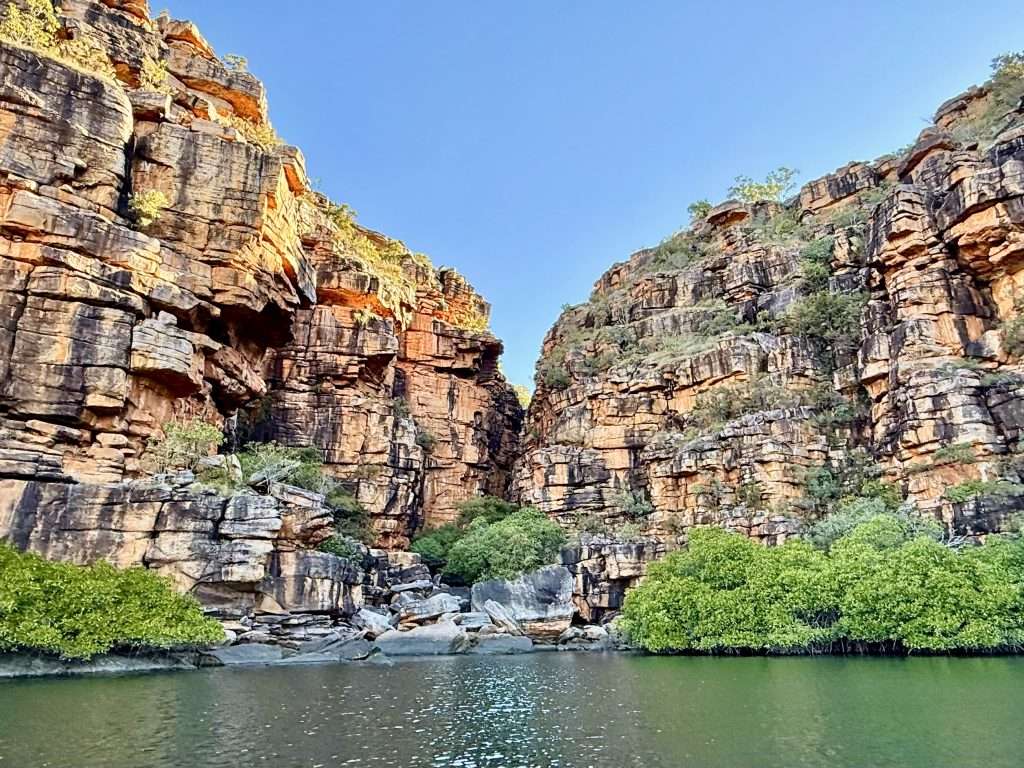
Covering an astonishing 423,000 square kilometres spread over Australia’s entire north-western corner, the Kimberley is one of the world’s last true wilderness regions. Three times larger than England but with a tiny population of less than 40,000 (nearly half of whom are Aboriginal), the Kimberley region remains one of the most untouched and tranquil regions on earth. Towering red cliffs, dramatic gorges and majestic canyons over two billion years old are home to prolific wildlife and ancient aboriginal rock art. Natural wonders of the world such as breathtaking flat waterfalls and a tidal reef that magically rises out of the sea at low tide take your breath away. The Kimberley region truly is the stuff of outback dreams.

Why You Should Visit the Kimberley Coast on a Cruise
Travelling through the Kimberley requires a sense of adventure. Let’s get one important fact straight at the outset – there is no road along the Kimberley Coast. The closest you can get to it on land is the Gibb River Road – a 660 kilometre unsealed outback track which stretches from Derby in the west to Wyndham in the east. Once a cattle route, the Gibb River Road is now regarded as a tourist route through the Kimberley region, but it remains a remote, unsealed outback track with severely corrugated sections, blinding dust, deep water crossings, animals (eg kangaroos) on the road and no mobile phone coverage. Even in a 4 wheel drive vehicle, driving the Gibb River Road is not for the faint hearted. Add to that the saltwater crocodiles that inhabit the major waterways along the route and you begin to understand that for the majority of travellers, cruising is the way to go. Even if you are up for the drive, the only accommodation along the route is remote campsites.


A Kimberley cruise, however, provides unparalleled access to this remote region, allowing travellers to explore its hidden treasures and marvel at its extraordinary, untouched beauty whilst enjoying all the comforts and luxury of a cruise ship.
Cruiselines can offer expertly organised Zodiac excursions, allowing travellers to visit remote locations inaccessible by any other means and get up close and personal with the diverse wildlife in their natural habitat. Cruise lines also usually have expert guides on board who can provide insights into the Kimberley’s wildlife, unique wonders and deep cultural history. Silverseas‘s Silver Cloud had no less than 24 people in her expedition crew all of which were experts in their chosen field spanning from ornithology to history, marine biology to entomology, geology to botany and everything in between. If you had a question about pretty well anything you had seen, there was always at least one person who could answer it!

Our Kimberley Itinerary - A 10 Day Expedition Cruise
We chose to explore the Kimberley on a 10 Day Expedition Cruise with Silversea. Having travelled with them before, we had confidence in their ability to deliver a great experience. The Kimberley expedition is on Silver Cloud – one of the older ships in their fleet carrying 254 passengers at maximum capacity and almost the same number of crew.
With 20 zodiacs, 10 kayaks and a choice of 4 restaurants, you can sit back, relax and enjoy the luxury of a fully air conditioned ship whilst the expert crew take care of managing all the logistics of your adventure in the remote Australian wilderness for you. For the first time, we booked a veranda suite on this voyage as we knew it was going to be hot and wanted to be able to enjoy the stunning views of the moon, sunrise and sunset from the comfort of our own balcony. We were careful to choose a suite on the port side of the ship as this offers marginally better views en route.
We travelled a grand total of 1,753 nautical miles on our expedition cruise around the Kimberley Coast:

Darwin to Ashmore Reef – 463 nautical miles
Ashmore Reef to Wyndham – 413 nautical miles
Wyndham to King George River Region – 134 nautical miles
King George River Region to Vansittart Bay & Jar Islan – 103 nautical miles
Vansittart Bay to Hunter River – 178 nautical miles
Hunter River to Montgomery Reef – 160 nautical miles
Montgomery Reef to Freshwater Cove – 18 nautical miles
Freshwater Cove to Talboy Bay – 53 nautical miles
Talbot Bay to Broome – 231 nautical miles
We travelled with four friends that we met on our Antarctica expedition with Silversea. It is amazing that we could arrange this trip with friends from as far away from the UK as Gold Coast and Seattle and our reunion made the voyage doubly enjoyable.

Darwin
Our voyage began in Darwin –the tropical capital of Australia’s “Top End” – the Northern Territory. Darwin is a resilient, modern city having rebuilt itself from the devastation of heavy bombing during World War II and subsequently being flattened by Cyclone Tracy in 1974. Darwin is the gateway to the Kimberley region, but is in fact closer to Asia than it is to Australia providing access to Bali, Singapore and Jakarta.
We only spent 1 night in Darwin so had little time to explore in any depth. The city’s maritime and wartime history is well narrated in the outdoor memorial plaques surrounding the Cenotaph and Bicentennial Park overlooking Darwin Harbour on The Esplanade.
Ashmore Reef
After a day at sea acclimatising ourself to life on board, we anchored in the Indian Ocean close to the fragile protected environment of the Ashmore Reef Marine Park. The colourful reef is home to countless species of nesting seabirds and migratory shore birds, 500 species of fish but also marine turtles, dugongs and dolphins.


To protect the fragile reef, human activities can only take place in the Recreational Use Zone which includes a small area of the West Island – one of the three tiny islands in this remote area. The rest of the area has been declared a Sanctuary Zone where only scientific research is permitted.

Ashmore Reef boasts around 255 species of reef building corals – some of the highest diversity in Australia. The reef is a sprawling, remote coral platform located in the Indian Ocean. It features flourishing hard and soft corals, extensive seagrass meadows, and deepwater drop-offs that support an incredibly high-density of marine life including dugongs, turtles, and over 500 species of fish. You can drift over a richly coloured kaleidoscope of huge coral bommies, intricate brain coral, sprawling table coral and dense forests of stag horn coral as you watch shoals of tiny brightly coloured fish dart in and out of their pretty playground. Giant clams, blue starfish and slow moving sea cucumbers come into view as you move slowly over the reef in amazement at this underwater world that is usually hidden to man. What other wonders might there be lying buried in the hidden depths of the ocean beyond where you can venture even on a close exploration like this I wonder?


You would undoubtedly get the best views of the reef and its marine life if you snorkelled, which many passengers did. I am not yet a confident snorkeller, but I was able to see all the beauty of Ashmore Reef from the deck of a purpose built glass bottomed zodiac. I was very grateful to the Silversea team for making this option happen for non-snorkellers like me. Snorkelling is now very high on my “Things I must Conquer” list though – I just need a very calm sea to have another go at it!
Wyndham - El Questro Homestead - Welcome to Country
Aboriginal and Torres Strait Islander Australia is made up of many distinct indigenous groups, each with their own culture, customs, language and laws. You can view a detailed map of the Indigenous Australia on this link. When Aboriginal people use the word “country”, it means so much more to them than a term describing the lands, waterways and seas to which they are connected. “Country” has a much deeper meaning encapsulating complex ideology about laws, place, custom, language, spiritual beliefs, cultural practices, material sustenance, family and identity. It is, in effect, the word used to convey the meaning of life.
Welcome to Country
Being welcomed to Country means that your hosts are talking to their spiritual ancestors and asking them to let a visitor come through. It carries a trust that the visitor will do no harm to the Country and that in return, the Country will look after them and ensure they they will come to no harm on their visit. Music and smoke usually accompany a true Welcome to Country ceremony. The scent of burning eucalyptus trees is regarded as a way of cleansing the mind and spirit. We experienced our first Welcome to Country at the El Questro Homestead close to Wyndham where we were welcomed by the Ngarinyin and Balanggarra people.


We learned much from the family who welcomed us to their Country. I was particularly interested to hear about aboriginal avoidance laws which prevent fathers and daughters in law and mothers and sons in law from conversing. Brothers and sisters are also brought up to “give each other the side” after puberty and talk to each other only through other people. This separation is designed to prevent incest, regulate marriage eligibility and preserve family harmony across generations

We learned too about “The Dreaming”. The Dreaming is the term used to describe the process of the creation of the universe by the Ancestral Spirits who shaped the land, formed the mountains, rivers, and animals and laid down the moral and social laws for human life. Many ancient artworks depict the Wandjina (the iconic, mouthless cloud and rain spirits who govern the sky, clouds, and storms) which interact with the Wunngurr – the serpent who governs the water on earth, including rivers, pools, and underground spring. The laws, ceremonies and totems established during the creation period have been passed down through the generations through songs, dance and art and remain very much alive today.
Wyndham
Wyndham is a small outback township. It was established back in 1886 with the Halls Creek Gold Rush. Today Wyndham has a population of only 900 people and operates largely as a port gateway to the Ord River exporting cattle, servicing the mining industry and hosting a few small ships. We drove through Wyndham on the way to visit the El Questro Homestead. The little settlement has changed a lot over the years. The most prominent buildings I could see in Wyndham were the police station, the prison/work camp for offenders, the alcoholics rehabilitation centre and the welfare centre.
Boab Trees
The road between Wyndham and El Questro Homestead is peppered with the stately Kimberley boab trees. Like humans, they come in many shapes and sizes. They usually have a wide base and a thinner neck with a tangle of branches on top that looks like a messy hairdo. The boab’s tuberous root is edible in season. When in fruit, the boab tree produces nuts which are used to produce some truly beautiful artwork.


Indigenous artists in the Kimberley region hand-carve the hard boab seed pod using sharp tools to scrape away the dark outer layer exposing the lighter inner fibrss beneath. We saw examples of delicately carved kangaroos and also depictions of a Wandjina spirit figure with the distinctive large, round face; prominent, wide eyes with lash-like ray lines and a distinct lack of a mouth. Wandjinas do not have mouths because it is thought that having one would unleash unstoppable rains and floods.


Kimberley Kapok - Nature's Calendar
The yellow flowers of the wild kapok bush also punctuate the roadsides. The indigenous people used kapok as a powerful calendar. When the vibrant yellow flowers appear, crocodiles are mating and the females are building their nests. When the green seed pods emerge, nesting has taken place and female crocodiles will have laid between 25 and 50 eggs. By the time the seed pods burst open 9 weeks later, releasing their cottony seeds, the baby crocodiles will all have hatched.

In the heat of the late afternoon sun as the light begins to fade again for the day, a towering wall of glowing red rock face seems to rise with every kilometre we travel along the road back from El Questro to the ship. The delicate fringe of trees that somehow manage to attach themselves to the very edge of the escarpment appear minuscule – almost lost in the gigantic scale of this most rugged of wildernesses. The heat is intense here – I began to understand what people mean when they talk about the “Kimberley Hug”.

The Mighty King George Falls
Western Australia’s highest twin waterfalls – often described as Kimberley’s “Jewel in the Crown” drop 80 meters down a sheer sandstone gorge into the King George River below. Silverseas’s nippy zodiacs were able to get us right into the action as our skipper aimed the bow right under the tumbling water showering us with the spray. Exhilarating stuff and one of the highlights of our expedition.


Do bear in mind if you are crafting your own itinerary for visiting the Kimberley that the King George Falls have the most water early in the season. If you visit towards the end (October), they may well have all but dried up!

Vansittart Bay - Jar Island and the Anjo Peninsula
Jar Island in Vansittart Bay is a popular place to anchor on a Kimberley expedition cruise to view the Bradshaw (Gwion Gwion) style of rock art. The Anjo Peninsula area is also widely known for its World War II history, including the famous C-53 Skytrooper wreck located on a nearby salt flat.
Aboriginal Art
As the Aboriginal People had no written language, important cultural stories were passed down through the generations by means of rock art. The artwork conveys knowledge of Country and teaches survival and ancient spiritual beliefs. Simpler formats were used for children teaching right and wrong and the consequences of good and bad behaviour. When told to an audience of initiated elders, the communication would be at a higher level conveying significantly deeper meanings and morals.

The aboriginal people painted with all that they had to hand. Red from blood and burnt limonite; orange and yellow from highly prized ochre pigments; white from chalk at the bottom of river beds, pipe clay, gypsum and burnt selenite; blue from glauconite and charcoal and manganese oxide for black. Their tools were fingers, feathers, rocks, stones and sticks. It is amazing to see what level of detail was created using just those few simple materials and to think that some of it has lasted for many thousands of years.
The ancient rock art in the Kimberley is manly of 2 types: Gwion Gwion and Wandjina. You can see pictures of both on the links for each style.
Dating back at least 12,000 to 17,000 years, the elegant figures depicted in Gwion Gwion art are celebrated as some of the oldest art on earth. The delicate paintings often show figures dressed in elaborately tasselled ceremonial dress. The large-eyed, mouthless creator and spirit figures associated with the Wandjina style of rock art are much younger dating back about 3,500 to 4,000 years. These precious paintings are still lovingly retouched by elders who have been given the required permissions to preserve them for future generations.


Interestingly, a gap of between 8,000 and 13,000 years separates the oldest Gwion Gwion style of aboriginal rock art from the Wandjina style. It is thought that the gap must correlate with a period when rising sea levels and drought caused the indigenous people to leave the area returning when the monsoons began again. Perhaps this is why the Wandjina creatures are so closely associated with water and rain?
Anjo Peninsula - C-53 Plane Wreck
More modern history (World War II) can be found by a wet beach landing on the Anjo Peninsula and a hike across a mud flat to an area where an almost intact wreck of a C-53 Skytrooper aeroplane can be seen . The story goes that the plane couldn’t find Broome because of the blackout – Darwin had just been heavily bombed. The plane had run out of fuel and so made an emergency landing on the Anjo Peninsula.
There are a number of stories about how it actually got there – we were told 3 in all. Who knows what the real story was?!

It was the little mudskippers and crabs on the salt flat that were the stars of the show for me on the Anjo Peninsula though. The on board lecture about the life cycle of these tiny little creatures was captivating.
Mudskippers are unique, air-breathing fish that spend up to 90% of their lives out of water. They construct deep, U-shaped tunnels in inter tidal mudflats by using their mouths to scoop and carry out chunks of mud. Their distinctive eyes sit high on top of their flat heads to maintain a 360-degree view while their bodies remain safely concealed in their burrows. Their courtship rituals have to be seen to be believed – sorry – I am afraid I didn’t manage to snatch any photos!

The Bungle Bungles
Many people assume that the famous striped domes of the Bungle Bungles are part of the Kimberley coast, but in fact, they are located in the Purnululu National Park deep in the East Kimberley around 300 kilometres south of Kununurra and well inland from the coast. We could have taken a helicopter flight to see them by air from Vansittart Bay (via Silversea), but I think incredible landscapes like this deserve time on the ground to absorb the awesome peace, stillness and scale of them and that simply wasn’t possible on this trip. If I ever come back to this remote part of Australia, I would stay at the Bungle Bungle Wilderness Lodge and take some time to walk through the Bungle Bungles and explore them properly.

The other way to see the Bungle Bungles from the air during your Kimberley trip is to take a scenic flight from Broome. Broome Aviation has regular flights and is way cheaper than taking an excursion organised by a cruise ship. Either way, you have to marvel at the way they were created over tens of millions of years. This is truly the stuff of dreams for geologists.
Hunter River
The Hunter River is THE place to see one of the world’s most immense mangrove systems spreading as they do at the feet of the towering red sandstone cliff faces above them.
Navigating the Kimberley is all about tidal flows because the range is huge here. In the Hunter river, high tide can be a full 8 metres above low tide. What starts off as a weird looking water system full of submerged trees gradually changes to expose the tangled tentacles of the mangrove trees and all the wildlife that make them their home. They provide shelter for numerous bird species, mudskippers, fiddler crabs and the most aggressive crocodile species known to man – the salties.


Mangroves are vital coastal ecosystems that act as powerful natural shields. Their tangled root systems protect coastlines from erosion and storms and absorb massive amounts of carbon dioxide to combat climate change. They also provide shelter for countless marine species that would not exist without them. Humans have found to their great cost that destroying mangroves removes essential protection and greatly increases the risk of catastrophic damage in the event of a tsunami.


The ship’s zodiacs got us as close to the mangroves as it is possible to get. I definitely don’t wish to be any closer to a hungry man eating saltwater crocodile than this!
What a difference a day makes to this area. By the afternoon, at low tide, we could see all the mangrove roots and the amazing pencil root system now exposed. The pencil roots are specialised aerial roots that grow vertically upward from the underground horizontal roots functioning as ‘snorkels’ for the trees as they struggle to thrive in highly waterlogged, oxygen-poor mud.

Mitchell Falls
The photogenic Mitchell Falls are located around 70 – 100 kilometres inland from the coast. I confess that I would really like to have seen the four tiers of waterfalls plunging into the deep emerald green pools that flow out into the mighty Mitchell River, but the only way to visit them during a cruise is to take a helicopter flight, which can be arranged separately on Silversea, but my budget didn’t run to this. Alternatively, you could also arrange to see them via a flight from Broome via Broome Aviation which would no doubt be substantially cheaper.
Montgomery Reef
Montgomery Reef is an incredible natural phenomenon which appears to rise up out of the sea as the enormous tides around Yawajaba Island offshore from the Prince Regent River begin to recede. The reef spans over 300 square kilometres and stretches about 80 kilometres in length, making it the largest inshore reef in the world. The water rushing off the reef during a single tide cycle can fill roughly 400,000 to 600,000 Olympic-sized swimming pools – that’s millions of litres of water gushing off the coral platform every single second!
Silversea‘s nippy rubber zodiacs zipped through the swirling channels of the reef as the water cascaded down into the ocean giving the illusion that the ocean was draining. Water bubbled and spurted from all over the emerging reef as a myriad of tiny rushing waterfalls twinkled like a necklace of diamonds in the early morning light. This incredible sight was the unparalleled highlight of the trip for me. Unfortunately, photographs just cannot do it sufficient justice – this is one sight you really have to be sitting right in front of to appreciate the wonder of it. How lucky we felt watching schooling fish and turtles swim around us as we gazed in awe at this miracle of nature. The full moon spring tides are the perfect time to witness the splendour of Montgomery Reef at its very best.


Sunrise, Sunset and the Light of the Silvery Moon
I knew when I booked this trip that the Kimberley would be a magical place to see sunrise and sunset, but I really hadn’t appreciated just how beautiful the moonlight would be. Several days required a very early morning start to catch the tide and see the environment at its best. Montgomery Reef was particularly demanding in this respect as there are 10 metre tides here requiring a 4.30 am wake up call to be sure that we were ready in time to see it at its exposed magnificent best.


This had the added bonus that we got to see the moon before it went to sleep for the day and – on the other side of the ship – the early morning sunrise at the same time. By the time we were finishing our expeditions for the day, the sun was beginning to set which meant three photographic highlights in a single day – and that is without including Montgomery Reef!

Freshwater Cove - Wijeengadda Bard Bard
Silver Cloud moved her position during the day to allow us to anchor at Freshwater Cove (Wijeengadda Bard Bard). A very steep walk later that afternoon – in blistering heat – gave us an opportunity to see a little more of the vegetation of the Kimberley and visit an ancient Aboriginal rock art cave at the Dambimangari Indigenous Protected Area, Prince Regent River.


Talbot Bay - The Horizontal Falls

Sir David Attenborough once described Horizontal Falls as “one of the greatest natural wonders of the world”. In the turquoise water of Talbot Bay, which is subject to 13 metre tides, the rapid tidal currents squeeze through two narrow gorges forcing the water through the twin gaps at breakneck speed producing cascades that are effectively turned on their side creating the phenomenon of horizontal waterfalls. To appreciate the nature of what is happening here, it really helps to look at a topographical map of the area around Talbot Bay.


The power of the motion in the ocean is exhilarating to feel through the base of a little rubber zodiac. Sadly, a major accident took place at the Horizontal Falls on the 27th May 2022 when the high-speed tour vessel Falls Express crashed into a rock wall leaving 27 passengers with serious injuries. As a result of the incident, it was decided to phase out fast-boat trips through the falls to protect both the sacred cultural significance of the site and visitor safety. A ban on traversing the falls is now in place for most tour operators with the last licence expiring in March 2028. While we were watching the falls, we watched a small boat make the treacherous traverse and you could see why there is now a phased ban in place. The video below is scheduled to be one of the last that can be taken, so enjoy!
It is quite hard to appreciate the significance of the Horizontal Falls from the vantage point of the boiling ocean that lies just in front of them. Viewing them from the air would probably give you a better impression of what is actually happening in front of your eyes?
The Buccaneer Archipelago
Our Kimberley expedition was coming to a close now as we sailed through the scenic 800+ rocky islands of the Buccaneer Archipelago on our way to Broome.
Which is the Best Way to see the Kimberley: Darwin to Broome or Broome to Darwin?
There is a debate over which way to travel the Kimberley coast: which is best: Darwin to Broome or Broome to Darwin? I’m not sure it makes much difference to be honest. I was happy we took the Darwin to Broome route because the cruise got more spectacular as it went on, finishing with the highlights of Montgomery Reef and the Horizontal Falls which gave a crescendo to our expedition. Also, Broome is closer to home in the UK for us, so it also made good financial sense to do the trip this way around.
Broome
Our expedition ended in Broome, which gave us the opportunity to spend a few days exploring the coastal city that had been too far north to visit on our previous visit to Western Australia. You can read more about Broome on the next post.
Tip for Future Travellers
There was some confusion at the end of our cruise about whether taxis could be hired to collect passengers disembarking at Broome’s cruise terminal. We were told that this wasn’t possible and that we would need to transfer to a hotel in town and book a taxi from there. Taxis to the airport or to Cable Beach Resort could be booked via Silversea for $US70 per guest. We were glad that we chose not to book through Silversea at this exorbitant price and found a taxi very easy to pre book on line for a collection from the Broome Port Jetty to anywhere you wanted to go in town. I can highly recommend Broome Private Taxis who provided a highly efficient service for a fraction of the price we had been quoted by Sliversea.
When is the best time to visit the Kimberley Coast?
Kimberley - The Land of Two Seasons
The Kimberley has two distinct seasons: the dry season (April-October) and the wet season (November-March). The dry season offers comfortable temperatures with daytime temperatures between 20 – 30 degrees C, cooler nights and waterfalls at their peak level of flow. King George Falls and Mitchell Falls are at their best at this time.
The wet season delivers dramatic waterfalls for sure, but high temperatures (24 – 35 degrees C), 90% of the season’s annual rainfall an uncomfortable level of humidity and the real risk of cyclones.
Both lunar phases result in the most dramatic, maximum tidal movements in the Kimberley region. Whether you are at a new moon or full moon, you will witness the most impressive flow at natural wonders like the Horizontal Falls and Montgomery Reef. So is there any difference between the two and if so, which is best? Visiting the Kimberley during a New Moon or a Full Moon primarily affects the tidal intensity and night visibility. The lunar cycle is around 29.5 days, which doesn’t tie in with the Gregorian calendar, so the timing of the Full Moon and New Moon varies through the year.
Full Moon
If you visit the Kimberley during a Full Moon, you can look forward to bright, silvery moonlight (which makes navigation easy). You may also witness the optical illusion of The Staircase to the Moon in Broome, if you time your visit to coincide with it. It happens 2 -3 days each month between March and October. We didn’t manage to see a Staircase to the Moon on our trip – but the sunset in Broome delivered a fiery red Staircase to the Sun instead!
New Moon
If you visit the Kimberley during a New Moon, you will be able to gaze upwards to some of the darkest skies in the world – The Kimberley has virtually no light pollution which gives you pitch-black skies and some of the best stargazing and astrophotography opportunities available to man. You will not be able to see the Staircase to the Moon, but you will be able to gaze at an exceptionally clear and vibrant Milky Way.
What about the Whales?
If you visit the Kimberley between June and September, you might catch the epic humpback whale migration in the calm, protected waters of Camden Sound.

Alternative Ways of Exploring the Kimberley Coast
We chose to visit the Kimberley with Silversea as we had travelled with them several times before and had confidence that they would deliver a great experience. There are a number of other alternatives though and making the choice of cruise operator is always a personal one. It is always a trade off between comfort, on board amenities, number of expedition guides, cuisine, stability of the vessel and – last but not least – cost. Itineraries tend to be very similar between the various operators, but some will offer longer voyages with more stops along the way if you really want to explore the region in more depth.
As I have no experience of the other operators, I will do no more than include some of their websites as a footnote to this post so that you can research the other alternatives that are available and suit your own preferences when planning your own trip. After all, it is worth spending a bit of time shopping around for what is likely to be a once in a lifetime experience. However you choose to do it, enjoy every moment!
Alternative Kimberley Cruise Operators
Kimberley Expeditions – Reef Prince
True North – Kimberley Explorer
Silversea Discounts
I should also add that Silversea offers referral discounts to travellers who are “New to Silversea”. Savings of up to £350 per suite are available, so do contact me if you want to take advantage of their offer. I am very happy to recommend them.
The Last Word - What Would Lee Do?
Keep in mind that saltwater crocodiles are dangerous and almost everywhere in the Kimberley. Not only are you not able to swim on the beaches, you are not even allowed to put your hands or feet in the water. I have to include this hilarious video which was shown to us on Silversea as part of the “Be Croc Aware” Safety Briefing. I hope it makes you chuckle. It certainly had us asking whenever we encountered a dangerous challenge or obstacle during our journey “What Would Lee Do?” A sense of humour has to be the first thing you pack on any expedition – don’t travel without it!