Table of Contents
A Gentle Stroll through the Salzkammergut - Austria’s Lake District
Our gentle stroll through Austria’s Salzkammergut – roughly translated as the Salt Domain – will take us high up into the towering Dachstein Mountains and around the crystal clear lakes that lie in the valleys at their feet We will visit the spa town of Bad Goisern, the UNESCO World Heritage Site of Hallstatt, the expanse of the Vorderer Gosausee and the “heaven on earth” resort of Bad Ischl en route.

We have a week to make the trip allowing ample time for a gentle meander via public transport and our own two feet. The slow pace will allow us time to appreciate the solitude of the mountains, admire alpine meadows in full bloom and gaze on mirrored reflections of snow covered mountain summits in the Salzkammergut’s clear blue lakes.
This is a peaceful region of Austria – proud of its history, traditions and culture and keen to preserve them. Locals enjoy wearing their colourful national dress not just on high days and holidays but all year round. Lederhosen and dirndl skirts are a common sight here.
Close your eyes and reflect on your vision of quintessential Austria for a moment. The Salzkammergut delivers that picture postcard view around every bend of its mountain roads.
Alpine houses with geranium laden balconies cluster around village churches. The houses are widely spaced, interspersed with green flower filled meadows giving each its own generous allocation of outdoor space. Many houses have free range chickens in their back garden.
Everywhere looks neat and well cared for. Each house has a tidily stacked pile of wood carefully protected from the elements – all ready for cooler days and winter snow. For now though, it is Summertime and the warm sunshine brings everyone outdoors to swim in the lakes and enjoy the clear mountain air.
Not that there are that many people here – the population of Austria is a little over 9 million which is about the same as London – but London would fit into Austria 53 times over! That means there is plenty of room to spread out here.


Day 1 - Getting to the Salzkammergut
As the nearest big city, Salzburg is the logical place to start a trip to the Salzkammergut. We chose instead to start in Munich as the flights are more convenient there from the UK and there are frequent trains connecting East Munich and Salzburg. We decided not to spend any time in Salzburg on this trip as we have visited it previously – albeit in the Winter.
With all the transport links completed without a hitch, it took us most of the day to arrive at our first port of call – sleepy Saint Agatha – in time for dinner.
Day 2 - St. Agatha and Bad Goisern
Surrounded by peaceful countryside, St. Agatha makes a good choice for a first base. A gentle day’s walk around the surrounding area with a lunch stop at the village of Bad Goisern made a pleasant start to our exploration of the Salzkammergut region. Visiting in early July, we walked past masses of blackberries and apples just beginning to ripen, pastel coloured hydrangeas, bright orange day lilies and, of course, bright red geraniums and pink and white petunias in profusion, tumbling from every balcony.


Bad Goisern is a small spa town – interesting to visit for its fame as a centre for shoe making. The “Goiserer” is a quality mountaineering shoe manufactured to exact custom specifications to ensure the perfect fit. Arnold Schwarzenegger apparently has a pair. Austria’s Emporer Franz Josef had a pair made for him too. They are still manufactured today but will cost you over €600 and will require at least a 6 month wait. That is if you can even find the shoemaker to place your order. His shop was firmly shut when we visited – he was far too busy making shoes to accept any new orders.


The Heritage and Landler Museum and the Woodcutter Museum in Bad Goisern give plenty of information about the history of the town. They only open between 10 and 12 though and are shut on Mondays, so you need to time your visit accordingly.


Day 3 St. Agatha to Hallstatt
As the name suggests, the Salzkammergut region was built on the riches of salt – Austria’s “white gold”. Salt was discovered in the water here as early as the 2nd millennium B.C. Land that was originally under the sea enveloped the white gold of salt inside its mountains as the continents shifted to form the land mass of Austria we know today.
The arduous task of mining the salt by hand with picks, shovels and baskets was originally done by men, women and young children. These days, machines have taken over and forestry and tourism are both more important industries than salt mining. Without the salt though , the picture postcard towns and villages we can visit today would probably not have existed.
The Hallstatt Salt Mine
We left St. Agatha early – just before 8am – to start our 6 mile walk to Hallstatt. The early start enabled us to reach the ferry terminal in good time to catch the 10.30 sailing.
Arriving by water is a great way to make your first acquaintance with the pretty town of Hallstatt as vehicular access to the centre is limited. The car parks are on the outskirts and there are shuttles in – or you can walk. After a quick bite of lunch, we walked through the town to the funicular at the far end which takes you up the mountain to the Hallstatt Salt Mine.
We just managed to catch the 12.25 tour. Numbers are strictly monitored and tours operate in a first come first served based.
Is a Trip to the Hallstatt Salt Mine Worth It?
It isn’t a cheap trip – but overall, I am glad we visited the Hallstatt Salt Mine. I have visited many such attractions over the years but have never actually been inside a working salt mine before, so this was a new experience, which is always good!
You have to dress in the protective clothing of the salt miners before you start the tour and backpacks must be left in lockers and reclaimed at the tour’s end.
The tour itself took around an hour. You get to ride on two wooden miners’ slides during the trip which is good fun. At the second slide, your speed is recorded as you pass the camera positioned to catch all the fun. We managed to clock up only a miserable 11 kilometres per hour compared to our guide’s winning score of 28.6 kilometres per hour. It’s all in the way you place your arms and legs I think – shame we can’t have another practice! You also get to ride on the miners’ train back at the end which makes a nice finale.


Inside the cave, it is interesting to see the salt deposits up close. Various informative movies are played as you walk through the mine and you get a good feel for the 7,000 year history of salt mining in this part of Austria.
Salt is a good preservative, so the Salt Mine is an archeological treasure trove. Towards the end of the tour, you get to see the oldest European evidence of a wooden staircase. Dated back to 1344 BC – an incredible 3349 years ago – this unique and perfectly preserved find shows how advanced Bronze Age salt mining in this area actually was.

Tips for Future Travellers
A tour for 2 at the time of writing cost 82 euros – with a 2 euros per person discount allowed with a voucher available from the tourist office in the centre of town which you pass en route to the fiunicular.
You need to allow around 3 hours to complete the tour as there are inevitably going to be queues for the funicular and then for entrance to the mine. It is a little claustrophobic once inside – one of our party ran back out of the entrance tunnel because she found it a little too overwhelming. The tunnels are not big either – if you are tall, you would need to duck quite a bit. The last tour is at 4pm in high season. Check the website link above for opening times before you visit.
Day 4 The Dachstein Ice Caves and Mountains
Hallstatt is a beautiful town- chocolate box Austria at its best. It is also a UNESCO World Heritage Site which attracts more day trippers than it can comfortably accommodate making it claustrophobically busy for most of the day.
The best time to see the Hallstatt’s oft photographed market square or take in the panoramic view of the city from the observation point on the outskirts is early in the morning – before all the day-trippers arrive.


The earliest time for breakfast at the Hotel Grüner Baum is 8am which meant catching the 9.15am 544 bus to the cable car station at Obertraun Dachsteinbaahn. You can find a bus timetable for buses from Hallstatt to the cable car station on this link.
A return ticket cost 11.20 euros for 2 at the time of writing – cards are accepted on the bus.
At Obertraun Dachsteinbahn, you can buy a combined ticket to visit the Dachstein Ice Caves and the panoramic viewpoints of the Five Finger Platform and the World Heritage Spiral. At the time of writing, a combined ticket cost €120 for 2 people.
Dachstein Ice Caves
At the next cable car station – Dachstein Krippenstein – you need to get your ticket stamped with a time for your visit to either the Ice Cave, the Mammoth Cave or both. There is a very steep walk up to the Ice Cave which takes a good 20 minutes to climb. Thankfully, there are some beautiful alpine plants lining the route which takes your mind off the effort involved a little. Once there, the tour takes around 50 minutes and involves quite a few more steep staircases inside.


To leave 29 degree Summer sun and climb into a cave where the temperature falls sharply down to -2 degrees C (take a fleece/sweater) is quite an experience. The ice stalactites and stalagmites that have slowly formed over so many years, drip by drip, are quite something to behold. Walking across the wobbly suspension bridge over the icy abyss in the centre of the cave is a memorable experience too. Eventually, you emerge through the cave door to feel a rush of the wind outside and the welcome warmth of the sunshine. The path back down to the cable car station is considerably easier than the walk uphill.


At this stage, you have some choices to make. You can visit the Mammoth Cave and/or walk out to the 5 Fingers Platform which takes 30 minutes, so at least an hour there and back plus viewing time. The World Heritage Spiral is a 15 minute walk away in a different direction, so requires at least another half an hour there and back. Unless you have arrived very early – or walk very fast – you will need to decide whether to see a second ice cave and the panoramic viewpoints or opt instead to take the scenic walk down through the mountains and take the cable car from Gjaidalm back up to Krippenstein at the end of the walk. Given that you need to take 3 cable cars to reach Obertraun again and then a bus to Hallstatt, there really just isn’t time to do everything here!


We opted for the solitude of the long walk down through the mountains, enjoyed a fun stop at the Dachstein Shark en route and arrived back in time to catch the 4pm cable car at Dachstein Krippenstein, the 4.15 cable car at Obertraun Dachsteinbahn and finally the 4.30pm 544 bus back to Hallstatt. There were only 2 more buses that day, so there was not too much room for manoeuvre!

Day 5 Hallstatt to Gosau
You can take a bus from Hallstatt to Gosau, but as we had luggage, we booked a taxi instead. Goiserer Taxis arrived at 10am promptly and collected us from the front door of the hotel – despite the gathering crowds in the busy market square.

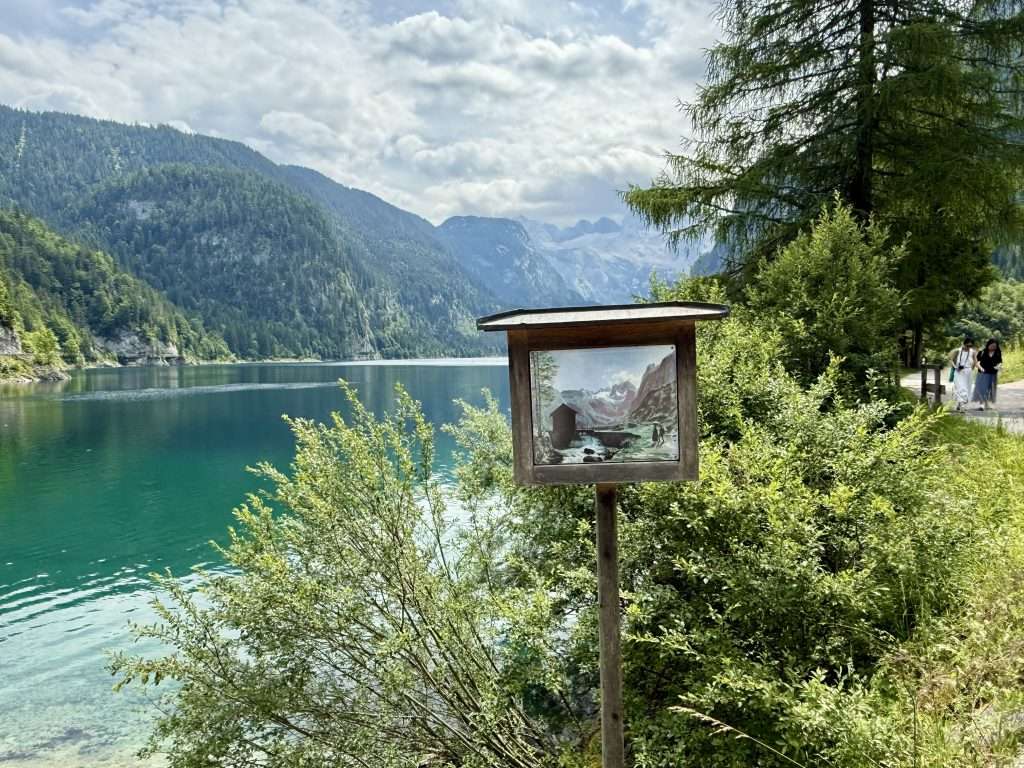
By 10.30 we were dropped off beside the stunning Vorderer Goshausee Lake. Overlooked by snow covered mountains, the lake looked at its best on a lovely Summer’s day mailing it a perfect day for walking. As we hiked all around the lake, we watched climbers braving the mountain face and swimmers enjoying cooling off in the pristine water of the lake. Our tour of the lake ended just in time for lunch at the strategically placed Gasthaus Gosausee.
A leisurely stroll through sweet smelling pine forests alongside a fast running river brought us to our third stop of the trip – the Hotel Gosauerhof in Gosau – just in time for tea.

Day 6 Gosau
Rain set in today – big time – which prevented us doing very much more than exploring the small village of Gosau and walking back along the route to the lake we had followed yesterday to sample the lunch menu at the Gasthaus Echo. Well protected from the rain, we enjoyed good local food in the middle of the forest which took the edge off not being able to venture up further into the high mountains today.

Our hike down from Krippenstein told us that these mountains need to be respected. They can be challenging enough in fine weather, but in poor weather – with heavy cloud cover – it is best not to risk your luck and stay safely down in the valley. In Easter 1954, the Heilbronner Dachstein Tragedy – where 3 teachers and 10 students lost their lives in a blizzard on the Dachstein Mountains – is a reminder to respect the power and dangers of Mother Nature as well as enjoying her gifts.
Day 7 Bad Ischl
The rain continued today again preventing us from doing a high level hike. Fortunately, there is a bus stop right outside the hotel which runs to the nearby town of Bad Ischl hourly, so when rain stops play, you at least have some alternative options available here.

The 9.37 bus whisked us to the centre of Bad Ischl by 10.19. Austrian Emperor Franz Joseph had his ochre coloured Summer residence (the Kaiservilla) in Bad Ischl and spent almost every Summer of his long 68 year reign on the Hapsburg dynasty throne there with his beautiful wife Eli-sabeth (Sisi). He described the town as his “heaven on earth”. Sisi apparently hiked to the top of its forested Jainzen mountain every day at 6am. These days, there is a retro cable car which will wizz you up to the top of the peak in no time so you can enjoy the views much more quickly than Sisi could.

Bad Ischl has thrived on the strength of its royal connections and continues to make the most of them today. Its rather grand buildings with their colourful, decorative facades transport you another era of the town’s halcyon days of grand balls and afternoon tea dances.
Inside the Kaiservilla, you can step into Franz Joseph’s private study and see the letter addressed An Meine Völker” (“To My People”) – the signed declaration of war on Serbia which eventually triggered the outbreak of the First World War.
There must have been many happy family holidays at the Kaiserville but the imperial family suffered more than its fair share of tragedy too. The royal couple lost their daughter Sophie to illness aged just 2 and their only son Rudolf committed suicide. The couple eventually drifted apart and lead separate lives. That’s a shame isn’t it – I much prefer happy endings?
Dirndls and Lederhosen
The centre of Bad Ischl is a great place to shop for traditional Austrian national dress of dirndl skirts and lederhosen. Wearing the national dress is commonplace in the Salzkammergut.


Men wear the practical lederhosen donned by hunters and foresters years ago. A true pair of lederhosen gains character over time, developing a distinctive Speckigkeit of worn areas and stains earned through years of wear that make them unique to their owner. It is the well-worn look that gives a pair of lederhosen authenticity – washing is reserved for dirndl skirts. Only if the leather eventually begins to stiffen might the wearer consider getting his lederhosen professionally cleaned. You can pay anything from €190 or so to well over €2,000 for a good pair of lederhosen. Considering they are designed to last you a lifetime though, that may well be good value for money?
The feminine dirndl skirts for the ladies come in a range of colours that reflect the unique characteristics of different areas of Austria. Blue prints symbolise lakes; pink fabric represents the alpine daisy; greens signify forests and meadows and purple skirts are a reminder of regions where gentian flowers can be found. The shops sell tiny versions of the national dress, so children can join in the fun of wearing it too.

When you have had your fill of sightseeing, be sure to leave enough room for one of the sumptuous gateaux at the Zauner Café in the centre of Bad Ischl. Find a spare table (if you can!) in the cosy café lit by a dazzling collection of chandeliers, order your choice of cake at the counter, hand the ticket to your waitress when you order a drink to accompany it and then sit back and enjoy the sweet taste of traditional Austria at its best. These are just the sort of treats that make holidays special?


Foodie Firsts
Franz Joseph’s idea of culinary bliss was a dinner of soup (consommé or beef), Tafelspitz (boiled beef) and Kaiserschmarrn (shredded pieces of sugared pancake served with fruit compote).
Perhaps his dinner table would have looked something like this?


Sachertorte
The Sachertorte is a delectable combination of chocolate, complemented by a layer of apricot jam and a compulsory mound of schlag (whipped cream). The whipped cream moistens the denseness of the chocolate cake layers – every bite should be dipped into it before it is devoured.

Grűner Veltliner
Beer is the alcoholic drink of choice in Austria, but if you are a wine lover, Grüner Veltliner is a popular grape variety to choose. The quality is highly dependent upon the vineyard and the yield. Winegrowers strive for spicy, peppery wines, or wines with notes of stone fruit. You can probably tell from the price how close the bottle you are thinking of buying got to their goal?

It is a light, easily drinkable wine – like a Riesling – and so makes an ideal aperitif on a warm Summer’s evening, particularly if you are able to overlook Lake Hallstatt as you sip it.
Where We Stayed
St. Agatha/Bad Goisern - The Land Hotel St. Agathwirt
The Land Hotel St. Agathawirt is a comfortable base for a couple of nights, particularly as they have a nice pool and sauna area available for hotel guests. The buffet breakfast is generous and the à la carte menu offers plenty of choice too. The hotel is well run / efficient and friendly. Drinks are reasonably priced too.


Hallstatt - The Hotel Grũner Baum

Let’s start with all the positives: The Hotel Grůner Baum was formerly a salt trader’s house and it is elegant and romantic – full of history. Located right on the edge of Hallsttat’s gorgeous market square and with a lakeside views on the other side, it also wins hands down on the location front. The hotel makes the most of its prime spot on the Hallsttat Lake with a wrap around Lakeside Terrace restaurant. If you choose a lake view room with a spacious balcony, views don’t come much better than this! You will probably save the cost of the room upgrade by buying your aperitifs at the local supermarket and enjoying them in the privacy of your own balcony.


Unfortunately, the hotel has its downsides too. Breakfast is available from 8am – unless you are part of a tour group when you are given thje privilege of making an early start on clearing the buffet table. By the look of what was left when we arrived, lunch was all sorted too?! There was just one table left without a covering of dirty crockery by 8am. It was bathed In hot sunshine – you could see why no one from the earlier crowd had picked this one. We ate breakfast with one hand over our eyes to shield some of the hot sun and were treated to the sound of the hoover running around the crockery laden tables as we ate. It was a breakfast that was memorable – but for all the wrong reasons.

There was also a disconcerting notice on our bed. Bedbugs have obviously been a problem here previously. They seem to have sorted it now – but then why leave such an off putting notice on every bed?!
Downsides aside, we enjoyed our stay at this hotel overall, but they really do need to pay more attention to guests who are not part of a group – as previous reviews have mentioned.
Gosau - Hotel Gosauerhof
Hotel Gosauerhof is a small family run hotel which is well located in the centre of the valley with great views of the Dachstein Mountains and within easy reach of the Gosau Lakes. The owners are friendly and welcoming and the rooms are clean and comfortable. The family take a great pride in serving generous portions of traditional Austrian cuisine. A half board basis offers very good value for money. The hotel is also happy to provide walking maps and any information you need on local transport and timetables. Highly recommended.


Inn Travel
Our trip was booked through a company we have used before for walking holidays – Inn Travel.
All the travel arrangements worked seamlessly and left us free to focus on enjoying the walking and the countryside while our heavy suitcases were efficiently transported between the 3 hotels by Goiserer Taxis.
The hotels chosen were good quality, well located and gave a good feel for the history, culture and traditions of Austria. All the walking instructions were precise and easy to follow – as usual – and the ability to download GPX maps of all the routes we followed which we could access off line was very useful too.

You May Also Like
Austria in Winter is a completely different place. – Fewer people and not much open down in the rallies – all the activity is up on the ski slopes. If you are looking for Winter sunshine with a difference though, Fuschl-am-See makes a good choice for a peaceful holiday.

Other walking holidays we have enjoyed with Inn Travel include trips to Catalonia, Lanzarote and Italy. Find out more on these links:


